Professional Joint Sealing Contractors in Kent
If you’re looking for joint sealing contractors in Kent, the short answer is this: the contractor matters more than the product. A correctly sealed joint will keep water and salt out of a pavement structure for ten years or more. A poorly sealed one will fail inside two winters. The cost of putting it right is usually three to four times the cost of getting it right the first time.
At Shepherd and Sons, we’ve spent more than 40 years sealing joints on airfields, highways, ports and car parks across Kent and the wider South East. We’re based at Westerhill Farm just outside Maidstone. We’re also one of the few Kent-based contractors who hold full membership of the Extruded Sealant Association, the UK industry body that sets the standards for joint sealing on concrete and asphalt pavements. We walk through what good joint sealing in Kent actually looks like, when each type of sealant should be used, and the questions worth asking before you appoint anyone.
What joint sealing actually does, and why it fails
Joint sealing fills the gap between concrete slabs, or between asphalt and concrete, to stop water and contaminants getting underneath the surface. Once water gets in, it freezes, expands, lifts the slab edges, and the pavement starts to break up. On a Kent A-road that carries 20,000 vehicles a day, that deterioration can move from a hairline crack to a full surface failure inside one bad winter.
In our experience, around 70% of the failed joints we’re asked to repair across Kent weren’t failed sealant. They were failed installation. Wrong sealant for the joint movement. Applied in the wrong weather window. Or poured into a joint that wasn’t properly cleaned and dried. The product manufacturers all publish clear application data. The issue is almost always whether the contractor followed it.
Hot applied vs cold applied: which one your project needs
This is the question we get asked most often, so it’s worth answering directly.
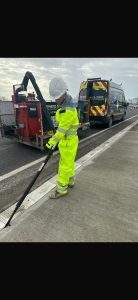
Hot applied joint sealants are heated to around 180 to 200°C in a melter and poured into the joint. They cure in minutes, bond aggressively, and handle heavy traffic loads. They’re the standard choice on motorways, A-roads, and airfield runways. The N1 grade is the workhorse for highway joints. N2 is fuel-resistant and used in fuelling areas and aircraft stands. The 9525 grade is the high-performance specification for airfield pavement joints.
Cold applied sealants are two-part chemical-cure systems poured at ambient temperature. They take longer to cure but they’re indispensable when you can’t get a hot melter on site. Typical use cases include warehouses, multi-storey car parks, port buildings, and any area with overhead restrictions or fire risk.
In our experience, hot applied N1 works better than cold applied two-part sealant on heavily trafficked Kent highway joints. The bond cures inside an hour and the road can reopen the same shift. A cold applied system needs 24 hours minimum before traffic. On a B2110 overnight closure between Tonbridge and Hadlow, that difference is the gap between one closure and three.
That said, for a chilled distribution warehouse in Aylesford, cold applied is the only sensible option. You can’t run a propane melter inside a food-grade environment. The right answer is project-specific, not a default.
What proper joint sealing in Kent actually involves
A correctly executed joint seal goes through six steps. Skipping any of them is where most failures start.
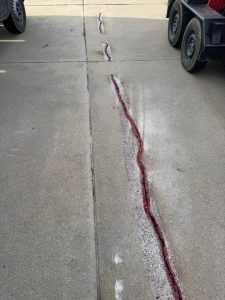
The joint is cut or routed to the correct width-to-depth ratio, typically 2:1 for hot applied and 1:1 for cold applied. It’s then mechanically cleaned, usually with a wire brush attachment and high-pressure air lance, until the joint walls are dust-free. A backer rod is inserted to control depth and stop three-sided adhesion. This is the single most common cause of premature sealant failure. A primer is applied where the manufacturer’s data sheet specifies one. We’ve found this is the step contractors skip most often when they’re rushed. The sealant is then applied at the correct temperature and depth, tooled flush with the surface, and protected until cured.
We’ve completed joint sealing on more than 180 projects across Kent, Surrey and Essex over the past five years alone. The projects that have come back to us as warranty issues, a single-figure number, have all traced back to one of those six steps being compromised. Usually because of weather pressure or a tight programme.
When joint sealing should happen, and the Kent weather problem
Most sealants have a minimum substrate temperature for application, typically 5°C and rising. In Kent, that gives you a realistic working window of roughly March through to early November for hot applied work. Cold applied systems have a tighter window. They need substrate temperatures above 10°C to cure properly.
From working with clients across Kent’s highway and port sectors, we’ve found that sealing programmes booked between late March and June give the most reliable long-term results. Mid-summer bitumen runs hotter, which softens the asphalt joint walls and can compromise sealant bond. Late autumn work is technically possible but the cure window narrows. A single early frost on uncured sealant means you’re back the following spring redoing the work.
If a contractor is happy to seal joints in February with substrate temperatures hovering around 3°C, that’s a warning sign. We turn that work down, and we’d recommend you do too.
What to ask a joint sealing contractor before appointing them
Three questions tell you most of what you need to know.
First: are they ESA members? The Extruded Sealant Association sets the UK Code of Practice for joint sealing. Members commit to following it. Non-members are under no obligation to. There aren’t many ESA-member contractors based in Kent, which is part of why we get called in on specifications that other contractors can’t credibly meet.
Second: which specific products do they recommend, and why? A contractor who can only quote on one sealant is selling you what they have in the van, not what your joint needs. A proper contractor will discuss N1 versus N2 versus 9525 for hot applied work. Or two-part versus one-part for cold applied. The choice depends on traffic load, fuel exposure and substrate type.
Third: what’s their preparation methodology? If the answer is short, walk away. Joint preparation is 80% of the job.
Sectors we cover across Kent and the South East
We work across four main sectors. The joint sealing approach differs significantly between them.
For highway authorities and Tier 1 contractors, we run hot applied N1 and N2 programmes on A-roads, B-roads and motorway slip works, with full Chapter 8 traffic management compliance. Aviation clients, including airside work at major UK airports, we apply 9525 hot applied and high performance specifications to CAA standards. For port operators in Sheerness, Ramsgate and beyond, we use Sikaflex and Sea-Kar one-part systems suited to chemical exposure and heavy plant loading. For councils and public sector clients, we cover everything from school car parks to leisure centre service yards.
If you want to see recent project work, we post site photos and finished jobs regularly on our Instagram and LinkedIn.
Getting a quote that actually means something
A meaningful joint sealing quote should specify the sealant grade, linear metres, joint preparation method, primer (if required), and reinstatement timing. A quote that just lists “joint sealing, £X per metre” tells you nothing about what you’re actually getting.
If you want a properly specified quote for joint sealing in Kent, whether that’s a single car park, a stretch of highway joints, or a full airfield programme, get in touch. We’ll come and look at the work, discuss the right specification, and give you a quote that holds up to scrutiny.