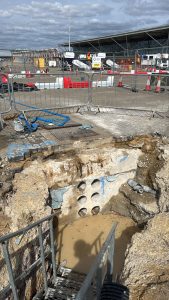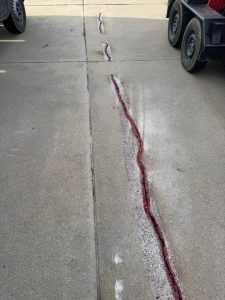
So, What is Diamond Drilling?
Diamond drilling is a precision cutting technique that uses hollow, diamond-tipped core barrels to cut accurate circular holes through concrete, masonry, reinforced concrete, and stone. The diamonds embedded in the cutting edge of the barrel grind through the material as the drill rotates, producing a clean, straight-sided hole and a solid concrete core that can be removed in one piece. The drilling is done wet, with continuous water feed cooling the diamonds, suppressing dust at source, and flushing out the cuttings. It’s the standard specification for forming penetrations through structural concrete for services, mechanical and electrical installations, drainage, fuel mains, fibre-optic networks, and structural alterations.
At Shepherd and Sons, we deliver diamond drilling across UK airfields, highways, ports and infrastructure projects, including specialist applications around live aviation fuel mains and embedded services. We’re based in Kent, we’ve been operating in this sector for more than 40 years, and we hold SafeContractor and CHAS accreditation alongside our Extruded Sealant Association membership for the related joint sealing work. This article covers what diamond drilling is, how it works, when it’s the right method, and what proper application involves.
How diamond drilling works
The principle is abrasion, not impact. Industrial diamonds (synthetic or natural) are bonded into the cutting edge of a hollow steel core barrel. As the barrel rotates against the concrete, the diamonds grind through the cement matrix and the aggregate, including any reinforcement bar in the path. The barrel is hollow so it cuts a ring through the concrete, leaving a solid core in the centre that can be removed once the cut is complete.
Three things separate diamond drilling from percussion methods like SDS hammer drilling:
Low vibration. The cutting is rotational, not percussive. There’s no hammer action transmitting shock through the surrounding concrete. This matters on sensitive structures, occupied buildings, and live operational pavements where adjacent slabs or fittings could be damaged by vibration.
Precision. The hole is round, straight, and accurate to within millimetres of the marked position. Edge quality is clean and consistent, which makes the hole immediately ready for service installation, sleeve fitting, or pipe penetration without further dressing.
Capability through reinforcement. Diamond core barrels cut through rebar without stalling, breaking the bit, or deflecting off the steel. Percussion drills struggle with heavy reinforcement.
Diamond drills run on three power sources: electric (the standard for internal and enclosed work), hydraulic (for heavy industrial drilling), and petrol or diesel (for remote external sites without mains power).
When diamond drilling is the right method
Five scenarios drive specification towards diamond drilling rather than alternatives.
Service penetrations. The largest application. Holes through floor slabs, walls, foundations and bridge decks for drainage, water mains, fuel mains, gas lines, electrical conduit, fibre-optic networks, ventilation ducts and structural fixings. Diamond drilling produces a sized, sleeve-ready hole in one operation.
M&E installations. Mechanical and electrical penetrations for HVAC, plumbing, fire protection and building services. The clean edge condition makes the hole suitable for fire-stopping and waterproof sealing once the service is installed.
Structural alterations. Forming openings for additional structural elements, anchor bolts, holding-down bolts, post-tensioning ducts and reinforcement starter bars. Common on bridge strengthening, retaining wall extension and concrete frame modification work.
Inspection and investigation. Coring concrete pavements and structures to extract samples for compressive strength testing, thickness verification, reinforcement location confirmation, or contamination analysis. The recovered core gives the structural engineer a real specimen rather than a guess.
Sensitive cutting work. Where conventional concrete cutting risks damaging adjacent structures, services or sensitive equipment, diamond drilling is the controlled alternative. The lateral isolation of each core hole protects what’s around it. For wider-scale cuts where the work goes through the full slab thickness, the technique sits alongside full depth concrete cutting and the two are often specified together on the same project.
Stitch drilling. A specialist application where overlapping cores are drilled side-by-side to form a cut line, with the narrow webs between them broken out and the section removed by vacuum lifting plant. This is the standard method for cutting concrete around live aviation fuel mains, where conventional sawing risks puncturing services, and for any application where mechanical breaking isn’t permitted. We’ve found that stitch drilling works better than continuous sawing around live high-pressure fuel mains because the depth control and the lateral isolation of each core protects the embedded service in a way no continuous blade can match. On a live airside apron repair where a fuel main runs 600mm below the slab surface, that method is the difference between a controlled cut and a serious incident.
Drilling capacity, diameter and depth
Diamond drilling diameters cover an extremely wide range. Standard core diameters run from 10mm (for small fixings and anchor bolts) up to 1000mm or more (for major services and structural openings). The most common diameters in UK construction and civil work are:
- 20mm to 50mm. Small fixings, anchor bolts, electrical conduit.
- 50mm to 150mm. Standard services, drainage, soil pipes, small ducting.
- 150mm to 300mm. Major services, drainage stacks, ventilation ducts, structural reinforcement.
- 300mm to 600mm. Large services, structural openings, manhole formation.
- 600mm to 1000mm+. Specialist openings, drainage chambers, large ducting.
Drilling depth is effectively unlimited because barrels can be extended sequentially. The drill core is removed between extensions, and the next barrel section is fitted to continue the bore. Deep cores through multi-storey foundations and bridge structures of several metres are routine work for specialist contractors. For context on the cutting depths achievable by saw-based methods rather than core drilling, how deep can you cut concrete? covers the relationship between blade diameter and slab depth.
Diamond drilling versus core drilling
The terms diamond drilling and core drilling are often used interchangeably in the UK construction sector. Strictly speaking, core drilling refers to the technique of cutting a hollow circular bore that produces a solid concrete core, while diamond drilling describes the cutting medium (industrial diamonds bonded to the barrel edge).
In practical terms, almost all core drilling in concrete and reinforced concrete is done using diamond core barrels, so “diamond drilling” and “core drilling” refer to the same operation in most UK construction contexts. Specialist applications like geotechnical investigation may use other coring techniques, but for above-ground concrete and structural work, diamond drilling is the standard method.
What proper diamond drilling involves
The process is more than just lining up the drill and pressing the trigger.
Site survey and services check. Before any hole is drilled, the substrate is surveyed for embedded services. Live cables, fuel mains, post-tensioning tendons, water and gas pipes, and reinforcement layout all influence drilling position and method. On airside work, this means liaising with the operator’s services drawings and confirming live fuel main locations physically before drilling.
Setting out. Hole positions are surveyed and marked precisely. On structural and airside work, tolerance is measured in millimetres because the hole has to align with mating fittings, embedded sleeves or service drawings.
Anchor or vacuum mounting. The drill rig is anchored to the substrate using bolt anchors, vacuum pad, or a wedge-and-strut frame depending on the work environment. A securely mounted rig is essential for accuracy because any movement during drilling will deflect the bore.
Water management. The cut is made wet, with continuous water feed cooling the diamonds and suppressing dust. Slurry is collected and removed to prevent contamination and slip hazard. On internal work, water control and containment matter because spillage can damage finishes below.
Controlled cutting. The operator advances the drill at a controlled rate matched to the concrete strength, reinforcement and diamond bond. Pushing too hard glazes the diamonds and slows the cut. Cutting too slowly wears the diamonds prematurely. Practised operators read the cutting feel and adjust accordingly.
Core retention and removal. As the cut completes, the core is held to prevent it dropping out and damaging anything below. On overhead and horizontal cores, the core is supported with chain slings or lifted out with vacuum lifting plant.
Final clean-up. The hole edges are cleaned, water and slurry are removed, and the core is taken away for disposal or sampling.
We’ve found that contractors who skip the services survey on diamond drilling work are the contractors who eventually hit a live service. The drill bit doesn’t care what it’s cutting through. A pre-drill services check is the difference between a routine job and an incident.
Standards and compliance
Diamond drilling in the UK is governed by:
- HSE guidance for diamond drilling and sawing operations
- The Drilling & Sawing Association (DSA) Code of Practice
- BS EN 12504 series where coring is done for sampling and testing
- CDM 2015 Regulations for construction projects
- CAA / ICAO / DIO standards for airfield applications
Operator competence is governed by NVQ Level 2 in cutting and drilling, with operatives holding CSCS cards and supervisors holding SSSTS. For airside work, additional airside familiarisation and CAA-aligned method training is needed.
Sectors where diamond drilling is specified
Aviation clients specify diamond drilling for airfield service penetrations, AGL fitting installations, stitch drilling around fuel mains, and apron service trenching tied into pavement work. This is some of the most demanding diamond drilling in UK construction because of the live service environment and the airside compliance regime.
Highway authorities and Tier 1 contractors use diamond drilling for bridge deck strengthening, gantry foundations, retaining wall fixings, and drainage installations on motorway and trunk road work. Heavy reinforcement and structural sensitivity make diamond drilling the standard method.
Port operators at Sheerness, Ramsgate and Dover use diamond drilling for quayside service installations, fender fixings, bunker handling area penetrations, and dockside structural work.
Public sector clients including councils, schools, hospitals and government facilities specify diamond drilling for building services, structural alterations, and infrastructure penetrations.
We’ve delivered diamond drilling work on more than 300 UK projects in the past six years across these four sectors, with the largest volume in aviation work.
Specifying diamond drilling properly
A meaningful diamond drilling specification will identify the hole diameter and depth, the substrate type and reinforcement, the access constraints (internal versus external, live versus closed site), the services survey requirement, the mounting method, the slurry management requirement, and the interface with any following work (fire-stopping, sealing, service installation, sleeve fitting).
If you’re specifying or commissioning diamond drilling work, particularly around live services, on airfields, or where the drilling interfaces with joint sealing or pavement reinstatement, get in touch. We’ll assess the substrate, the services, the access constraints and the follow-on works, and quote the full scope properly. You can see recent project work on our LinkedIn and Instagram.