So, What is Thioflex 555?
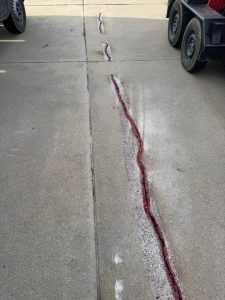
Thioflex 555 is a two-component, polysulfide cold-applied joint sealant manufactured by Fosroc, used to seal expansion and contraction joints in concrete pavements. It’s the go-to specification for areas where fuel spillage is a risk, including aircraft fuelling areas, oil terminals, garage forecourts, runway hard standings, and aircraft parking and cargo aprons. Its main purpose is to keep water, fuel, hydraulic fluid, and de-icing chemicals out of pavement joints while accommodating up to 35% movement.
At Shepherd and Sons, we apply Thioflex 555 across our aviation, highway and public sector work, and we’ve installed thousands of linear metres of it over the past five years. This article covers what it is in technical terms, when to specify it, how it performs in real-world conditions, and the application points that determine whether it lasts a decade or fails inside two years.
What Thioflex 555 actually is
Thioflex 555 is classified under BS EN 14188-2 as a two-component (M), self-levelling (sl) cold applied joint sealant, certified to Classes B, C and D. Translated: it’s a chemical-cure sealant supplied in two parts (a base and a hardener) that you mix on site, and it’s tested for resistance to fuel, de-icing salts, and aggressive liquid chemicals.
The polysulfide chemistry is what sets it apart. Polysulfides give the sealant high stress relaxation, meaning the material absorbs joint movement without transferring stress to the bond face. That’s why it holds up under temperature swings from -40°C to +70°C without hardening in the cold or going soft in the heat. Its movement accommodation factor is 35% under BS 8449, which is the maximum joint expansion-and-contraction range it can handle as a percentage of joint width.
It’s available in two grades: Machine Grade for fast-return-to-service applications using a metered mixing machine, and Hand Grade for smaller jobs and detailed work using a slow-speed drill and paddle.
When to specify Thioflex 555
The product is built for one specific category of work: concrete pavements where chemical exposure is a real risk. That includes:
- Aircraft fuelling areas and aprons
- Oil terminals and fuel storage facilities
- Garage and HGV forecourts
- Aircraft parking and cargo zones
- Concrete runway hard standings
For an airfield apron handling Jet A-1 fuel, kerosene, Skydrol hydraulic fluid, and glycol-based de-icers, there are very few cold-applied sealants that hold up. Thioflex 555 is one of them. The Test Fuel I and Test Fuel II results in the technical datasheet show no adhesion or cohesion failure after immersion, which is the benchmark that matters when an aircraft sits on a stand for hours dripping fuel onto the joint.
It’s not the right product for everything, though. For industrial floor joints inside warehouses, Fosroc themselves recommend higher-modulus sealants like Nitoseal MS300 or PU800. For motorway carriageway joints with no fuel exposure, hot-applied N1 is faster, more rigid and cheaper.
In our experience, Thioflex 555 Machine Grade works better than hot-applied N2 on civilian aircraft fuelling stands because the cold-applied chemistry doesn’t risk softening adjacent fresh concrete, and the 30-minute return-to-service time at 35°C ambient is faster than waiting for a hot melter to reach pour temperature on a remote apron. On a Stansted-type project, that difference is real money.
Performance specification: the numbers that matter
Three numbers tell you most of what a specifier needs to know.
Movement accommodation: 35%. A 20mm-wide joint can flex roughly 7mm in either direction without the sealant failing. That covers everything except severe expansion joints in heavy diurnal-temperature environments.
Return to service times. Machine Grade is genuinely fast: 10 minutes at 35°C, 30 minutes at 20°C, 90 minutes at 5°C. Hand Grade is slower: 60 minutes at 35°C up to 36 hours at 5°C. This is the single biggest factor in choosing between grades.
Chemical resistance. Tested against and resistant to aviation fuels, Skydrol, kerosene, glycols, petrol, diesel, hydraulic oil, potassium formate and acetate de-icers, and mono-ethylene glycol. No failure across the full BS EN 14188-2 chemical exposure regime.
Other specs worth knowing: tensile strength 0.34 MPa, elongation at break 350%, Shore A hardness of 10 (soft and resilient), elastic recovery 91.7%, flash point above 65°C, and a service temperature range of -40 to +70°C. Resistance to flame is a pass under BS 5212-1.
Joint dimensions: the spec that gets ignored
Fosroc specifies a width-to-depth ratio of 1:1 to 1.5:1 with a minimum 10mm depth of sealant. A typical contraction joint is 15mm wide x 13mm deep. A typical expansion joint is 25mm wide x 20mm deep. The finished sealant level should be recessed 5 to 8mm below the pavement surface.
We’ve found this is the spec that gets ignored most often by contractors quoting on Thioflex 555 work. They price for a thin bead of sealant on top of a backer rod, which looks fine on day one but fails inside a year because there isn’t enough material to absorb joint movement. The depth is not optional. It’s load-bearing.
Application points that make or break the job
Thioflex 555 is forgiving on chemistry but unforgiving on preparation. Six things determine whether the sealant lasts.
Joint preparation. Slots must be dry, sound, clean, and free from dust and frost. Grit blasting is the manufacturer’s recommended method for both new and existing concrete, followed by an oil-free compressed air blow-out. We’ve found that contractors who skip the grit blast and go straight to wire-brushing are the same contractors who get warranty calls 18 months later.
Backer rod. A heat-resistant Expandafoam cord must be caulked tightly into the base of the slot to control sealant depth and prevent three-sided adhesion. Three-sided adhesion is the most common cause of premature cohesive failure in cold-applied sealants.
Priming with Fosroc Primer 7E. This is non-negotiable on concrete substrates. Empty the hardener into the base, mix for two minutes, and apply with a clean dry brush or by spraying. Avoid pooling. Sealant must be applied between 20 minutes and 4 hours after priming. Beyond 24 hours, the cured primer must be removed and the joint re-primed. We’ve turned down work where the timeline didn’t allow proper repriming windows because the failure risk is too high to take.
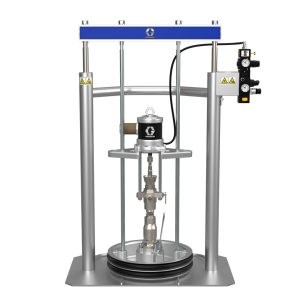
Mixing. Machine Grade goes through a metered 1:1 volume mixing machine. Hand Grade is mixed for three minutes with a slow-speed drill (300-500 rpm) using a Fosroc paddle, scraped down, then mixed for a further two minutes. Air must not be mixed in. Material at the bottom of the tin must be incorporated.
Temperature window. Application ambient temperature is 5°C to 50°C. Material temperature should be 15°C to 40°C. In cold conditions, components can be warmed to around 30°C immediately before use to improve workability.
Pot life. Machine Grade material must not sit in the hose for more than five minutes at 20°C, or three minutes at 40°C, or it will start to gel before extrusion.
Storage, shelf life and pack sizes
Thioflex 555 has a 12-month shelf life in unopened containers stored at 25°C or below. Higher storage temperatures shorten the shelf life. Machine Grade is supplied in 30-litre and 400-litre packs, Hand Grade in 5-litre packs (with 30 and 400-litre packs available for machine application where a slower set is needed).
Yield is well-defined: a 10mm x 10mm joint takes 0.10 litres per metre, giving you 300 metres from a 30-litre Machine Grade pack. A 25mm x 20mm joint takes 0.50 litres per metre, giving you 60 metres per 30-litre pack. We always over-order by 10 to 15% to account for joint dimension variation and waste in the lance.
Standards and compliance
Thioflex 555 carries CE and UKCA marking and complies with:
- BS EN 14188-2:2004 (Type M, Class B/C/D)
- BS 5212 Part 1:1990
- BS 8449 (movement accommodation)
- US Federal Specification SS-S-200E (jet blast resistant)
- ASTM C920 Type M, Grade P, Class 25
For UK airfield and highway specifications, the BS EN 14188-2 and BS 5212 compliance is what matters, and these are the standards we work to as members of the Extruded Sealant Association.
Getting it specified and applied properly
Thioflex 555 is a high-performing product. It is not a high-tolerance product. The chemistry is forgiving; the application isn’t. Specifying it correctly means matching the right grade to the substrate temperature and return-to-service requirement, sizing the joint to the 1:1 to 1.5:1 ratio, and using a contractor who follows the priming windows and pot-life limits.
If you’re specifying or commissioning joint sealing work that needs Thioflex 555, get in touch. We’ll talk through grade selection, joint preparation, programme constraints, and quote the work properly. You can also follow our recent project work on LinkedIn or Instagram.