So, What is Sikaflex?
Sikaflex is a family of elastic sealants and adhesives manufactured by Sika, the Swiss construction chemicals company. It is not a single product. It’s a brand name covering more than 40 individual products used across building, civil engineering, port, marine, automotive and industrial applications. The most common UK uses are sealing expansion and movement joints in concrete pavements, port hard standings, building facades and floor joints, and bonding structural elements where flexibility and weather resistance matter. The defining characteristic of the range is one-part application: most Sikaflex products are pre-mixed, supplied in cartridges or sausages, and cure through reaction with atmospheric moisture once applied.
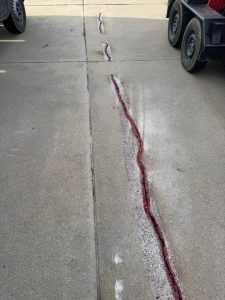
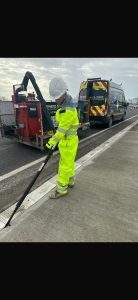
At Shepherd and Sons, we apply Sikaflex products as part of our one-part cold applied joint sealing work, particularly on port and dockside hard standings and civil infrastructure joints. We’re members of the Extruded Sealant Association, and we’ve used Sikaflex products in UK joint sealing work for over a decade. This article explains what Sikaflex actually is, the common misconceptions about the range, which product fits which job, and what proper installation looks like.
The most common Sikaflex misconception
When most people search “Sikaflex” they’re thinking of one product. The reality is that “Sikaflex” is closer to “Coca-Cola” than “Diet Coke”. It’s the brand that contains the products, not a product in its own right.
The confusion is understandable because Sika markets the range cohesively, and the products share core chemistry (one-part polyurethane or hybrid polymer in most cases). But specifying “Sikaflex” without naming the product variant is like specifying “paint” without naming the type. The end result depends entirely on which one you pick.
For a UK construction or civil engineering project, the products that actually matter are a relatively small subset of the full range. Most projects will only need one or two specific products from the Sikaflex family.
The Sikaflex products that matter for UK joint sealing and civil work
Four product categories cover the bulk of the relevant UK demand.
Sikaflex Pro and Sikaflex 11 FC. General-purpose construction sealants for movement joints in masonry, concrete, timber and metal substrates. Used in general building joints, perimeter sealing around windows and doors, and interior expansion joints.
Sikaflex PRO-3. A heavy-duty floor joint sealant for warehouse floors, car parks, industrial premises and commercial buildings. Designed to handle forklift, pallet truck and HGV trafficking without extruding or tearing. The product most often specified where the joint is regularly crossed by heavy plant.
Sikaflex AT Connection and AT Facade. Hybrid polymer sealants formulated for exterior building envelope work, including curtain wall perimeters, window and door perimeters, and cladding joints. UV-stable and weather-resistant for long-term external exposure.
Sikaflex Tank. A specialist sealant for industrial storage tanks and secondary containment, with elevated chemical resistance for fuel and chemical handling environments.
There are dozens of other Sikaflex products, including automotive direct glazing products (Sikaflex 250 series), marine deck sealants (Sikaflex 290 DC Pro) and DIY kitchen and bathroom products. These fall outside typical UK construction joint sealing scope.
What unites the Sikaflex range
All Sikaflex products share four characteristics that distinguish them from two-part sealants like Thioflex 555 or hot applied sealants like N1.
One-part application. No on-site mixing required. The product is supplied in 300ml or 600ml cartridges, or 600ml foil-pack sausages, ready to apply with a manual or pneumatic gun. This removes mix ratio variables, pot life pressure, and metered equipment requirements.
Moisture cure. The sealant remains stable in the sealed packaging. Once extruded and exposed to atmospheric humidity, the cure reaction begins. Full cure typically takes 24 to 72 hours depending on temperature, humidity and joint depth.
Elastic when cured. Most Sikaflex products deliver 20% to 35% movement accommodation depending on the specific product and joint design. This handles thermal cycling, structural movement and substrate flex without losing the seal.
Broad substrate adhesion. Bonds to concrete, masonry, metal, timber, glass and most plastics when matched with the correct Sika primer. The primer system varies by substrate and is not interchangeable between Sikaflex products.
Where Sikaflex is the right specification
In joint sealing work, Sikaflex one-part polyurethane is the right call in three specific scenarios.
Port and dockside detail work. From working with clients across UK ports, we’ve found Sikaflex polyurethane practical for patch joint work, quayside detail areas, and locations where two-part metered mixing equipment isn’t viable. Salt water, bunker fuel exposure and marine atmosphere don’t trouble the polyurethane chemistry, and the cartridge application gets the work done within tight tidal access windows.
Floor expansion joints in industrial buildings. Sikaflex PRO-3 is harder than polysulfide once cured, which means it resists tyre indentation from forklift and pallet truck traffic. The trade-off is slightly lower movement accommodation, which is rarely a constraint in industrial floor applications because thermal movement is limited compared to outdoor pavement.
Building and civil infrastructure joints adjacent to pavement work. Sikaflex products handle the structural movement joints in adjacent buildings, retaining walls and bridge interfaces while pavement-grade sealants do the pavement work. The two product families are designed for different jobs and should be specified accordingly.
In our experience, one-part Sikaflex polyurethane works better than two-part polysulfide on port dockside detail work specifically because the cartridge application is faster, the cure happens passively in the marine atmosphere, and there’s no metered mixing equipment to transport, calibrate or clean down on a remote quayside. On a Sheerness or Ramsgate dockside patch programme working to a tidal window, that operational simplicity is what gets the work done within the available access slot.
For pavement work with fuel exposure or high movement requirements, the answer is different. Two-part polysulfide products like Thioflex 555 deliver 35% movement accommodation, BS EN 14188-2 Class B/C/D certification, and full fuel and chemical resistance. Sikaflex products don’t generally carry equivalent pavement-grade certifications.
How Sikaflex compares to other UK sealant options
For specifiers weighing options, the practical comparison points are:
Versus hot applied N1 or N2. Sikaflex is cold applied, doesn’t need a heated melter, and can be applied in fire-restricted environments. Hot applied is faster on large linear runs and cheaper per metre on highway and airfield carriageway work.
Versus two-part cold applied polysulfide (Thioflex 555). Sikaflex is operationally simpler (no mixing) but has lower fuel resistance certification and slightly lower movement accommodation on most products. Two-part polysulfide is the specialist choice for aviation fuelling aprons and oil terminals.
Versus silicone sealants. Sikaflex polyurethane is paintable, has higher abrasion resistance, and handles structural movement better than most silicones. Silicone has better high-temperature performance and UV stability for specific glazing applications.
Versus general construction sealants from other manufacturers. Sikaflex sits in a similar product category to products from Bostik, Soudal, Mapei and others. The technical specifications are broadly comparable. The choice often comes down to local supply chain, accredited applicator availability, and specification preference.
What proper Sikaflex installation involves
Sikaflex is the most forgiving product category we work with on application discipline, but it isn’t preparation-free. We’ve found that contractors who treat one-part as “shake the gun, squeeze the trigger” are the ones who get failures.
Substrate preparation. Joint surfaces must be sound, dry, clean and free from oil, grease and laitance. Concrete is wire-brushed or lightly grit-blasted. Metal substrates are degreased. Loose material is removed.
Backer rod. A closed-cell polyethylene backer rod controls sealant depth and prevents three-sided adhesion. Without it, the sealant fatigues at the joint walls and tears within two years.
Primer. Sika supplies a range of matched primers including Sika Primer-3 N for porous substrates and Sika Aktivator-205 for non-porous surfaces. The primer is selected by substrate type and Sikaflex product, and the matching guidance is product-specific. Wrong primer or no primer is the most common cause of adhesion failure on Sikaflex work.
Application. The cartridge or sausage is loaded into a manual or pneumatic gun. The sealant is extruded into the joint and worked to ensure full contact with the primed faces. Joint design typically follows a 2:1 width-to-depth ratio for one-part polyurethane.
Tooling. The sealant is tooled to a smooth concave finish before skin formation, typically using a tool wetted with dilute detergent solution.
Cure protection. Skin formation happens within 30 to 120 minutes depending on temperature and humidity. Full cure takes 24 hours to several days. The joint should be protected from heavy disturbance during cure.
Standards and compliance
Sikaflex products are tested and certified under:
- ISO 11600 (classification and requirements for building construction sealants)
- EN 15651 series (sealants for facade, glazing, sanitary and pedestrian walkway use)
- BS 6093 (design of joints and jointing in building construction)
- ASTM C920 (American specification for elastomeric joint sealants)
Product-specific datasheets identify the exact certifications held. For specifiers writing into NBS or equivalent, requesting the relevant Sika TDS and confirming the product matches the joint design is the proper approach.
Specifying Sikaflex properly
A meaningful Sikaflex specification identifies the specific product (Sikaflex Pro, PRO-3, AT Connection, Tank or other), the joint dimensions, the substrate type, the matched primer, and the cure-window protection. A specification that just says “Sikaflex sealant” leaves too much undefined.
If you’re specifying or commissioning joint sealing work that involves Sikaflex or comparable one-part polyurethane systems, particularly on port, civil infrastructure or pavement-adjacent applications, get in touch. We’ll discuss the substrate, exposure conditions, programme and movement requirement, and recommend the right product. For Sikafloor industrial flooring, Sarnafil roofing or Sika concrete repair work, you’ll need a specialist contractor in those product families.
You can see recent project work on our LinkedIn and Instagram.