Professional Sika Installers
Sika installers are contractors who specify and apply products from the Sika range, a Swiss-headquartered construction chemicals manufacturer with one of the largest product catalogues in the UK construction and civil engineering market. Sika’s range covers structural waterproofing, concrete repair, structural strengthening, industrial flooring (Sikafloor), roofing membranes (Sarnafil), elastic sealants and adhesives (Sikaflex), and dozens of specialist product families. As a result, there is no single category of “Sika installer”. There are multiple specialist contractor markets, each focused on a different part of the Sika catalogue, and each requiring different training, accreditation and equipment.
At Shepherd and Sons, we specify and apply Sika products as part of our one-part cold applied joint sealing work, specifically Sikaflex polyurethane sealants used in port and dockside hard standings, bunker fuel areas, and civil infrastructure joints. We’re members of the Extruded Sealant Association and we’ve installed Sikaflex products across UK port, aviation and infrastructure projects for over a decade. This article covers what a Sika installer actually is, the main categories of Sika contractor in the UK, where each fits, and how to identify the right one for your project.
Why there’s no single category of Sika installer
The Sika range is too broad for a single contractor type to credibly cover all of it. A contractor competent in Sikafloor industrial resin systems is unlikely to be competent in Sarnafil single-ply roofing. A contractor accredited for Sika structural strengthening with CarboDur carbon fibre plates won’t typically also be a Sikaflex joint sealing specialist.
The UK market has divided itself into five distinct Sika installer categories, each with its own accreditation regime, training requirements and project profile.
The five main categories of Sika installer
1. Sika joint sealing and waterproof sealing contractors. Specialist contractors who apply Sikaflex one-part polyurethane sealants and Sika hybrid polymer sealants in expansion joints, movement joints, port and dockside hard standings, building facades and civil infrastructure interfaces. This is where Shepherd and Sons operate in the Sika product range, alongside our wider joint sealing specialism.
2. Sikafloor industrial flooring installers. Resin flooring specialists trained and accredited by Sika to apply Sikafloor epoxy, polyurethane and methyl methacrylate floor systems. Used in food production, pharmaceutical, automotive manufacturing, warehousing, and clean room environments. The accreditation regime is rigorous because the products are technically demanding and quality control is critical.
3. Sarnafil and Sika roofing contractors. Single-ply membrane roofing specialists, typically accredited through Sika’s Approved Contractor scheme for Sarnafil PVC and FPO roofing systems. The work is roofing-trade specific and unrelated to most other Sika installer categories.
4. Sika concrete repair and structural strengthening contractors. Civil engineering specialists who apply Sika MonoTop concrete repair mortars, Sika CarboDur structural strengthening systems, Sika anchor grouts and corrosion protection products. Often hold ICRI or equivalent concrete repair accreditation in addition to Sika training.
5. Sika waterproofing contractors. Below-ground and structural waterproofing specialists applying Sika membranes, liquid-applied waterproofing systems and waterproof concrete additives. Frequently CSSW (Certified Surveyor in Structural Waterproofing) qualified through the Property Care Association.
Most contractors specialise in one or two of these categories. The very few that span more typically do so through separate divisions or sister companies.
Where Sika installers actually work in practice
The application sector dictates the type of Sika installer required.
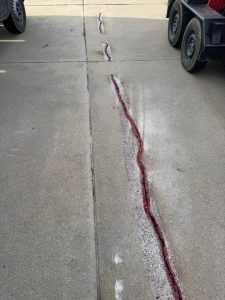
Port and dockside hard standings. Specialist joint sealing contractors apply Sikaflex one-part polyurethane in expansion joints, bunker fuel handling areas and heavy plant operating zones. The marine atmosphere, salt exposure and bunker oil spillage rule out lower-grade products. From working with clients across UK ports, we’ve found Sikaflex one-part systems practical here where two-part metered mixing equipment isn’t viable on remote quayside locations.
Industrial manufacturing floors. Sikafloor accredited contractors apply resin floor systems to food production, pharmaceutical, automotive and warehouse environments. Specialist work with strict environmental and quality controls.
Commercial and industrial roofing. Sarnafil-approved contractors install single-ply PVC and FPO roofing systems on commercial buildings, schools, hospitals and industrial facilities. Approval is project-by-project for Sika’s 20-year guarantee scheme.
Concrete bridge repair and reinforcement. Sika concrete repair contractors deliver structural strengthening and corrosion protection on highways, rail and civil structures.
Below-ground and basement waterproofing. CSSW-qualified Sika waterproofing contractors deliver Grade 2 and Grade 3 protection to BS 8102 standards on new build and remedial projects.
Building facade and curtain wall joints. Sika sealant specialists apply Sikaflex AT Connection and AT Facade in building envelope joints, often working alongside cladding contractors.
In our experience working on infrastructure projects, specialist joint sealing contractors with Sikaflex experience work better than general construction contractors on port and dockside detail work because the cartridge application is faster, the cure happens passively in the marine atmosphere, and there’s no metered mixing equipment to mobilise. On a Sheerness or Ramsgate dockside patch programme working to a tidal window, that operational efficiency is what gets the work done within the available access slot.
How to identify the right type of Sika installer
Five points separate competent specialist Sika installers from general contractors quoting on the work.
Specific product family experience. Ask what Sika products the contractor uses regularly. A contractor who lists “Sika products generally” without naming specific product families is unlikely to be a specialist in any of them. A genuine specialist will name the product range (Sikaflex Pro, Sikafloor 263 SL, Sarnafil S327, Sika MonoTop 412 N, etc.) and explain when each is appropriate.
Sika accreditation or approval. Several Sika product families have formal contractor accreditation schemes, including Sarnafil Approved Contractors, Sikafloor Approved Applicators, and Sika MonoTop concrete repair specialists. Membership of these schemes is verifiable.
Project references in the relevant sector. Floor resin experience isn’t joint sealing experience. Roofing experience isn’t waterproofing experience. Ask for references in the specific sector and product family that matches your project.
Equipment ownership. Specialist applicator equipment varies by product family. Sikafloor work needs proper trowels, rollers and spike rollers. Sarnafil work needs hot-air welding equipment. Sikaflex joint sealing work needs cartridge guns and bulk dispensers. A contractor without the right kit isn’t a specialist.
Trade body membership. Different Sika product families align with different UK trade bodies. Joint sealing specialists typically hold ESA membership. Concrete repair specialists hold ICRI accreditation. Waterproofing specialists hold PCA membership. These memberships indicate genuine specialism in the relevant trade.
Where Shepherd and Sons fit in the Sika installer market
To be clear about scope: we are specialist joint sealing contractors who apply Sikaflex products as part of our one-part cold applied joint sealing work. We are not Sikafloor flooring contractors, Sarnafil roofing specialists, Sika concrete repair contractors or below-ground waterproofing specialists. For those product families, you’ll need a specialist in that specific area.
Our Sika work focuses on:
- Sikaflex one-part polyurethane in port hard standings. Bunker fuel handling areas, container yard joints, heavy plant operating zones.
- Sikaflex in airfield civil structures. Plant rooms, ancillary buildings, terminal forecourt joints where building-grade sealants are appropriate alongside our pavement work.
- Sikaflex in highway infrastructure. Bridge interface joints, retaining wall expansion joints, gantry foundation joints.
- Sikaflex in public sector facilities. Council depot buildings, vehicle maintenance facilities, infrastructure facades.
We’ve installed Sikaflex products across more than 80 UK port, aviation and infrastructure projects over the past decade, with the largest volume in port and dockside applications.
What proper Sikaflex installation involves
Sikaflex application is operationally simpler than two-part sealants like Thioflex 555, but the preparation discipline still determines long-term performance.
Joint preparation. Surfaces must be sound, dry, clean and free from contamination. Concrete is wire-brushed or lightly grit-blasted. Metal substrates are degreased. Loose material is removed.
Backer rod. A closed-cell polyethylene backer rod controls sealant depth and prevents three-sided adhesion. Without it, the sealant fatigues at the joint walls within two years.
Priming. Sika supplies matched primers for different substrate types, including Sika Primer-3 N for porous substrates and Sika Aktivator-205 for non-porous surfaces. Primer selection follows Sika’s product-specific guidance, which varies by Sikaflex product.
Application. The cartridge or sausage is loaded into a manual or pneumatic gun and the sealant is worked into the joint to ensure full contact with the primed faces.
Tooling. The sealant is tooled to a smooth concave finish, typically using a tool wetted with dilute detergent solution.
Cure protection. Skin forms within 30 to 120 minutes depending on temperature and humidity. Full cure takes 24 hours to several days depending on joint depth.
We’ve found that contractors who skip the substrate primer on Sikaflex work are the ones who get adhesive failures within 18 months, particularly in port and marine environments. The product is forgiving on application but not on preparation.
Standards and compliance
Sika products and their installation are governed by:
- EN 15651-1, EN 15651-2, EN 15651-3, EN 15651-4 (building sealants for façade, glazing, sanitary and pedestrian walkway applications)
- ISO 11600 (classification and requirements for building construction sealants)
- BS 6093 (design of joints and jointing in building construction)
- Sika’s own product-specific application guidance and accredited contractor schemes
For specifiers, requesting both the relevant product accreditation and trade body membership (ESA for joint sealing, ICRI for concrete repair, PCA for waterproofing) is the clearest way to verify installer competence.
Specifying a Sika installer properly
A meaningful Sika installer specification identifies the product family, the specific products, the joint or surface dimensions, the substrate type, the matched primer, programme constraints, and the cure-window protection. A specification that just lists “Sika sealant” or “Sika system” without product detail isn’t a complete specification.
If you’re specifying or commissioning joint sealing work involving Sikaflex one-part polyurethane systems, or you’re working on a project that combines pavement joint sealing with port, civil or infrastructure joint work, get in touch. We’ll discuss the substrates, exposure conditions, programme and movement requirement, and recommend the right specification. For Sikafloor, Sarnafil or concrete repair Sika work, we’d point you to specialist contractors in those product families.
You can see recent project work on our LinkedIn and Instagram.