Professional Concrete Cutting Contractors in Kent
If you’re looking for concrete cutting contractors in Kent, you want a specialist with the right equipment, the right accreditations, and the experience to handle live sites, embedded services and the interface with follow-on work like joint sealing and concrete reinstatement. Concrete cutting isn’t a generalist trade. It needs diamond-bladed floor saws, wall saws, core drills and wire saws, plus operatives trained in NVQ Level 2 cutting and drilling, services surveys, slurry management, and method statements that hold up under HSE and client scrutiny. The wrong contractor can hit a live cable, damage adjacent slab, or leave you with an edge condition that fails inside two years.
At Shepherd and Sons, we deliver concrete cutting across Kent and the wider South East. We’re based at Westerhill Farm just outside Maidstone, and we’ve been operating in this sector for more than 40 years across airfields, highways, ports and infrastructure projects. We hold SafeContractor and CHAS accreditation, and we work to UK standards including SHW Series 700 for highway pavement cutting and CAA/ICAO requirements for airside work. This article covers what proper concrete cutting in Kent looks like, what to ask before appointing anyone, and the projects we cover locally.
What proper concrete cutting in Kent actually involves
Concrete cutting splits into several distinct techniques, and a competent Kent contractor will offer the right one for the job rather than forcing every project through the same method.
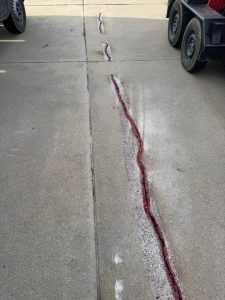
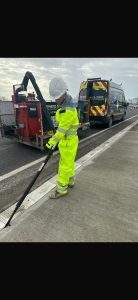
Diamond floor sawing. Walk-behind diesel, petrol or electric saws with circular diamond blades. The standard method for horizontal slab cuts in highway, airfield and industrial pavement work. Used for joint formation, slab removal, service trenches and isolation cuts before demolition. Our confirmed maximum cut depth is 420mm, which handles the standard thickness range for Kent highway carriageways, airfield aprons, port hard standings and industrial floors.
Diamond wall sawing. Track-mounted circular blade for vertical or angled cuts. Used for door and window openings, structural alterations and controlled section removal.
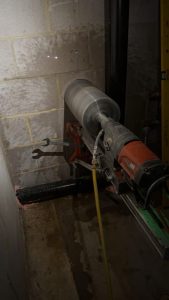
Diamond drilling (core drilling). Hollow diamond-tipped barrels for circular cuts through concrete and masonry. Used for through-slab penetrations, services installation, M&E penetrations and inspection access. Depth is effectively unlimited because barrels can be extended.
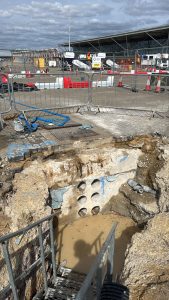
Stitch drilling. A series of overlapping cores forming a cut line where mechanical breaking isn’t permitted. The specialist method for working around live high-pressure aviation fuel mains, live electrical cables and post-tensioning tendons. The narrow webs between cores are broken out, and the section is removed by vacuum lifting or controlled lifting plant.
Diamond wire sawing. Continuous diamond wire fed through pulleys around the section. Used where the cut depth or geometry exceeds blade capacity, including heavily reinforced sections, foundations over 600mm thick, and awkward geometries.
In our experience, stitch drilling works better than continuous sawing around live aviation fuel mains because the lateral isolation of each core protects the embedded service in a way no continuous blade can match. On a live Kent airside apron repair where a fuel main runs 600mm below the slab surface, that method is the difference between a controlled cut and a serious incident. For routine highway joint formation in West Malling or Sevenoaks, conventional floor sawing is faster and the right call.
What separates a competent Kent contractor from a generalist
Five points tell you most of what you need to know.
Accreditation and trade body membership. SafeContractor and CHAS are baseline accreditations expected on most commercial sites. For specialist work, the Drilling & Sawing Association (DSA) is the relevant trade body. For projects involving joint sealing alongside cutting, the Extruded Sealant Association is the relevant body. We hold SafeContractor, CHAS and ESA membership.
Operative qualifications. Operatives should hold NVQ Level 2 in cutting and drilling, CSCS cards, and where supervising, SSSTS. For airside work, additional airside familiarisation and CAA-aligned method training is needed.
Equipment ownership and range. A contractor with one walk-behind floor saw isn’t a concrete cutting specialist. A proper outfit will have diesel and electric floor saws, wall saws, core drills, and access to wire sawing for specialist work. The equipment range determines which projects they can credibly take on.
Services survey methodology. Before any cut is made, the slab needs to be surveyed for embedded services. Live cables, fuel mains, post-tensioning tendons and reinforcement layout all influence cut placement. A contractor without a documented services survey approach is taking risks they shouldn’t be taking.
Joint sealing and reinstatement interface. Many cuts feed straight into joint sealing work or concrete reinstatement. A contractor who only cuts and walks away leaves an incomplete scope. We’ve found that specifying cutting and sealing together produces consistently better outcomes than treating them as separate scopes, particularly on airfield and highway work where the joint slot geometry determines whether the sealant will perform. The ESA Code of Practice Section 5.1 specifies that joint slot faces should be within 10° of vertical, which is a cutting specification, not a sealing one.
The projects we cut concrete on across Kent
Kent’s geography means concrete cutting work spans aviation, highway, port and public sector projects across a small area.
Aviation. We work on airside concrete cutting at major UK airports including stitch drilling around live fuel mains, apron and taxiway slab replacement, runway joint reformation and AGL pavement work. The CAA-compliant airside methodology and our 40+ year aviation heritage make this our core specialism.
Highway. A20, A2, A21, M20, M2 and M25 carriageway joint reformation, slab replacement, drainage trenching and bridge deck work for highway authorities and Tier 1 contractors, with full Chapter 8 traffic management compliance. We’ve delivered cutting work alongside National Highways and major Kent civils contractors.
Ports. Concrete cutting at port operators in Sheerness, Ramsgate and Dover, including hard standing slab replacement, fuel handling area reinstatement, and quayside service installation. The combination of heavy plant loading, marine atmosphere and chemical exposure shapes how the cutting work interfaces with subsequent joint sealing.
Public sector. Council depot floors, school car parks, vehicle workshop concrete, fire and rescue training facilities, and hospital service yards for public sector clients across Kent and the South East. We’ve worked with councils across Maidstone, Ashford, Tunbridge Wells, Canterbury, Medway and Sevenoaks.
We’ve delivered concrete cutting on more than 280 projects across Kent and the wider South East over the past six years, with the largest volume in aviation and highway work.
What proper cutting in Kent involves on site
The execution matters as much as the kit.
Site survey and services check. Before any cut, the slab is surveyed for embedded services. We confirm services drawings, scan where appropriate, and verify live fuel main locations physically before cutting on airside work.
Method statement. All cutting near live services, occupied buildings or operational pavements is covered by a documented method statement and RAMS. For airfield work this includes airside operating procedures and traffic management around the cut zone.
Setting out. Cut lines are surveyed and marked precisely. On airfield and highway work, tolerance is measured in millimetres because the cut has to align with existing slab geometry or service drawings.
Water and slurry management. Cuts are made wet, with continuous water feed cooling the blade and suppressing dust. Slurry is collected and removed before it dries and hardens. On Kent highway and airside work, slurry containment is critical because runoff into drainage or grass margins creates environmental compliance issues.
Section removal. Cut sections are lifted by excavator, telehandler or vacuum lifting plant. On sensitive sites including live airside aprons, vacuum lifting is the standard approach to avoid drop damage to surrounding slab.
Edge condition for follow-on work. Where the cut feeds into joint sealing or concrete reinstatement, the edge has to meet the next-phase specification. The ESA Code of Practice gives the geometry standards for sealing-bound joints. We’ve found that contractors who treat the cut as the end of their scope, rather than the start of the next scope, leave edges that don’t match what comes next.
Standards and compliance for Kent concrete cutting
Concrete cutting in Kent is governed by:
- HSE guidance for diamond drilling and sawing operations
- SHW Series 700 for highway pavement work
- CAA / ICAO / DIO standards for airfield applications
- BS 6187 (code of practice for demolition) where cutting precedes demolition
- BS EN 14188 series and ESA Code of Practice for joint formation tied to sealing
- CDM 2015 Regulations for construction projects
For specifiers, requesting both SafeContractor or CHAS accreditation plus the relevant trade body membership (DSA for cutting, ESA for sealing) is the clearest way to verify contractor competence.
What to ask any Kent concrete cutting contractor before appointing them
Five questions tell you most of what you need to know.
First: what equipment do they actually own? Hire-in-only operations are limited in what they can take on and where they can mobilise.
Second: what’s their maximum cut depth? Verified figures matter more than headline marketing claims. Our confirmed depth is 420mm.
Third: what’s their services survey methodology? If the answer is short, walk away.
Fourth: can they handle live operational sites? Airfield and highway cutting near live services requires specific training and method statements that not every contractor holds.
Fifth: what’s their interface with joint sealing and reinstatement work? A contractor who can only cut, without understanding what comes next, will leave you with edge conditions that fail.
Booking a concrete cutting contractor in Kent
A meaningful concrete cutting quote will identify the slab thickness and reinforcement type, the cut linear metres and geometry, the required depth and width, the access constraints (internal versus external, live versus closed site), the services survey requirement, the section removal method, the slurry management requirement, and the interface with any following work.
If you’re specifying or commissioning concrete cutting work in Kent, whether that’s airfield slab replacement, highway joint reformation, port hard standing repair or public sector pavement work, get in touch. We’ll assess the slab, the services, the access constraints and the follow-on works, and quote the full scope properly under the relevant standards. You can see recent project work on our LinkedIn and Instagram.