So, What Installers Use Thioflex 555?
Thioflex 555 is used almost exclusively by specialist joint sealing contractors who work in aviation, fuel handling, port and concrete pavement maintenance. It’s not a product that general builders, civils contractors, or surfacing crews handle. The reason is that it’s a two-component polysulfide cold applied sealant requiring metered mixing equipment, primer-window discipline, BS EN 14188-2 standards knowledge, and operatives trained in fuel-resistant sealant application. Roughly 95% of the contractors who use it in the UK are members of the Extruded Sealant Association or work directly to its Code of Practice.
At Shepherd and Sons, we’ve been applying Thioflex 555 across UK airfields, fuelling aprons, oil terminals and concrete pavements for more than 40 years. From working with clients across aviation, ports and highways, we’ve come to know the small group of UK contractors who genuinely install this product to specification. We cover the four categories of installer who actually use Thioflex 555, the sectors they operate in, and how to identify the right one for your project.
The four categories of installer who use Thioflex 555
The UK contracting market for Thioflex 555 is narrow. Four distinct categories of installer use the product day-to-day.
1. ESA-member joint sealing specialists. The Extruded Sealant Association is the UK trade body for specialist joint sealing contractors. Members commit to the ESA Code of Practice and work to BS EN 14188-2 and BS 5212. There are fewer than 20 ESA-member contractors in the UK. These are the installers who use Thioflex 555 most regularly and at the highest specification levels, typically on airfields, oil terminals and fuel handling pavements.
2. Aviation-approved surfacing contractors. A smaller subset of the above, these contractors hold airside passes, CAA familiarisation, and approved-contractor status with airport operators or BAA-equivalent bodies. They use Thioflex 555 on aircraft fuelling stands, parking aprons, taxiway shoulder joints and hard standings. The combination of airside access, fuel-resistance specification and aviation programme discipline narrows this category to a handful of UK contractors.
3. Specialist concrete pavement maintenance contractors. These contractors focus on motorway concrete carriageway joints, MSA and HGV refuelling pavements, and weighbridge surrounds. They use Thioflex 555 where the localised fuel exposure of an HGV refuelling area pushes the sealant specification beyond standard hot applied N1.
4. Port and dockside surfacing specialists. Contractors who work on port hardstanding, bunker fuel areas and container yards. Thioflex 555 is used here where bunker fuel and hydraulic spillage rules out standard hot applied sealants. Often the same contractors will also apply one-part polyurethane systems like Sikaflex and Sea-Kar in port environments where two-part mixing isn’t practical.
In our experience, ESA-member aviation-approved contractors work better than general joint sealing contractors on Thioflex 555 work because the combination of airside discipline, primer-window control and metered mixing accuracy is what determines whether the sealant lasts 10 years or fails inside two. We’ve been called in to remediate Thioflex 555 work installed by non-specialist contractors on three separate occasions in the past two years, and in every case the failure traced back to either skipped priming or incorrect mix ratio.
Who doesn’t use Thioflex 555
This is worth covering directly because clients are often quoted Thioflex 555 work by contractors who don’t actually have the capability to install it properly.
General civil engineering and groundworks contractors. They work in concrete but typically don’t carry two-part metered mixing equipment, ESA-aligned QC procedures, or operatives trained in polysulfide application.
Surfacing and tarmac contractors. Their focus is asphalt overlay, planing, and surface dressing. Joint sealing is sometimes added as a subcontracted line item but rarely with Thioflex 555 specifically.
General builders and concrete repair contractors. They handle spalled joint repairs and minor reinstatement work, but the specialist BS EN 14188-2 Class B/C/D fuel-resistant work isn’t where their day-to-day expertise sits.
If you’re being quoted Thioflex 555 work by any of the above, that’s a warning sign. Ask for ESA membership, metered mixing equipment confirmation, and project references involving fuel-exposed substrates.
Where Thioflex 555 installers actually work
The product’s specification dictates the sectors where it’s installed. From working with clients across the aviation, highway, ports and public sectors, we see Thioflex 555 used most regularly in:
Aviation pavements. Aircraft fuelling stands and aprons, cargo handling areas, parking aprons, hard standings. Used wherever Jet A-1, kerosene, Skydrol hydraulic fluid and glycol-based de-icers contact the joint.
Oil and fuel terminals. Tanker loading and unloading areas, bulk fuel hardstanding, distribution depot pavements.
HGV refuelling and MSA pavements. Motorway service area forecourts, dedicated HGV refuelling stations, and toll plaza joints where diesel and AdBlue spillage is routine.
Port bunker areas. Heavy fuel oil handling pavements, bunker barge loading stations.
Military and emergency services facilities. Vehicle fuelling depots, fire and rescue training facilities, MOD fuel installations.
We’ve completed Thioflex 555 work across all five categories over the past five years, with the highest volumes in aviation fuelling apron installations. The product specification carries over consistently between sectors, but the programme constraints differ significantly between an airside apron, a public motorway HGV station and a controlled fuel terminal.
How to identify a genuine Thioflex 555 installer
Six points separate genuine Thioflex 555 installers from contractors quoting on it without the capability.
ESA membership. The Extruded Sealant Association maintains a published member list. Verify membership rather than taking the contractor’s word for it.
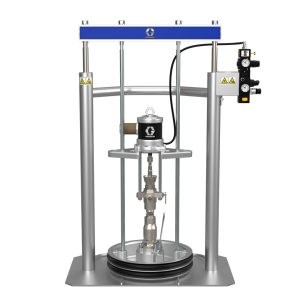
Metered mixing equipment. Machine Grade Thioflex 555 cannot be installed properly without 1:1 volume metered mixing kit. Ask the contractor to confirm they own and operate this equipment, not just rent it ad-hoc.
Fosroc Primer 7E supply chain. Genuine installers maintain stock of Fosroc Primer 7E and understand the 20-minute to 4-hour application window. If a contractor doesn’t reference the primer by name, they’re not installing the system.
Mix ratio QC records. The ESA Code of Practice requires mix ratio checks at the start of every shift and when materials are changed. A genuine installer will have these records on previous projects.
Project references in fuel-exposed environments. General joint sealing experience isn’t the same as Thioflex 555 experience on fuelling aprons. Ask for references where the substrate handled Jet A-1, kerosene or hydraulic fluid.
Sample-and-test compliance. The ESA Code of Practice requires sampling at not less than one per 1,000m of joint, or one per day. Genuine installers maintain documented sampling records.
What proper Thioflex 555 installers actually do on site
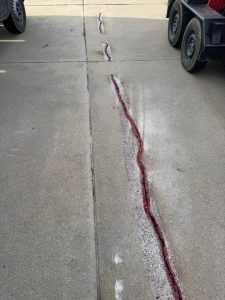
The kit and process is consistent across the genuine UK installer base. Joints are grit-blasted clean, blown out with oil-free compressed air, and dried. A heat-resistant backer rod is caulked into the slot. Fosroc Primer 7E is applied with a clean dry brush. Within the 20-minute to 4-hour primer window, Machine Grade Thioflex 555 is extruded through metered mixing equipment, or Hand Grade is poured directly from 5-litre packs after slow-speed paddle mixing. The sealant is recessed 5 to 8mm below the pavement surface, with 7mm recess for joints wider than 25mm and 10mm in cold weather. The joint is protected from traffic until cured, which is 30 minutes at 20°C for Machine Grade or four hours for Hand Grade.
This process is uniform across competent installers because the manufacturer specification and the ESA Code of Practice leave little room for deviation. What separates installers is consistency, programme discipline, primer-window control, and QC documentation. We’ve found that contractors who short-cut any of the six steps above produce work that fails within two years, regardless of how well-intentioned the workmanship looks on day one.
Booking a competent Thioflex 555 installer
A meaningful Thioflex 555 quote will specify grade (Machine or Hand), linear metres, joint dimensions, primer requirement, programme constraints, cure-window protection, and QC sampling rate. A quote that doesn’t reference these details isn’t quoting on a specified system. It’s quoting on liquid in a joint.
If you’re looking for a Thioflex 555 installer for an airfield, fuel terminal, HGV refuelling area or port pavement, get in touch. We’ll assess the substrate, the chemical exposure, the programme, and quote against the actual specification under the ESA Code of Practice. You can see recent joint sealing project work on our LinkedIn and Instagram.