So, What is Full Depth Concrete Cutting?
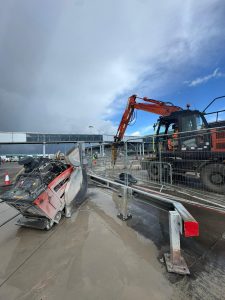
Full depth concrete cutting is the process of cutting all the way through a concrete slab, pavement or structural element using a diamond-bladed saw. The cut passes through the entire thickness of the concrete (typically 150mm to 500mm or more) rather than scoring partway into the surface like a joint cut or crack-inducing cut. It’s used to remove damaged or redundant sections of slab, form isolation cuts before demolition, create openings for services, and produce clean, accurate edges where new concrete or steelwork will be installed. The cut is made wet, with water suppression managing both blade temperature and dust, and the resulting edge is straight, vertical and ready for immediate reinstatement work.
At Shepherd and Sons, we deliver full depth concrete cutting across UK airfields, highways, ports and infrastructure sites, including the specialist scenarios where conventional break-out methods aren’t permitted. We’re based in Kent, we’ve been operating in this sector for more than 40 years, and we’ve delivered cutting work across airside aprons, motorway carriageways, port hard standings and live operational facilities. This article covers what full depth concrete cutting is, when it’s the right method, what the process involves, and how to specify it properly.
What “full depth” actually means
In concrete cutting terms, depth is measured from the slab surface down. A typical UK road slab is 150mm to 250mm thick. A highway concrete carriageway can be 200mm to 350mm. An airfield apron or runway can be 300mm to 500mm or deeper. A heavy-duty industrial floor or port hard standing can be 250mm to 400mm.
A full depth cut goes through the entire thickness. The blade emerges through the underside of the slab and the cut isolates a defined section of concrete that can then be lifted, removed or broken out without affecting the surrounding material.
This is distinct from:
- Joint cutting (a shallow score-cut, typically 25 to 50mm deep, used to control where concrete cracks during cure)
- Partial depth cutting (cutting partway through the slab for surface repair or feature formation)
- Wall sawing (vertical cuts in walls, columns and structural elements)
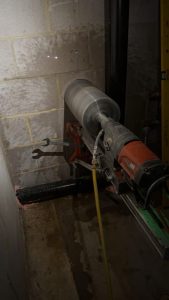
- Core drilling (circular holes through concrete, used for services and inspection)
Full depth cutting is specifically about slab-through horizontal work.
When full depth concrete cutting is the right method
Five scenarios drive specification towards full depth cutting.
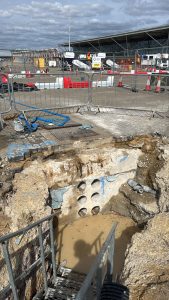
Slab removal for reinstatement. Where a damaged, deteriorated or contaminated section of concrete needs to be removed and replaced. Full depth cutting around the perimeter of the damaged area allows the section to be lifted out cleanly, leaving sound concrete on all sides with a vertical, square edge ready for new concrete to bond to. Common on airfield aprons with delaminated slabs, motorway carriageways with structural failures, and port hard standings with fuel-contaminated sections.
Service trenches and ducts. Cutting trenches through concrete pavement to install drainage, fuel mains, fire mains, electrical conduit or fibre-optic networks. Full depth cutting allows the trench to be excavated cleanly through the slab without breaking out the surrounding concrete, then reinstated to flush surface level.
Isolation cuts before demolition. Where part of a slab is to be demolished by excavator or breaker, full depth cuts around the demolition zone prevent damage propagating into the retained concrete. The cut isolates the demolition section from the surrounding asset.
Openings for new structures. Cutting square or rectangular openings through floor slabs for lift shafts, escalators, ventilation ducts, service risers and stairwells. Full depth cutting produces accurate, vertical, clean edges that are immediately ready for frame installation.
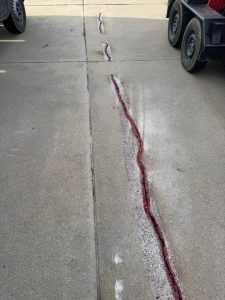
Expansion and contraction joint formation in existing slabs. Where new joints are required in an existing pavement, full depth cutting forms the joint slot in one pass, ready for joint sealing.
In our experience, full depth diamond sawing works better than mechanical breaking on airfield apron slab replacement because the cut leaves a clean vertical edge that bonds properly to new concrete, where breaker work produces an irregular jagged edge that becomes the failure point in the next 18 to 24 months. On a Heathrow-type apron repair where the replacement slab has to deliver a 30-year service life, that edge condition is the difference between a permanent repair and a recurring problem.
That said, for large-scale demolition of redundant concrete where no edge condition matters, mechanical breaking remains faster and cheaper. Full depth cutting is the right method where precision, edge quality and minimal collateral damage are required.
The equipment used for full depth cutting
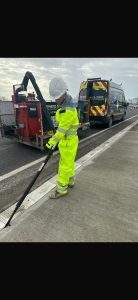
Full depth concrete cutting uses diamond-tipped circular blades mounted on walk-behind floor saws or, for very deep cuts, larger track-mounted saws.
Diesel floor saws. The standard external equipment for highway, airfield, port and yard work. Diesel power delivers the torque needed for deep cuts in heavily reinforced concrete. Industry-standard cutting depths for diesel slab saws typically range from 500mm to 620mm, with the deepest specialist machines cited at up to 870mm in narrow-blade configurations.
Electric and three-phase saws. Used internally and in enclosed environments where diesel emissions and fumes can’t be tolerated. Common applications include warehouses, manufacturing facilities, hospitals and supermarkets. Cutting depths are typically up to 600mm.
Petrol saws. Mid-range option for external work where diesel mobilisation isn’t economic.
Wire sawing. For cuts beyond conventional blade depth, or where the geometry doesn’t suit a circular blade, diamond wire sawing is the specialist alternative. Used on very thick foundations, heavily reinforced sections, and awkward geometries.
Cut width is determined by blade thickness, typically 3mm to 50mm. The deepest cuts are achieved with the narrowest blades because the blade kerf has to clear the concrete dust efficiently. We’ve found that matching blade specification to the actual reinforcement type in the slab matters more than headline depth figures. A 300mm cut through heavily reinforced airfield concrete is a different proposition from a 300mm cut through a plain industrial floor slab.
What proper full depth cutting involves
The process is more than just lowering a blade and pushing forward.
Site survey and services check. Before any cut is made, the slab is surveyed for embedded services. Live fuel mains, electrical cables, post-tensioning tendons, and reinforcement layout all influence cut placement and method. On airside work, this often means liaising with the operator’s services drawings and confirming live fuel main locations physically before cutting.
Setting out. Cut lines are surveyed and marked precisely. On airfield and highway work, the marking tolerance is measured in millimetres because the cut has to align with existing slab geometry or service drawings.
Method statement and risk assessment. Full depth cutting near live services, occupied buildings or operational pavements requires a documented method statement. Stitch drilling overlapping cores is a frequent specification when conventional sawing risks damage to live aviation fuel mains, with sections then removed by vacuum lifting rather than mechanical break-out.
Blade and saw selection. Blade choice is matched to the concrete strength, reinforcement density and target depth. Saw type is matched to access, power supply and emissions constraints.
Water management. The cut is made wet, with continuous water feed to the blade. This cools the diamond segments, suppresses dust at source, and produces the slurry that lifts cut material clear. Slurry is collected and removed before it dries and hardens (per the ESA Code of Practice Section 5.2.1 for joint formation work).
Cutting. The operator walks the saw along the marked line, controlling speed and depth. Speed is matched to the concrete hardness and reinforcement to maintain blade life and cut accuracy. On heavy reinforcement, the operator may make multiple passes at increasing depth rather than attempting full depth in one pass.
Section removal. Cut sections are lifted out by excavator or telehandler with chain slings, or vacuum lifting plant on sensitive sites. The cut section is held or supported from below where there’s a risk of it dropping and causing damage or injury.
Final clean-up. Slurry is removed by water-jetting and vacuum extraction. The cut edges are cleaned and prepared for the next phase of work (typically concrete reinstatement or joint sealing).
We’ve found that contractors who treat full depth cutting as a separate trade from the reinstatement work end up with edges that aren’t matched to the next phase, particularly where the reinstatement involves joint sealing. The cutting specification and the sealing specification have to be planned together. The joint slot dimensions, the bond breaker depth and the sealant choice all flow from the cut geometry.
The joint sealing tie-in
Full depth cutting and joint sealing are closely linked services. New concrete slabs typically need expansion and contraction joints formed by saw cutting, then sealed with hot applied or cold applied sealants. Replacement slabs need their interface joints with the surrounding pavement cut to spec and sealed to match the original joint regime. Joint widening and reforming on existing pavements always involves a cutting operation followed by a sealing operation.
This is why specifying cutting and sealing together usually produces better outcomes than treating them as separate scopes. The cut geometry determines whether the sealant will perform. The ESA Code of Practice Section 5.1 specifies that joint slot faces should be within 10° of vertical, and the joint slot width measured at the top level of the sealant should be not less than the minimum specified for the joint type. A poorly cut joint can’t be properly sealed.
Standards and compliance
Full depth concrete cutting in the UK is governed by:
- HSE guidance for diamond drilling and sawing operations
- The Specification for Highway Works (SHW) Series 700 for highway pavement work
- CAA / ICAO / DIO standards for airfield applications
- BS 6187 (code of practice for demolition) where cutting precedes demolition
- BS EN 14188 series for joint formation work tied to sealing
Operator competence is governed by NVQ Level 2 in cutting and drilling, with operatives typically holding CSCS cards and supervisors holding SSSTS. The Drilling & Sawing Association (DSA) is the relevant trade body. Shepherd and Sons hold both SafeContractor and CHAS accreditation, with the supporting safety management systems required for live airside and highway work.
Sectors where full depth cutting is specified
Aviation clients specify full depth cutting on apron slab replacement, runway joint reformation, taxiway service trenching, and live operational works where stitch drilling around fuel mains is required. The combination of CAA-compliant airside work and complex embedded services makes aviation cutting some of the most demanding work in the sector.
Highway authorities and Tier 1 contractors specify full depth cutting on concrete carriageway joint reformation, slab replacement, drainage trenching and bridge deck work.
Port operators specify it on hard standing slab replacement, fuel handling area reinstatement, and quayside service installation.
Public sector clients use it on council depot floors, vehicle workshop concrete, school car parks and infrastructure projects.
Specifying full depth concrete cutting properly
A meaningful full depth cutting specification will identify the slab thickness and reinforcement type, the cut linear metres and geometry, the access constraints (internal versus external, live versus closed site), the services survey requirement, the section removal method, the slurry management requirement, and the interface with any following work (joint sealing, concrete reinstatement, services installation).
If you’re specifying or commissioning full depth concrete cutting work, particularly where the cutting interfaces with joint sealing, slab reinstatement or live operational pavement, get in touch. We’ll assess the slab, the services, the access constraints and the follow-on works, and quote the full scope properly. You can see recent project work on our LinkedIn and Instagram.