So, How Deep Can You Cut Concrete?
The maximum depth you can cut concrete with a standard diamond floor saw is typically between 500mm and 620mm, with specialist deep-cut machines capable of up to around 870mm in narrow-blade configurations. For most UK construction, infrastructure and airfield work, cuts of 150mm to 500mm cover the vast majority of slab thicknesses. The depth you can achieve depends on the saw type, the blade diameter, the cut width, the reinforcement density in the concrete, and the access available. Beyond conventional saw capacity, diamond wire sawing handles cuts beyond 800mm and through awkward geometries where a circular blade can’t reach.
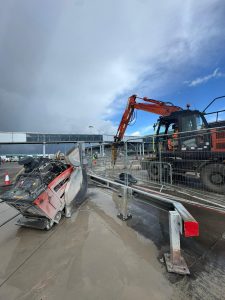
At Shepherd and Sons, we cut concrete daily across UK airfields, highways, ports and infrastructure projects. Our confirmed maximum cut depth using our diamond floor saws is 420mm, which covers the standard thickness range for highway carriageways, airfield aprons, port hard standings and industrial floors. We’re based in Kent and we’ve been delivering concrete cutting work for more than 40 years, alongside our joint sealing and surface repair specialisms. This article covers how deep you can practically cut concrete, what determines the depth, and the methods used when you need to go beyond standard saw capacity.
The relationship between blade diameter and cut depth
The single biggest factor in maximum cut depth is the blade diameter. As a rough rule, the achievable cutting depth is just under half the blade diameter, because the blade has to clear both the cut depth and the saw’s lower flange housing.
- A 350mm blade gives roughly 110mm to 130mm cut depth
- A 500mm blade gives roughly 180mm to 200mm cut depth
- A 600mm blade gives roughly 230mm to 270mm cut depth
- A 750mm blade gives roughly 300mm to 350mm cut depth
- A 900mm blade gives roughly 360mm to 420mm cut depth
- A 1000mm blade gives roughly 400mm to 450mm cut depth
- A 1200mm blade gives roughly 500mm to 540mm cut depth
- A 1500mm blade and above for deeper specialist work
Our standard machine fleet gets us to 420mm of cut depth, which handles the typical UK pavement and slab thicknesses we encounter. For deeper specialist work, the industry uses larger saws or moves to wire sawing.
What determines cut depth in practice
Headline depth figures are theoretical maxima under ideal conditions. The depth you actually achieve on site is determined by five factors.
Blade diameter and saw type. Walk-behind diesel floor saws are the standard for external slab cutting. Bigger machines and bigger blades give deeper cuts but require more space, more power and more time per metre.
Concrete strength and aggregate. A high-strength concrete with hard aggregate cuts slower and pulls more current. The blade may need cooling pauses on long deep cuts.
Reinforcement density. Heavily reinforced concrete with closely spaced rebar or post-tensioning strands cuts significantly slower than plain concrete. The blade has to grind through steel as well as concrete, and the cut speed drops accordingly.
Cut width (blade kerf). Wider blades cut faster but to shallower depths. Narrower blades cut deeper but slower. The deepest cuts on any given saw are achieved with the narrowest acceptable blade.
Access and saw geometry. A walk-behind saw needs space to manoeuvre, water supply and slurry management. In tight spaces, achievable depth may be limited by what saw can fit on site, not by what the largest saw could theoretically deliver.
In our experience, matching blade specification to the actual reinforcement type in the slab matters more than chasing headline depth figures. We’ve found that a properly specified 420mm cut through reinforced airfield concrete delivers a cleaner, faster job than a theoretical 600mm capability misapplied to the same slab. On a Heathrow-type apron repair, the cut quality at the edge is what determines whether the reinstatement holds for 30 years.
Standard cutting depth ranges by application
What you actually need to cut depends on the slab type. Typical UK slab thicknesses are:
- Domestic and light commercial floor slabs: 100mm to 150mm
- Industrial warehouse floors: 150mm to 250mm
- Highway concrete carriageways: 200mm to 350mm
- Airfield taxiways and aprons: 300mm to 500mm
- Airfield runways: 350mm to 500mm (sometimes deeper at threshold sections)
- Port hard standings: 250mm to 400mm
- Bridge decks: 200mm to 400mm
- Heavy-duty industrial yards: 250mm to 400mm
For the vast majority of UK construction, infrastructure and aviation work, cuts of 150mm to 500mm cover everything. A standard diamond floor saw delivers this range comfortably. Cuts deeper than 500mm are specialist territory and typically need either large-diameter blade saws or wire sawing.
Different cutting methods and their depth limits
Different concrete cutting techniques have different depth limits. The right method depends on what you’re cutting and how deep you need to go.
Diamond floor sawing (slab sawing). Walk-behind diesel, petrol or electric saws with circular diamond blades. The standard method for horizontal slab cuts. Industry depth range typically 500mm to 620mm with conventional saws, up to around 870mm with specialist deep-cut machines and narrow blades.
Diamond wall sawing. Track-mounted circular blade for vertical or angled cuts. Depth range typically up to 600mm to 730mm depending on saw and blade.
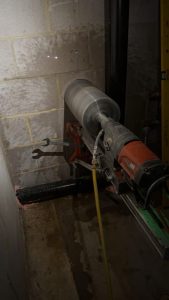
Diamond drilling (core drilling). Hollow diamond-tipped core barrels for circular cuts through concrete. Depth is effectively unlimited because barrels can be extended sequentially, with cores cleared between extensions. Used for through-slab penetrations, services and inspection holes.
Diamond wire sawing. Continuous diamond wire fed through pulleys around the section to be cut. Used where the cut depth or geometry exceeds blade capacity, including foundations over 1 metre thick, heavily reinforced bridge piers and complex demolition work.
Stitch drilling. A series of overlapping diamond cores used to form a cut line where mechanical breaking isn’t permitted. The cores are drilled side-by-side, the narrow webs between them broken out, and the resulting section lifted or vacuumed clear. This is the specialist method for working around live high-pressure aviation fuel mains, where conventional sawing risks puncturing services. Depth is effectively unlimited because each core can be extended.
In our experience, stitch drilling works better than continuous sawing on cuts around live aviation fuel mains because the depth control and the lateral isolation of each core protects the embedded service in a way that no continuous blade can match. On a live airside apron repair where the fuel main runs 600mm below the slab surface, that method is the difference between a safe controlled cut and a serious incident.
The cut width and cut depth trade-off
This is worth understanding in practice. Manufacturer depth figures typically assume the narrowest practical blade. As you go to wider blades for faster cutting, depth drops accordingly.
A 1200mm blade configured at 3mm kerf might cut to 540mm. The same saw with a 12mm kerf blade for fast bulk cutting might top out at 460mm. The headline depth figure on the spec sheet doesn’t tell you what depth you’ll achieve at the cut width you actually need.
For practical specification, decide on the cut width you need first (driven by what you’re forming, the reinforcement spacing, or the joint width if you’re cutting for sealing), then check whether the saw can deliver that width to the depth required.
When you need to cut deeper than standard saws allow
For cuts beyond around 620mm depth, the practical options are:
Specialist deep-cut floor saws. Industry references cite cuts up to 870mm with specialist diesel slab saws and narrow blades. These are typically hired in rather than owned by most contractors because the work doesn’t justify the capital cost. We can mobilise specialist equipment where the project genuinely requires it.
Diamond wire sawing. The standard solution for deep cuts, very heavy reinforcement and awkward geometries. Wire saws can handle cuts of 1 metre or more and aren’t limited by blade radius.
Two-pass cutting. Cut from above with a conventional saw to the maximum achievable depth, then break the remaining web manually or with a follow-up cut from the underside. Slower but works where wire sawing isn’t economic.
Combined cut and break. Cut to maximum saw depth, then use hydraulic bursting or controlled mechanical breaking to remove the remaining material. Practical where edge quality on the lower portion isn’t critical.
What proper deep cutting involves
Going beyond standard depth needs more than just bigger equipment.
Site survey and services check. Before any cut is made, the slab is surveyed for embedded services. Live fuel mains, electrical cables, post-tensioning tendons and reinforcement layout all influence cut placement and method. On airside work, this means liaising with the operator’s services drawings and confirming live fuel main locations physically before cutting.
Method statement. Deep cutting near live services, occupied buildings or operational pavements requires a documented method statement. Stitch drilling around fuel mains, water suppression on dust-sensitive sites, and slurry management all need to be specified before work starts.
Water management. The cut is made wet, with continuous water feed cooling the blade and suppressing dust. Slurry is collected and removed before it dries (per the ESA Code of Practice Section 5.2.1 where the cut interfaces with joint sealing). On deep cuts the water volume is significant and slurry containment matters.
Multi-pass cutting. Very deep cuts are usually made in stages, increasing depth across multiple passes rather than attempting full depth in one pass. This protects the blade, manages heat build-up, and gives better cut edge quality.
Section removal. Cut sections are lifted by excavator, telehandler or vacuum lifting plant. On sensitive sites, the section is held or supported from below where there’s a risk of it dropping.
The cutting and sealing relationship
Many cuts feed straight into joint sealing work. A new contraction joint cut in fresh concrete needs to be sealed once the slab has cured. A widened existing joint needs to be sealed once it’s prepared. A section replacement cut needs the new interface joints sealed once the reinstatement is poured.
The ESA Code of Practice Section 5.1 specifies that joint slot faces should be within 10° of vertical for proper sealant performance. A poorly cut joint can’t be properly sealed. We’ve found that specifying cutting and sealing together produces consistently better outcomes than treating them as separate scopes, particularly on airfield and highway work where the joint sealing specification depends on the cut geometry.
Sectors where deep cutting is specified
Aviation clients specify the deepest cuts, including airfield apron and runway replacement work in the 350mm to 500mm range, plus specialist stitch drilling around live fuel mains. Highway authorities specify cuts of 200mm to 350mm on concrete carriageway replacement and joint reformation. Port operators specify cuts of 250mm to 400mm on hard standing replacement and fuel handling area work. Public sector clients specify cuts ranging from light industrial floors to heavy depot pavements.
Specifying a concrete cut properly
A meaningful concrete cutting specification will identify the slab thickness and reinforcement type, the cut linear metres and geometry, the required depth, the required cut width, the access constraints (internal versus external, live versus closed site), the services survey requirement, and the interface with any following work (joint sealing, concrete reinstatement, services installation).
If you’re specifying or commissioning concrete cutting work, particularly where depth matters or where the cutting interfaces with joint sealing or live operational pavement, get in touch. We’ll assess the slab, the services, the access constraints and the follow-on works, and confirm what depth we can deliver and what method fits. You can see recent project work on our LinkedIn and Instagram.