Professional Diamond Drilling Contractors in Kent
If you’re looking for diamond drilling contractors in Kent, you want a specialist with the right rigs, the right accreditations, and the experience to handle live sites, embedded services and awkward access. Diamond drilling isn’t a generalist trade. It needs electric, hydraulic and petrol-powered rigs, hollow diamond core barrels sized to the specific hole diameter, water and slurry management on site, and operatives trained in NVQ Level 2 cutting and drilling. Get the contractor wrong and you’ll hit a live cable, damage the surrounding slab, or end up with an off-line bore that doesn’t line up with the service you’re trying to install.
At Shepherd and Sons, we deliver diamond drilling across Kent and the wider South East, with more than 40 years of specialist experience across airfields, highways, ports and infrastructure. We’re based at Westerhill Farm just outside Maidstone, we hold SafeContractor and CHAS accreditation, and we’re members of the Extruded Sealant Association for the related joint sealing work. This article covers what proper diamond drilling in Kent looks like, the local projects we work on, the questions worth asking any contractor before appointing them, and how to specify the work properly.
What proper diamond drilling in Kent involves
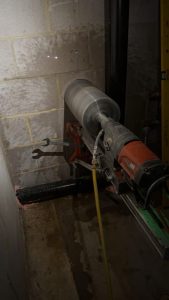
Diamond drilling uses hollow diamond-tipped core barrels to cut accurate circular holes through concrete, masonry, reinforced concrete and stone. The diamonds grind through the material as the drill rotates, producing a clean, straight-sided hole and a solid concrete core that can be removed once the cut completes. Everything is done wet, with continuous water feed cooling the diamonds, suppressing dust at source and flushing out the cuttings.
A competent Kent diamond drilling contractor will offer:
Vertical, horizontal and angled drilling. Standard vertical cores through floor slabs are only one of the applications. Wall penetrations, angled fixings, and horizontal service holes through walls and columns all need different rig configurations.
A working diameter range from 10mm to over 500mm. Small diameter for anchor bolts and electrical conduit. Mid-range for standard services. Large diameter for major penetrations and manhole formation. A contractor with only one rig size is limited in what they can take on.
Electric, hydraulic and petrol-powered rigs. Electric for internal and enclosed sites (warehouses, hospitals, schools, food-grade facilities). Hydraulic for heavy industrial and large-diameter drilling. Petrol for remote external sites without mains power.
Anchor, vacuum and wedge mounting. Different substrates need different mounting methods. A vacuum base is right for glass-smooth concrete floors. Bolt anchors are needed where the concrete is textured or where vibration is likely. A wedge-and-strut frame works between floor and ceiling in tight spaces.
Slurry management. Cutting water and concrete slurry has to be collected and removed, particularly on internal work where spillage can damage finishes and on airside and highway sites where runoff into drainage creates environmental compliance issues.
Stitch drilling capability. Overlapping cores drilled side-by-side to form a cut line, used where mechanical breaking isn’t permitted, including cutting around live aviation fuel mains, high-voltage cables and post-tensioning tendons.
In our experience, ESA-member specialist contractors with in-house rigs work better than general civils firms who hire equipment in for diamond drilling work because the ownership of kit means operatives are practised on it, the maintenance is controlled, and mobilisation on short-notice Kent projects (particularly overnight highway or airside work) is faster and more reliable. On a live airside apron project where a fuel main runs 600mm below the slab and stitch drilling is the only permitted method, the difference between an in-house specialist and a general firm with a hire rig is the difference between a controlled cut and an incident.
The Kent projects we drill on
Kent’s geography brings a specific mix of diamond drilling work, and we’ve delivered across all four sectors we cover.
Aviation. Airside diamond drilling at UK airports, including AGL fitting installations, apron service penetrations, stitch drilling around live fuel mains, and taxiway service work tied into pavement programmes. Our 40+ year aviation heritage and airside-approved operatives are what make this our core specialism.
Highway. Diamond drilling for bridge deck strengthening, gantry foundations, retaining wall fixings and drainage installations on M20, M2, M25, A20, A2 and A21 works for highway authorities and Tier 1 contractors. Chapter 8 traffic management compliance and SHW conformity are standard requirements.
Port. Quayside service installations, fender fixings, bunker handling area penetrations and dockside structural work at port operators in Sheerness, Ramsgate, Dover and beyond. Salt exposure, tight tidal working windows and marine atmosphere shape the way the work is delivered.
Public sector. Building service penetrations, structural alterations, depot floor work and infrastructure penetrations for public sector clients across Kent councils including Maidstone, Ashford, Tunbridge Wells, Canterbury, Medway, Sevenoaks and Tonbridge & Malling.
We’ve delivered diamond drilling on more than 300 UK projects in the past six years, with the largest volume in aviation and highway work, and Kent representing the single largest regional concentration.
What separates a competent Kent contractor from a generalist
Five points tell you most of what you need to know when shortlisting a diamond drilling contractor in Kent.
Accreditation and trade body membership. SafeContractor and CHAS are baseline accreditations expected on most commercial sites. For specialist drilling work, the Drilling & Sawing Association (DSA) is the relevant trade body. For projects involving joint sealing alongside drilling, ESA membership is the relevant credential.
Operative qualifications. Operatives should hold NVQ Level 2 in cutting and drilling, CSCS cards, and where supervising, SSSTS. For airside work, additional airside familiarisation and CAA-aligned method training is needed.
Equipment ownership. A contractor who owns their rigs and maintains them regularly will consistently outperform one who hires kit in for each job. Ownership means the operatives are practised on the specific equipment, calibration is known, and short-notice mobilisation is possible.
Services survey methodology. Before any hole is drilled, the substrate should be surveyed for embedded services. Live cables, fuel mains, post-tensioning tendons, water and gas pipes, and reinforcement layout all influence drilling position and method. A contractor without a documented services survey approach is taking risks they shouldn’t be taking, and putting you at risk of a live-services incident.
Follow-on scope integration. Many drilled holes feed into further work: fire-stopping through fire compartment lines, waterproof sealing through waterproofing membranes, or joint sealing where the drill core interfaces with a pavement joint. A contractor who cuts and walks away leaves the follow-on work uncoordinated. From working with clients across Kent’s aviation and highway sectors, we’ve found that specifying drilling and follow-on work together produces significantly better outcomes than treating them as separate scopes.
Diamond drilling depth and diameter capability in Kent
The depth achievable in diamond drilling is effectively unlimited because barrels can be extended sequentially. Deep cores through multi-storey foundations and bridge structures of several metres are routine work for specialist contractors. For context on the depth relationship between coring and other cutting techniques, our guide on how deep you can cut concrete covers blade-based cutting depth alongside coring.
Diameter capability determines what services you can install and what structural work is possible. Standard Kent construction and civil work typically covers:
- 20mm to 50mm. Anchor bolts, small fixings, electrical conduit.
- 50mm to 150mm. Standard services, drainage, soil pipes, small ducting.
- 150mm to 300mm. Major services, drainage stacks, ventilation ducts.
- 300mm to 600mm. Structural openings, large services, manhole formation.
- 600mm to 1000mm+. Specialist openings, drainage chambers, large ducting.
For pavement work where drilled cores interface with slab replacement or cutting operations, understanding the overlap with full depth concrete cutting helps in getting the specification right first time.
Standards and compliance for Kent diamond drilling
Diamond drilling in Kent is governed by:
- HSE guidance for diamond drilling and sawing operations
- The Drilling & Sawing Association (DSA) Code of Practice
- BS EN 12504 series where coring is done for concrete sampling and testing
- CDM 2015 Regulations for construction projects
- CAA / ICAO / DIO standards for airfield applications
- SHW Series 700 for highway pavement drilling work
- The ESA Code of Practice for Joint Sealing (Issue 3.0, November 2025) where drilling interfaces with joint sealing
For specifiers, requesting both SafeContractor or CHAS accreditation plus the relevant trade body membership is the clearest way to verify contractor competence.
What to ask any Kent diamond drilling contractor before appointing them
Five direct questions tell you most of what you need to know.
What rigs do you own? Hire-in-only operations are limited in what they can take on. Ownership indicates specialism.
What’s your maximum bore diameter and depth capability? Verified figures matter more than headline claims. A specialist will give you clear ranges for their in-house kit.
What’s your services survey methodology? If the answer is short, walk away. Pre-drill services surveys are non-negotiable on any site with embedded services.
Have you drilled around live services or on live airside sites? General drilling experience isn’t the same as live-services experience. Ask for references specific to the project type you’re commissioning.
How do you interface with follow-on work? Fire-stopping, sealing, service installation and reinstatement all need to be sequenced with the drilling. A contractor who understands this will produce better outcomes.
Specifying diamond drilling properly in Kent
A meaningful diamond drilling specification will identify the hole diameter and depth, the substrate type and reinforcement, the access constraints (internal versus external, live versus closed site), the services survey requirement, the mounting method, the slurry management requirement, and the interface with any following work (fire-stopping, sealing, service installation, sleeve fitting).
If you’re specifying or commissioning diamond drilling work in Kent, whether that’s airfield service penetrations, highway bridge deck fixings, port quayside service installations, or public sector building work, get in touch. We’ll assess the substrate, the services, the access constraints and the follow-on works, and quote the full scope properly under the relevant standards. You can see recent project work on our LinkedIn and Instagram.