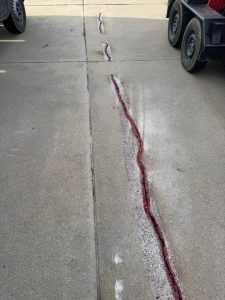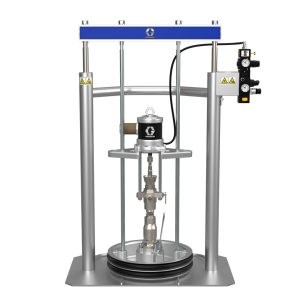
So, What is a Two Part Cold Applied System?
A two part cold applied system is a joint sealant supplied as two separate components, a base and a hardener, that are mixed on site and cure through a chemical reaction at ambient temperature. The two parts are kept apart in their packaging and only react when combined in a precise 1:1 volume ratio, typically through a metered mixing machine or by hand for smaller jobs. Once mixed, the sealant has a defined working time (the pot life) during which it must be applied to the joint, after which it cures into a tough, elastic, chemically-resistant seal. It’s the standard specification for fuel-exposed concrete pavement joints, including aircraft fuelling aprons, oil terminals, HGV refuelling areas, and port bunker zones.
At Shepherd and Sons, we’ve been installing two part cold applied systems across UK airfields, ports and concrete pavements for more than 40 years. We’re members of the Extruded Sealant Association, and we apply two part systems to BS EN 14188-2 and the ESA Code of Practice. This article covers what a two part cold applied system is, the chemistry behind it, when it’s the right specification, and what proper application looks like.
How a two part cold applied system works
The principle is straightforward. The base and the hardener are chemically reactive towards each other but stable in isolation. As long as they remain separate, the components have a defined shelf life (typically 12 months at 25°C or below for products like Thioflex 555). When combined in the correct ratio and mixed thoroughly, they undergo a polymerisation reaction that converts the liquid mixture into a solid, elastic, cross-linked rubber.
The chemistry varies between products. Polysulfide is the dominant chemistry for fuel-exposed pavement work, used in products like Thioflex 555. Polyurethane is used where higher modulus is needed, including industrial floor joints. Silicone-based two part systems are specified for high-temperature or chemical-exposure environments where neither polysulfide nor polyurethane is suitable.
The cure mechanism differs from hot applied sealants, which solidify through cooling, and from one part cold applied sealants, which cure either through moisture exposure (silicone, polyurethane) or solvent evaporation. Two part chemistry gives the installer control over cure speed through grade selection (Machine versus Hand) and ambient temperature management.
The two components, base and hardener
In a typical two part cold applied system like Thioflex 555, the components are:
Base. A liquid polymer (polysulfide, polyurethane or silicone) containing the bulk of the sealant material. In Thioflex 555 the base is white, with a specific gravity of 1.36 to 1.44 at 20°C.
Hardener. A curing agent that reacts with the base polymer to initiate cross-linking. In Thioflex 555 the hardener is black, with a specific gravity of 1.68 to 1.76 at 20°C.
When mixed, the two components produce a uniform grey sealant. The mix ratio is 1:1 by volume for Machine Grade Thioflex 555, with the machine output range of 100 parts by weight base to 114 to 125 parts by weight hardener depending on calibration. Hand Grade is supplied in pre-weighed units, which removes the ratio variable but requires careful site mixing.
Mix ratio accuracy matters. If the ratio is wrong, the sealant either won’t cure, will cure too soft, or will cure to brittle. The ESA Code of Practice requires mix ratio checks at the start of every shift and when materials are changed.
When a two part cold applied system is the right specification
Five scenarios push specification towards a two part cold applied system over alternatives.
Fuel and chemical exposure. This is the primary driver. Two part polysulfide systems are tested under BS EN 14188-2 Classes B, C and D, which cover Test Fuel I, Test Fuel II, de-icing chemicals and aggressive liquid chemicals. Hot applied sealants don’t carry these classifications.
Indoor or fire-restricted environments. Where a propane melter can’t be used. Warehouses, multi-storey car parks, food-grade production facilities, and any site with naked-flame restrictions.
Fresh or sensitive concrete. Where heat from hot applied sealant could stress the slab.
High movement accommodation requirement. Two part polysulfide systems offer 35% movement accommodation under BS 8449, which is at the upper end of what cold applied systems deliver.
Long service life requirement. Two part polysulfide cured properly will outlast most alternatives in fuel-exposed environments, typically 10 years or more.
In our experience, two part cold applied polysulfide works better than one part cold applied silicone on aircraft fuelling aprons because polysulfide maintains its 35% movement accommodation across the -40°C to +70°C service range and shows no adhesion or cohesion failure under Test Fuel I and II exposure, where one part silicone systems generally have lower movement accommodation and limited fuel resistance. On a dedicated fuelling stand, the chemistry difference is the gap between a 10-year sealed joint and one requiring resealing in three.
That said, two part isn’t always the right answer. For port bunker areas where ease of application matters and project programmes are tight, one part polyurethane systems like Sikaflex and Sea-Kar are often the better fit. For motorway carriageway joints with no fuel exposure, hot applied N1 is faster and cheaper.
Machine Grade versus Hand Grade
Most two part cold applied systems are supplied in two grades, with the difference being cure speed and application method.
Machine Grade. Applied through a 1:1 volume metered mixing machine. Cure is fast: 30 minutes return to service at 20°C for Thioflex 555 Machine Grade, dropping to 10 minutes at 35°C. Tack-free time is under 30 minutes. Pot life is short, typically under five minutes at 20°C, which means the material can’t sit in the hose before extrusion.
Hand Grade. Mixed on site with a slow-speed drill (300 to 500 rpm) and a Fosroc Sealant Mixing Paddle, then poured directly or applied through a ‘G’ Gun. Cure is slower: four hours return to service at 20°C, up to 36 hours at 5°C. Tack-free time is under three hours. Pot life is longer, giving more working time per mix.
The choice depends on programme. Machine Grade is right for fast-return-to-service work like airfield aprons and fuel terminals. Hand Grade is right for smaller jobs, detail work, repairs, and sites where mobilising a metered mixing machine isn’t economic.
What proper two part cold applied application involves
Application is technical and unforgiving on preparation. The performance of the sealant depends almost entirely on installation discipline.
Joint slot preparation. Slots must be sound dense concrete or asphalt, dry, sound, clean and free from frost. Grit blasting is the manufacturer-recommended preparation method, followed by oil-free compressed air blow-out to remove dust and laitance.
Backer rod. A heat-resistant backer rod or Expandafoam cord is caulked into the base of the slot. This controls sealant depth, prevents three-sided adhesion, and stops sealant flowing into the joint cavity. Three-sided adhesion is the single most common cause of premature cohesive failure in two part cold applied work.
Priming. Concrete joint faces are primed with Fosroc Primer 7E (for Thioflex 555). For asphalt substrates, Nitoflor FC130 is applied first, then Primer 7E. Sealant must be applied between 20 minutes and 4 hours after priming. Beyond 24 hours, the cured primer must be physically removed and the joint re-primed.
Mixing. Machine Grade goes through a metered mixing machine with mix ratio checks at the start of every shift. Hand Grade is mixed for three minutes with a slow-speed drill, scraped down, then mixed for a further two minutes. Air must not be incorporated. Material at the bottom of the tin must be included, or the sealant won’t cure properly.
Application. The mixed sealant is extruded or poured into the prepared joint. Width-to-depth ratio is 1:1 to 1.5:1, with a minimum 10mm sealant depth. The finished sealant level is recessed 5 to 8mm below the pavement surface, 7mm for joints wider than 25mm, and 10mm in cold weather.
Cure protection. The joint is protected from traffic until cured. Machine Grade Thioflex 555 returns to service in 30 minutes at 20°C. Hand Grade takes four hours at 20°C and 36 hours at 5°C.
We’ve found that contractors who treat two part cold applied as a simpler version of one part cold applied are the contractors whose work fails inside two years. The chemistry is more forgiving than hot applied on heat-sensitive substrates, but it’s more demanding on preparation and timing.
Standards and compliance
Two part cold applied systems for UK pavement work conform to:
- BS EN 14188-2 (System M two-component, type sl self-levelling or ns non-sag, Classes B/C/D for chemical resistance)
- BS 5212 Part 1:1990 (cold applied joint sealant systems for concrete pavements)
- BS 8449 (movement accommodation testing)
- BS 10948:2020 (application and use of hot- and cold-applied joint sealant systems)
- US Federal Specification SS-S-200E (jet blast resistance, for aviation applications)
- The ESA Code of Practice for Joint Sealing (Issue 3.0, November 2025)
For specifiers and clients, requesting an ESA-member contractor and BS EN 14188-2 Class B, C or D conformity is the clearest way to ensure the product and installation meet specification.
Yield, packaging and storage
Two part systems are typically supplied in pre-portioned containers to maintain the mix ratio. For Thioflex 555: Machine Grade comes in 30-litre and 400-litre packs; Hand Grade in 5-litre packs, with larger 30 and 400-litre Hand Grade packs available for machine application where a slower set is needed. Fosroc Primer 7E is supplied in 0.5-litre and 1-litre units, with 1 litre covering approximately 30 litres of Thioflex 555 sealant.
Yield depends on joint size. A 10mm x 10mm joint takes 0.10 litres per metre (300 metres per 30-litre pack). A 25mm x 20mm joint takes 0.50 litres per metre (60 metres per 30-litre pack). We’ve completed two part cold applied installations across more than 200 UK projects in the past six years, and we always over-order by 10 to 15% to allow for joint dimension variation and waste in the lance.
Shelf life is 12 months in unopened containers stored at 25°C or below. Higher storage temperatures shorten the shelf life. Base separation can occur in warm storage, which is why a drill-and-paddle remix is required before machine loading.
Sectors where two part cold applied systems are specified
Two part cold applied systems show up across the sectors we cover. Aviation clients specify them on fuelling aprons and hard standings. Highway authorities use them at MSAs, HGV refuelling stations and toll plazas. Port operators specify them in fuel handling and heavy plant areas. Public sector clients use them on council-operated bus depots, fire and rescue training facilities, and military fuel installations.
Specifying a two part cold applied system properly
A meaningful two part cold applied joint sealing quote will specify the product (and grade), linear metres, joint dimensions, primer requirement, programme constraints, cure-window protection, and QC sampling rate. A quote that doesn’t reference these details isn’t quoting on a specified system.
If you’re specifying or commissioning work that needs a two part cold applied system, get in touch. We’ll assess the substrate, chemical exposure, programme and cure window, and quote against the actual specification. You can see recent joint sealing project work on our LinkedIn and Instagram.