
Shepherd and Sons Ltd
Concrete Cutting in Aperfield
Aperfield is the older name for the settlement now generally called Biggin Hill, recorded as Apeldrefeld as far back as 1242, and it sits at the far southern edge of the London Borough of Bromley where Greater London meets Kent. For us that boundary is the point: Aperfield is closer to our yard near Maidstone than most of London is.
The airport is the work
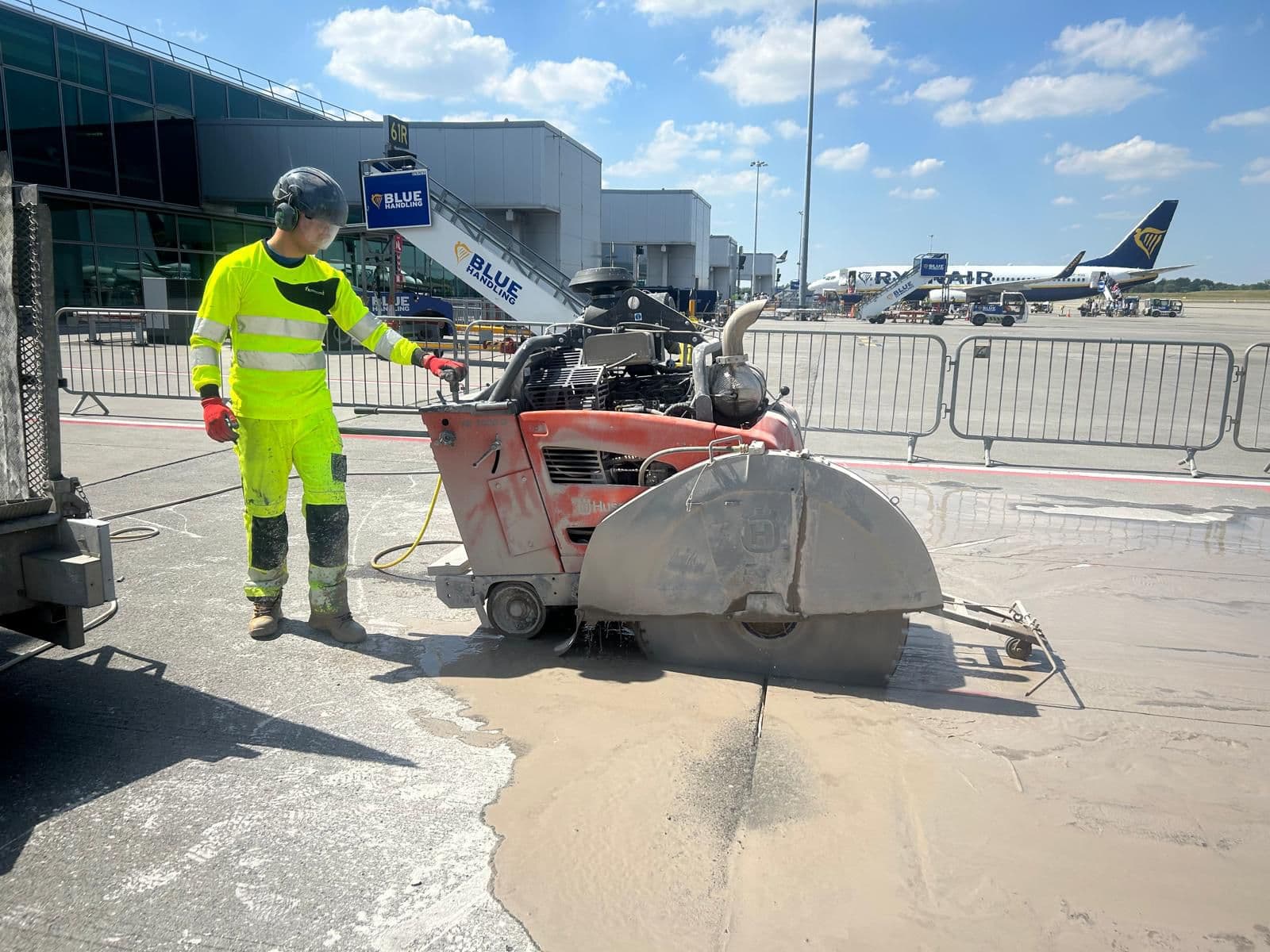
London Biggin Hill Airport dominates the local economy and the local built environment. It is a business aviation airport rather than a scheduled passenger one, which changes the nature of the surfaces: aprons and stands sized for private and corporate jets, hangar floors, maintenance aprons for the on-site MRO operations, taxiway links and perimeter hardstanding.
Business aviation also changes the programme. There is no overnight shutdown of the scale a major airport has, but there are far more predictable quiet periods, and work is usually packaged into them stand by stand rather than closing anything wholesale. Hangar floor work in particular tends to happen around aircraft movements rather than in a clear building.
Hangar floors and apron slabs
A hangar floor is a specific problem. It is a large, flat, power-floated slab that has to stay flat, because aircraft are moved across it on jacks and tugs, and it usually carries embedded services for power, air and fuel. Cutting into one means locating those services first and reinstating to a tolerance that a spirit level will not settle. Apron slabs outside are thicker, heavily reinforced and jointed, and the joints are as important as the concrete: cutting across one without a plan for resealing it leaves an ingress path straight into the sub-base.
Semi-rural access, London rules
Aperfield still looks and works like a Kent village in parts, with narrow lanes and no through routes, so plant access is planned around the approach rather than the site. Administratively though it is London, so the London-wide plant emissions rules apply in full. Every diesel saw, generator and compressor we bring into Greater London has to meet Stage IV of the Non-Road Mobile Machinery standard, which became the London-wide minimum on 1 January 2025, and every machine has to be listed on the NRMM register for the site before it turns a blade. Borough enforcement officers do check on site. It is worth asking any contractor quoting for London work to confirm both, because a machine that fails the check is a machine that goes home.
This page is part of our concrete cutting in London coverage. For the service itself, including cut depths, plant and specification, see concrete cutting.