
Shepherd and Sons Ltd
Concrete Cutting in Bedfont
Bedfont sits on Heathrow's southern edge, between the A30 Great South West Road and the airport boundary, and that proximity defines the work. This is not a suburb that happens to be near an airport. It is part of the airport's operational hinterland, and the cutting that happens here is airport cutting whether or not it is inside the fence.
Airside and landside are different jobs
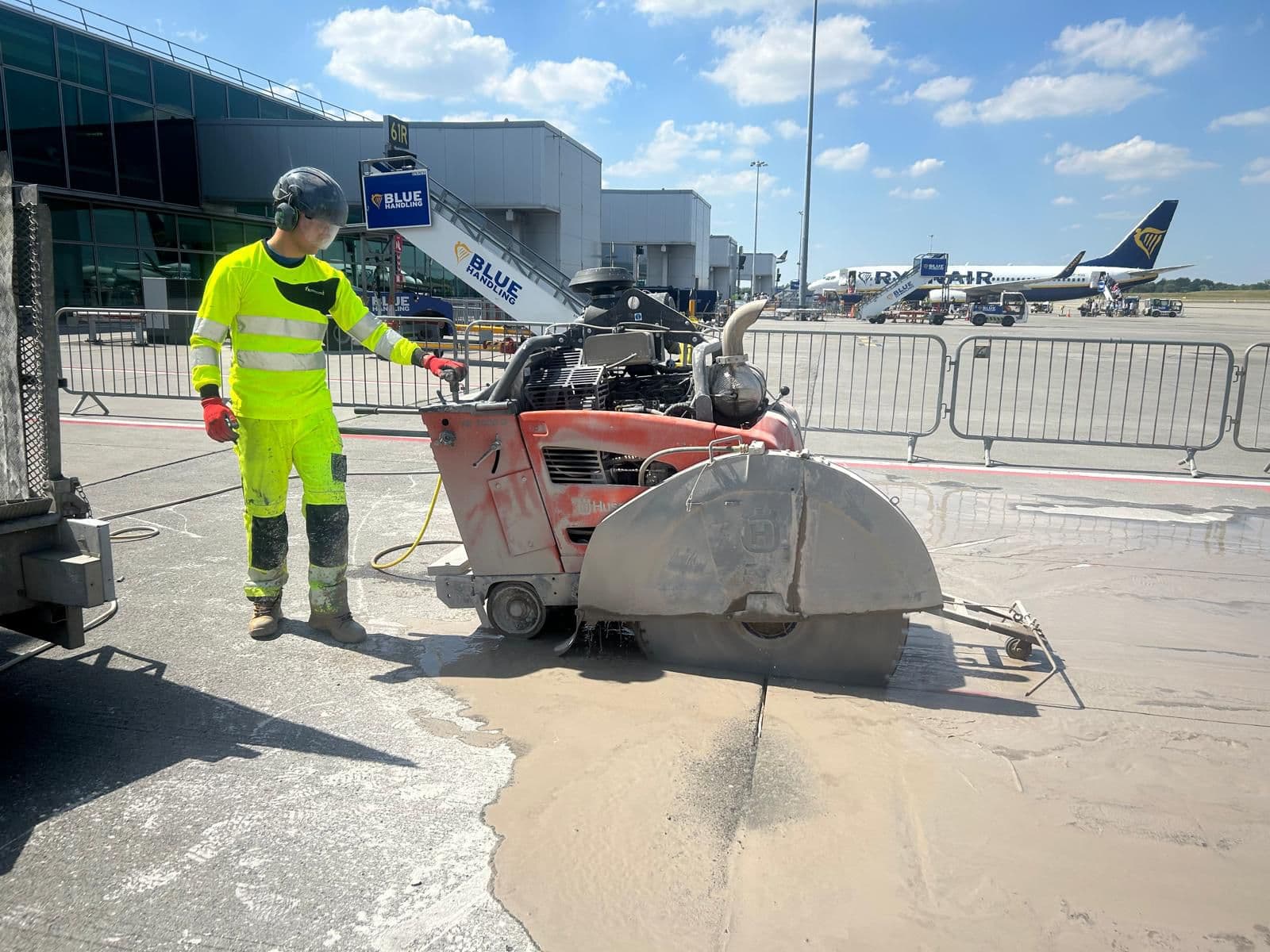
Inside the boundary, work is governed by the airport rather than the borough: escorted access, an airside pass for every operative, a permit for every penetration, and foreign object debris control strict enough that a single core plug left on a surface is a reportable hazard. The window is whatever the airport gives you, usually overnight, and the pavement is handed back serviceable before the first movement. It is the same discipline we apply to airfield surfacing work generally.
Outside the fence, Bedfont is cargo sheds, freight forwarders, hotels and the Bedfont Lakes business park. Those are heavy industrial floor slabs built for forklift and HGV loading, and they are usually cut while the operation continues around them, because a 24 hour logistics building does not close.
What that means for the slab
Airport-adjacent hardstanding is thicker and more heavily reinforced than commercial slab of the same age, and much of it carries buried services that are not on any drawing given to a contractor: fuel lines, ducting, drainage and communications. Coring to prove thickness and locate reinforcement before committing to a cutting method is normal practice here rather than an extra.
Access, hours and plant
The A30 and the airport perimeter roads run at capacity for most of the day, so plant movements are planned for the small hours. Noise is a live issue in the residential parts of East and West Bedfont despite the aircraft, and boroughs treat ground noise differently from air noise. Every diesel saw, generator and compressor we bring into Greater London has to meet Stage IV of the Non-Road Mobile Machinery standard, which became the London-wide minimum on 1 January 2025, and every machine has to be listed on the NRMM register for the site before it turns a blade. Borough enforcement officers do check on site. It is worth asking any contractor quoting for London work to confirm both, because a machine that fails the check is a machine that goes home.
This page is part of our concrete cutting in London coverage. For the service itself, including cut depths, plant and specification, see concrete cutting.