
Shepherd and Sons Ltd
N1 Sealant for High Movement Joints Explained
N1 sealant is the hot applied joint sealant grade classified under BS EN 14188-1 as elastic, high extension. It’s the specification for joints that experience significant thermal expansion and contraction, because the polymer-modified bitumen chemistry stretches and recovers across a wider movement range than the alternative N2 grade without cracking, tearing or losing bond at the joint face. In UK practice, N1 is the standard grade for concrete carriageway joints on motorways and A-roads, airfield taxiway and apron joints, bridge approach joints, and any pavement where the calculated joint movement exceeds what a low extension sealant can absorb.
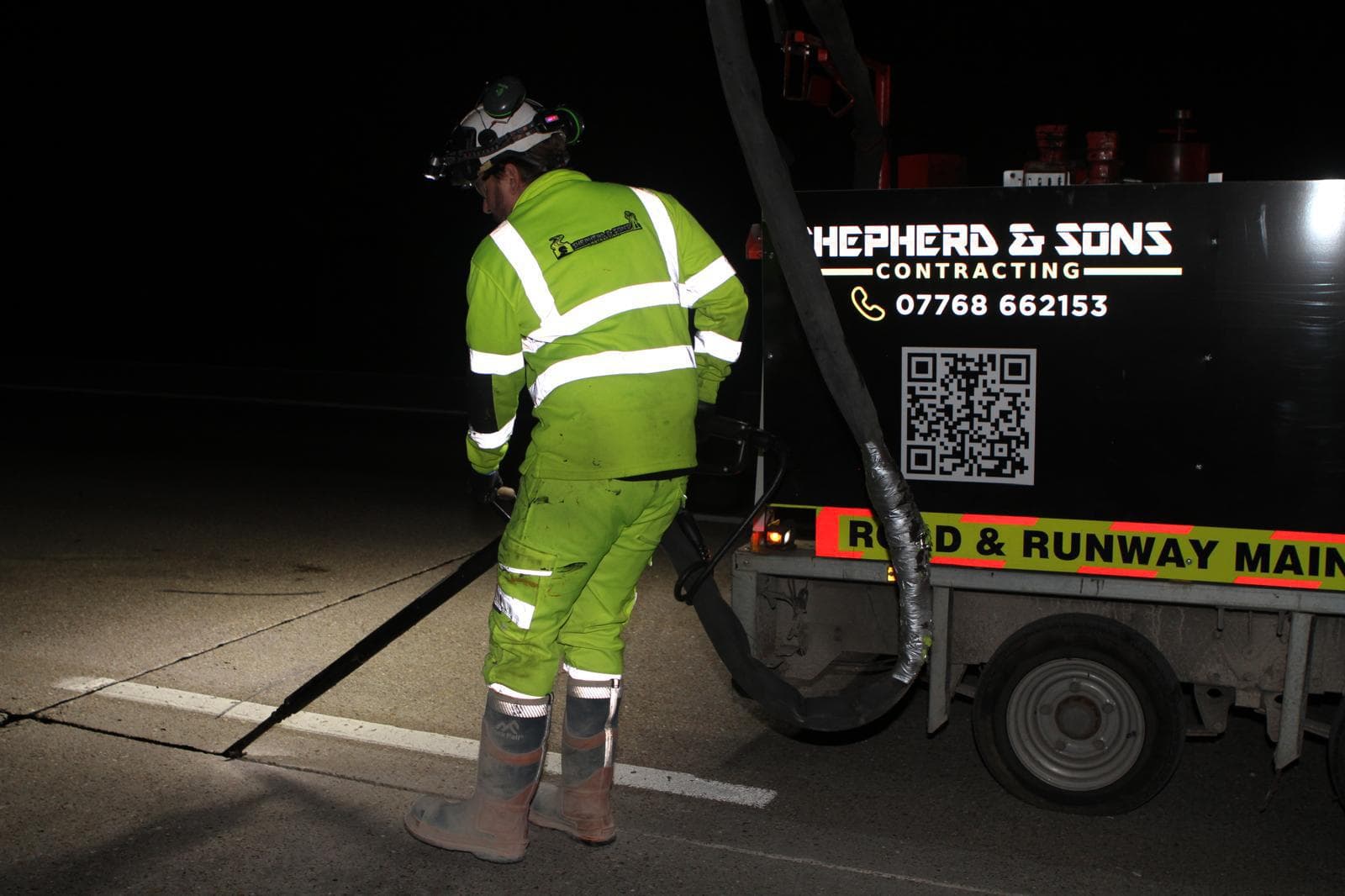
At Shepherd and Sons, we apply N1 hot applied sealant across UK highway, airfield and infrastructure work, with more than 40 years of experience in pavement joint sealing. We’re based at Westerhill Farm in Kent, and we’re members of the Extruded Sealant Association, working to the ESA Code of Practice and BS EN 14188-1. This article explains what high movement actually means in joint terms, why N1 handles it, where high movement joints occur, and how to design and specify around them properly.
What “high movement” actually means
Movement in a pavement joint is not a vague concept. It has a defined measurement, and understanding it is the difference between specifying correctly and guessing.
The ESA Code of Practice defines the movement accommodation factor as the total movement range between maximum compression and maximum extension that a sealant can tolerate, expressed as a percentage of the minimum joint width. So a sealant with a 25% movement accommodation factor in a 20mm joint can handle roughly 5mm of total movement range.
The movement a joint actually experiences depends on four things:
Slab length. Longer slabs move more. A 6m concrete bay expands and contracts significantly more across a full seasonal cycle than a 3m bay, because thermal movement is proportional to length.
Temperature range. UK concrete pavements routinely swing from below freezing in January to surface temperatures well above 40°C in July on dark aggregate in direct sun. That range drives the movement.
Joint type. Expansion joints, which have compressible filler placed full depth between slabs, accommodate the largest movement. Contraction joints, formed by saw cutting to induce controlled cracking, move less. Longitudinal joints between slab edges typically move least of all.
Restraint. Tied joints, where lateral or vertical displacement is restrained but rotation can occur, behave differently to free joints. Base friction and subgrade restraint also reduce the movement that reaches the joint.
From working with clients across the highway and aviation sectors, we’ve found that specifications frequently assign a sealant grade by joint type alone (expansion joint gets one grade, contraction joint gets another) without calculating the actual movement for the slab dimensions on that specific pavement. That approach works until it doesn’t. On long-bay concrete pavements it produces undersized joints and premature sealant failure.
Why N1 handles high movement
The ESA Code of Practice classifies hot applied sealants into two types under BS EN 14188-1:
- Type N1: Elastic, high extension
- Type N2: Normal, low extension
The difference is polymer modification. N1 contains a higher proportion of elastomeric polymer in the bitumen binder, which gives the cured sealant three properties that matter under high movement:
Greater extension capability. The sealant stretches further before cohesive failure. Under the EN 13880 test regime, hot applied sealants are tested to 75% extension across three cycles at -20°C. N1 grades are formulated to survive that cycling; low extension grades are not.
Better elastic recovery. After being stretched, N1 returns closer to its original dimension. This matters because pavement joints cycle continuously. A sealant that stretches but doesn’t recover will progressively thin at the centre of the bead and eventually tear.
Retained flexibility at low temperature. Joints are at maximum extension when it’s coldest, which is exactly when bitumen is hardest and least forgiving. N1 retains more elasticity at low temperature, which is why the extension test is conducted at -20°C rather than at ambient.
Movement accommodation figures vary between manufacturers within the N1 classification, so the specific value should always be confirmed against the product technical data sheet rather than assumed from the grade designation alone.
Where high movement joints occur
Five categories of joint routinely require the high extension performance of N1.
Expansion joints in concrete carriageways. These are the highest movement joints in most pavements, designed specifically to accommodate slab expansion. On motorway and trunk road concrete, expansion joints are the standard N1 application.
Long-bay concrete pavements. Where slab lengths exceed typical dimensions, the accumulated thermal movement at each joint increases proportionally. Older concrete pavements with long bays frequently require N1 even at contraction joints.
Bridge deck and approach joints. Structural movement from thermal expansion, traffic loading and deck articulation combines to produce large movement ranges.
Airfield taxiway and apron joints. Large concrete slabs on airfields see substantial thermal cycling, particularly on aprons exposed to direct sun for extended periods with no shading from surrounding structures.
Pavements with high diurnal temperature swings. Exposed pavements with dark surfacing that heat significantly during the day and cool rapidly overnight produce a larger daily movement cycle than the seasonal average suggests.
In our experience, N1 works better than N2 on expansion joints in long-bay concrete carriageways because the higher extension capability absorbs the full seasonal movement range without fatiguing at the joint walls, where a low extension grade will show progressive cohesive tearing through the centre of the bead within three to five winters. On a Kent concrete carriageway resealing programme, the joints we had to reseal earliest were consistently the expansion joints where a low extension grade had been specified on the original works. The contraction joints on the same pavement, with identical exposure, were still sound.
Joint design for high movement
The sealant grade is only half the specification. The joint geometry determines whether the sealant can actually do its job.
Joint width. A wider joint reduces the percentage strain on the sealant for a given absolute movement. A 5mm movement in a 10mm joint represents 50% strain. The same 5mm movement in a 25mm joint represents 20% strain. Widening the joint is often the more effective route to accommodating high movement than upgrading the sealant grade alone.
Sealant depth and width-to-depth ratio. The sealant needs sufficient depth to develop bond, but excessive depth reduces its ability to stretch. Manufacturer TDS specifications govern the ratio for each product.
Backer rod. A heat-resistant backer rod suitable for hot applied sealants must be caulked into the base of the slot. This controls the sealant depth and, critically, prevents three-sided adhesion. A sealant bonded to the base of the joint as well as both faces cannot stretch properly and will tear under movement. Standard closed-cell polyethylene rod will melt under a hot applied pour, so the heat-resistant grade is essential.
Slot face condition. The ESA Code of Practice requires joint slot faces to be sound dense concrete or asphalt, with the slot widened if defective or contaminated material is encountered. On high movement joints, bond strength is under greater stress, so face preparation matters more, not less.
Sealant recess. The finished sealant level sits below the pavement surface to prevent traffic extrusion damage. The ESA Code specifies a minimum 5mm recess for transverse joints under normal vehicle traffic, increasing to 7mm for joints wider than 25mm and 10mm if applied in cold weather, with a tolerance of ±2mm. Wide high movement joints therefore need a deeper recess than standard joints.
Application discipline for N1 on high movement joints
The application process for N1 follows standard hot applied joint sealing practice, with a few points that carry extra weight on high movement work.
Sealant heating and agitation. N1 is loaded into a thermostatically controlled melter with continuous mechanical agitation, heated to the manufacturer’s specified pour temperature. Overheating degrades the polymer, and it’s the polymer that delivers the extension performance. An overheated N1 sealant is functionally a low extension sealant by the time it reaches the joint.
Hold time discipline. Material held at application temperature beyond the manufacturer’s permitted duration loses polymer performance. We’ve found this is where high movement joint failures most often originate, because the sealant looks identical when poured but no longer performs to grade.
Re-melt rules. Some hot applied sealants are designated re-meltable, others are not. Re-melting non-re-meltable material accelerates polymer degradation. On high movement joints, that degradation shows up as premature cohesive failure well inside the expected service life.
Cooling protection. The joint is protected from traffic until the sealant has cooled and set, typically 30 to 60 minutes depending on ambient temperature and pour depth.
Crossfall management. On pavements with steeper crossfalls, or on wide joints, the sealant can flow along the joint before cooling. The ESA Code requires placing material in thin layers with each layer allowed to stiffen before the next, and completing each joint within one working shift.
When N1 is not the right answer
N1 is the high extension hot applied grade, but it isn’t the answer to every demanding joint.
Fuel and chemical exposure. N1 is classified by extension performance, not chemical resistance. Where joints are exposed to aviation fuel, kerosene, diesel or hydraulic fluid, the specification moves to cold applied systems under BS EN 14188-2 Classes B, C and D, which are tested against Test Fuel I, Test Fuel II and de-icing chemicals. Aircraft fuelling aprons and oil terminals fall into this category.
Indoor and fire-restricted sites. A propane-fired melter cannot be used inside warehouses, multi-storey car parks or food-grade facilities. Cold applied is the only viable option.
Airfield runway specifications. Major aviation pavements frequently specify 9525 hot applied or a high performance specification above standard N1.
Movement beyond hot applied capability. Where calculated movement exceeds what any hot applied grade can accommodate, the answer is either a wider joint or a different sealant technology, not a heroic assumption about N1 performance. For the full comparison between the two hot applied grades and how to choose between them, what’s the difference between N1 and N2 sealant sets out the decision framework.
Standards and compliance
N1 hot applied joint sealing works to:
- BS EN 14188-1 (Type N1 elastic high extension)
- BS 10948:2020 (application and use of hot and cold applied joint sealant systems for concrete pavements)
- SHW Volume 1 Series 1000 (Specification for Highway Works, road pavements, concrete materials)
- Highways England Concrete Pavement Maintenance Manual V1.1
- The ESA Code of Practice for Joint Sealing (Issue 3.0, November 2025)
The ESA Code requires sample testing at three stages: at the factory, from packages on delivery, and on site. For hot applied sealant, test samples are retained at not less than one per 1,000m of joint, or one per day. Depth measurements are taken at three locations along each transverse joint, mid-width, to an accuracy of ±0.5mm using a metal ruler and 150mm straightedge.
Sectors where N1 high movement work is specified
Highway authorities and Tier 1 contractors are the largest specifiers, using N1 on concrete carriageway expansion joints, long-bay pavements and bridge approach work. Aviation clients specify N1 on taxiway and apron joints where thermal cycling is significant but fuel exposure is limited. Port operators use N1 on dockside concrete pavements away from bunker and fuel handling zones. Public sector clients specify N1 on depot pavements, bus stations and infrastructure concrete.
We’ve delivered hot applied joint sealing across these sectors, with N1 accounting for roughly three quarters of the work because of the extension range modern concrete pavement design requires.
Specifying N1 for high movement joints properly
A meaningful specification will identify the grade, the calculated joint movement range for the actual slab dimensions, the joint width and depth, the backer rod type and size, the linear metres, the recess depth, the programme and cooling window, and the QC sampling rate. A specification that lists “N1 sealant” without the movement calculation behind it is a product selection, not a joint design.
If you’re specifying or commissioning joint sealing work on high movement joints and want to confirm the grade, geometry and movement calculation, get in touch. We’ll assess the pavement, the slab dimensions, the exposure and the movement range, and specify against the ESA Code of Practice. You can see recent project work on our LinkedIn and Instagram.
More on Joint Sealing
 Joint Sealing
What’s the Difference Between N1 and N2 Sealant?
Read More » Joint Sealing
Sika Installers
Read More »- Joint Sealing
What is Sikaflex?
Read More »  Joint Sealing
What is Thioflex 600?
Read More » Joint Sealing
What are the benefits of Thioflex 555
Read More » Joint Sealing
What is hot applied joint sealing?
Read More »