
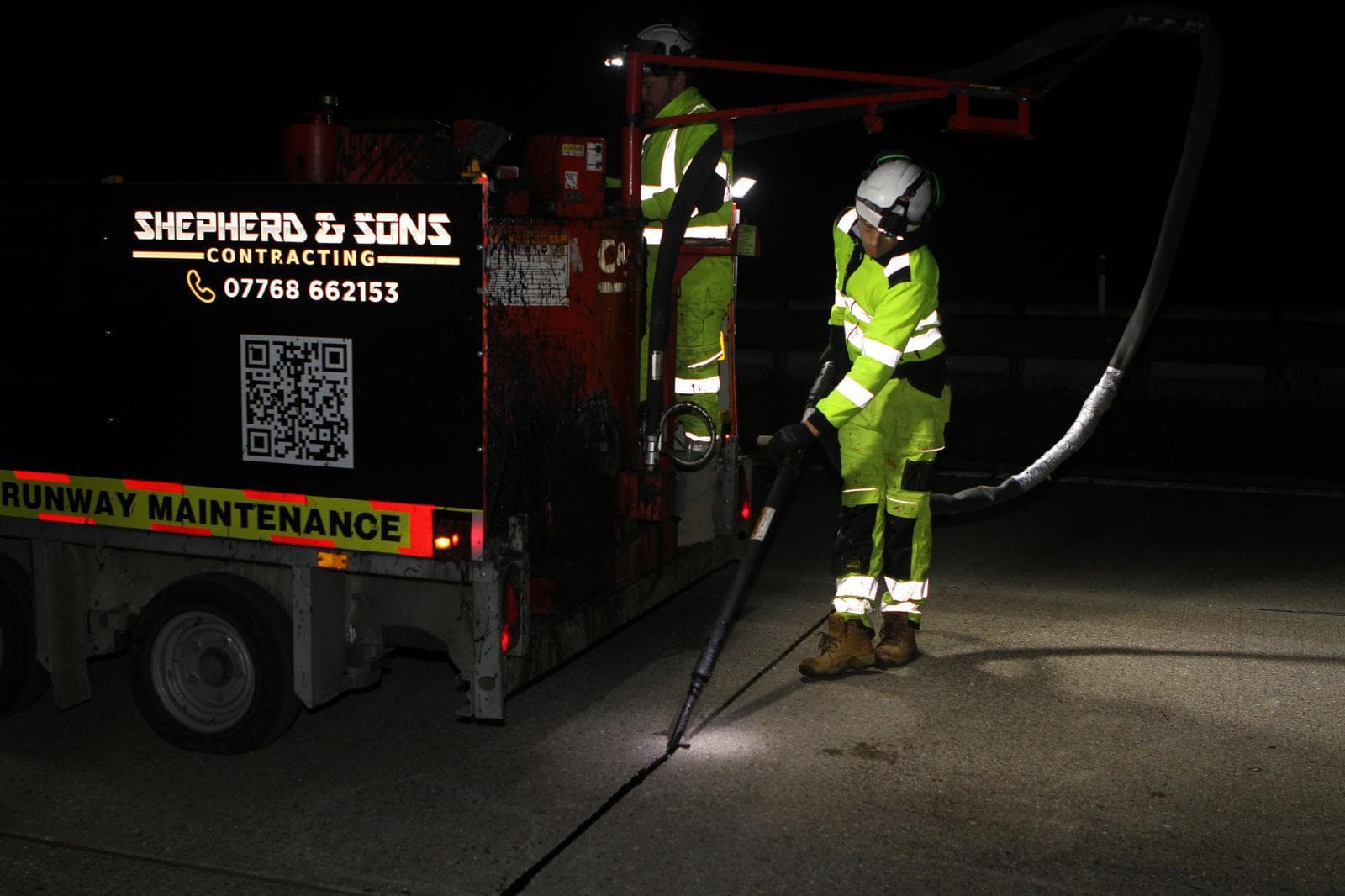
We provide floor sawing across Essex, cutting to 625mm in concrete and asphalt alike. What makes Essex different from most counties is what the slabs are for. This is port and freight country. The concrete sits at the thick end of the range. It is built to take point loads rather than lorries. That changes the saw, the blade and the programme.
At Shepherd and Sons we have completed more than 300 cutting and drilling projects across the UK in the past six years. Essex is reached from our yard near Maidstone across the Dartford Crossing, which is a genuine part of the planning rather than a detail. From working with clients on the estuary terminals and at Stansted, we've found a pattern. The jobs that go wrong are the ones priced as though the slab were an ordinary warehouse floor.
Why Essex slabs sit at the thick end
A typical industrial floor runs 150 to 250mm. Port hardstanding runs 250 to 400mm, and it is reinforced accordingly.
The reason is the plant that stands on it. London Gateway is a deep-water container terminal handling close to two million TEU a year, laid out for straddle carriers and rubber-tyred gantries. Tilbury sits on the same bank, and both are tax sites within Thames Freeport. Those machines concentrate very high loads onto small contact patches. The pavement is therefore designed around point loading, not the spread axle loads a highway sees.
For a floor saw that means two things. The cut is deeper, and the concrete is harder work per metre. A quote built on warehouse assumptions will be wrong on both counts.
Where 625mm is comfortable, and where it stops
A floor saw reaches roughly just under half its blade diameter, so a 900mm blade gives 360 to 420mm. Our own working maximum is 625mm, and it holds for concrete and asphalt. Where a slab can be reached from both faces, the workable thickness roughly doubles. On a terminal apron there is usually no underside to get to, so one pass is what you have.
Against Essex slabs, that covers port hardstanding at 250 to 400mm and bridge decks at 200 to 400mm comfortably. It runs out on the heaviest terminal aprons and on anything approaching runway thickness. Past that point the answer is wire sawing rather than a bigger saw, because depth is set by blade diameter and not by engine power. How floor sawing works is the same everywhere; what changes county to county is what you are cutting into.
Dowel bars change the cut more than mesh does
Heavy-duty concrete is usually laid in bays with dowel bars across the joints. The dowels transfer load from one slab to the next so the bays move together under a wheel rather than stepping.
That matters to a saw. Mesh is a spread of thin bar and a blade works through it steadily. A dowel is a solid round bar, often 20 to 25mm, sitting exactly where a joint cut wants to go. Hitting one unexpectedly slows the cut, costs segments and can pull a blade off line.
So on heavy-duty slabs the joint layout has to be established before cutting, not discovered during it. Where drawings are missing, a scan is cheaper than a wrecked blade and a lost afternoon.
Where a bay has to come out whole, the cut runs alongside the dowels rather than through them. The bay is then lifted rather than broken. That keeps the adjacent slabs intact, and their load transfer with them.
The A12 corridor and the estuary
Away from the terminals, the county's concrete is concentrated on its roads. The A12 in particular carries north-east Essex on a corridor of ageing concrete and bridge structures. Ageing concrete means bay repairs, joint work and cutting out failed sections.
That work is night possession work, handed back before the morning. It sits alongside the port and dockside work rather than competing with it. The two together are most of what we are called into Essex for.
Working on a live terminal
A container terminal does not close because you have a slab to cut. The work happens in a fenced-off area inside a yard that is still running.
That means a permit, an induction and usually an escort. It also means an exclusion zone a straddle carrier driver can see and understand. The machines are tall, the sightlines are poor, and the driver is not looking for a floor saw. Deliveries and plant movements carry on around you.
We've found the constraint is rarely the cutting itself. It is how much of the yard the operator will give up, and for how long. That gets agreed before mobilisation, not on the day.
Salt is why the seal matters more here
An estuary pavement is a chloride environment. Water that gets into a cut on the Thames bank is carrying salt. Salt attacks the reinforcement rather than the concrete.
That makes reinstatement the part that decides how long a repair lasts. A cut sealed properly keeps water out of the slab. A cut left open, or sealed with something that fails in a season, is a route straight to the bar.
Stansted and the airside regime
Stansted is the county's aviation driver. It is also one of the seven former BAA airports we work across, as sole contractor for the British Airport Authority since 2008.
We are currently part of a ten-week programme there with Lagan Aviation and Infrastructure, coring out 150 airfield ground lighting seating pots inside restricted overnight possessions. That is coring rather than sawing, but the discipline is the same one the sawing runs under. Escorted access, a fixed handback time, and a surface swept clear of foreign object debris before the first movement.
The Dartford Crossing is part of the programme
Essex is close to us in miles and further in practice. The crossing is the only fixed point on the route, and it does not care about the start time on a programme.
In our experience, booking an Essex start for after the morning peak works better than a nominal eight o'clock. The crossing decides your arrival time, not the schedule. A crew sitting in a queue is a crew being paid to sit in a queue. Night possessions sidestep the problem entirely, which is one reason much of our Essex work runs after dark.
What to check before appointing anyone
- Has the slab thickness been established, or assumed from the building type?
- Is the joint and dowel layout known, and has anything been scanned?
- Does the price cover cutting only, or cutting and reinstatement?
- Are operatives NVQ Level 2 in cutting and drilling, with CSCS cards and Drilling and Sawing Association competence?
- For terminal work, who is arranging the permit and the escort?
Cutting is rarely the whole job. A cut left open lets water into the slab, and on a port pavement that water is carrying salt. The joint sealing that follows is part of the same operation, and we deliver both with the same team.
Essex sits inside the wider South East area we cover from the Kent yard, alongside our drilling work in the county. For floor sawing and concrete cutting anywhere in Essex, get in touch with our team.
More on Concrete Cutting
 Concrete Cutting
Port Concrete Cutting in Kent
Read More » Concrete Cutting
What is Core Drilling?
Read More » Concrete Cutting
Floor Sawing Services in Kent
Read More »- Concrete Cutting
Concrete Cutting in London
Read More »  Concrete Cutting
What is floor sawing?
Read More »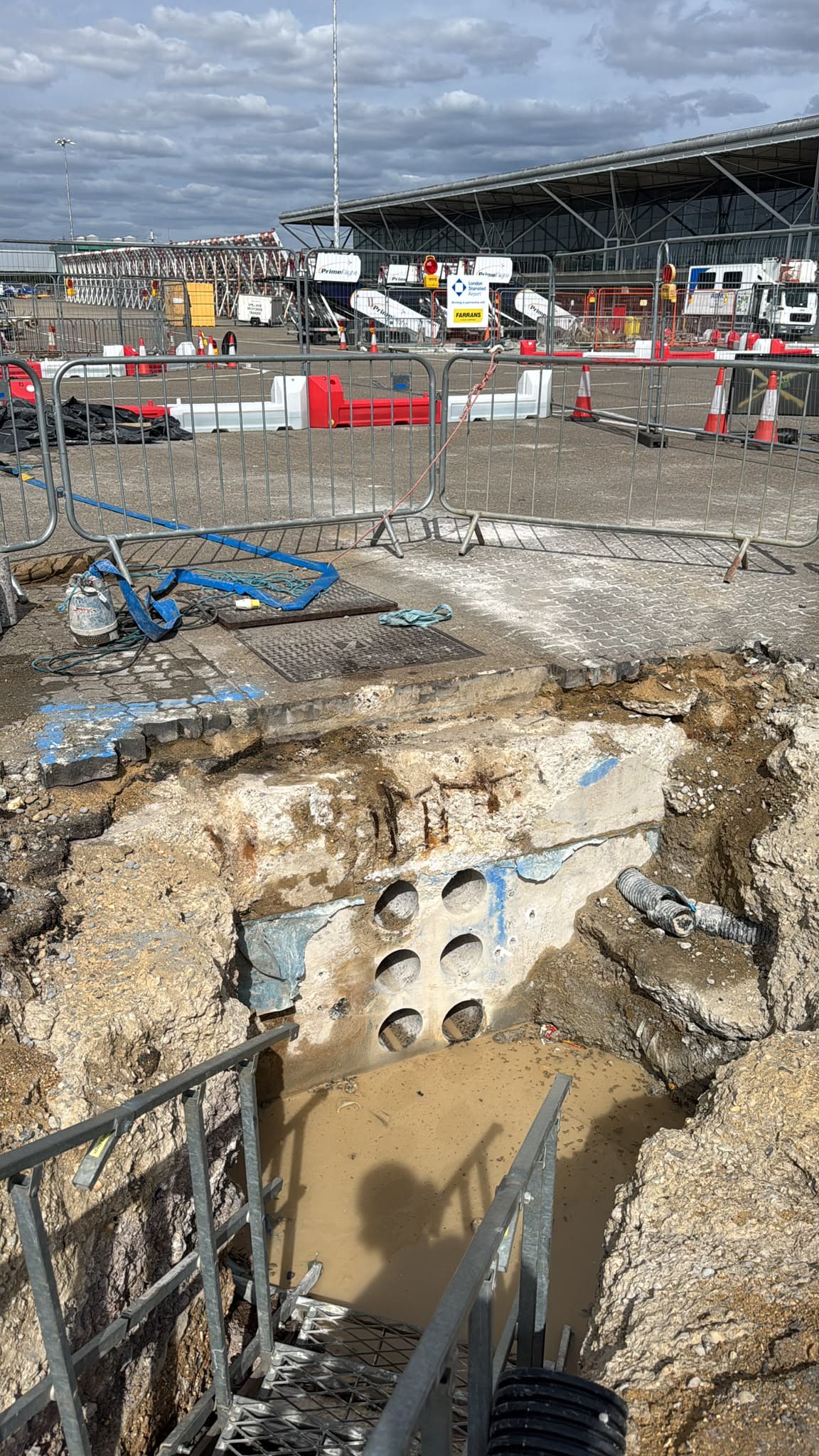 Concrete Cutting
Diamond Drilling Contractors in Kent
Read More »