Service
Floor Sawing
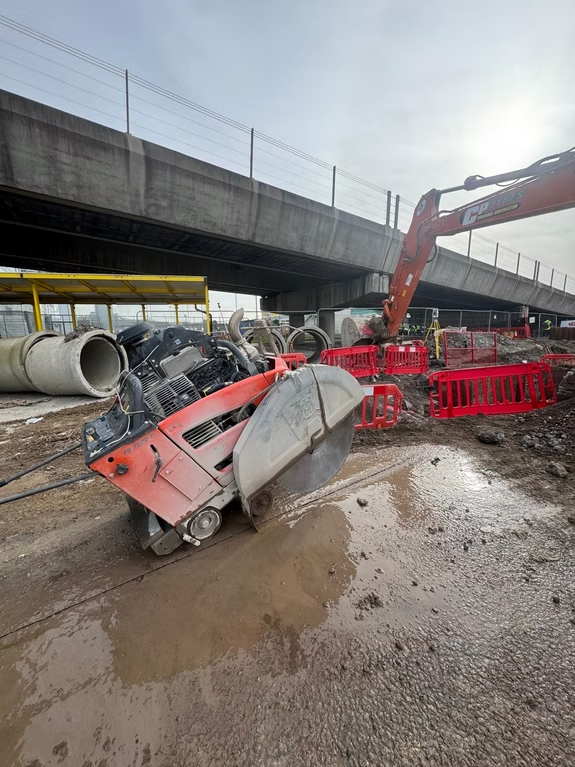
Floor sawing is the horizontal cutting of concrete and asphalt with a large diamond blade on a walk-behind or self-propelled saw. It is how joints are formed and reformed, how failed bays are cut out for replacement, how service trenches are opened across a slab, and how airfield and highway pavements are cut inside a possession. Our working maximum is 625mm in one pass, in concrete and asphalt alike.
What we use it for
- Joint forming and reforming on concrete carriageways and airfield pavements, cut to the width and depth the sealant needs, with the faces within 10 degrees of vertical as the ESA Code of Practice asks.
- Bay removal, cutting round a failed slab so it lifts out as a clean panel without disturbing its neighbours. See full depth sawing.
- Service trenches for drainage, ducting, fuel mains and fibre, cut as two parallel lines and reinstated afterwards.
- Openings in floors and hardstanding for pits, plinths and new drainage, such as the channels, pits and trenches cut to 300mm for the Stansted terminal extension.
Depth, and where a floor saw stops
Depth follows blade diameter, at a little under half of it. Our working maximum of 625mm covers nearly all UK highway concrete (typically 200 to 350mm), port hardstanding (250 to 400mm) and industrial floors. Airfield aprons and taxiways, at 300 to 500mm, are the one category that can need more than a single pass. Past that the job becomes wire sawing, and where the cut runs vertically or overhead it is wall sawing.
A saw quoted as cutting much deeper than 625mm in one pass is a different method under a familiar name, with a different rate and crew, so it is worth comparing like with like. There is more in how deep can you cut concrete?
Diesel outside, electric inside
Diesel saws give the torque for deep cuts through heavy reinforcement on highways, airfields and port yards. Inside warehouses, food production sites, hospitals and occupied buildings an electric saw is the only sensible choice. In Greater London, plant above 37kW has to meet Stage IV of the Non-Road Mobile Machinery standard and be registered for the site; most floor saws fall below that threshold, but the generator and support plant beside them often do not.
Reinforcement and dowels
Heavy-duty concrete is laid in bays with dowel bars across the joints, and a dowel sits exactly where a joint cut wants to go. Hitting one unexpectedly slows the cut, eats segments and can pull the blade off line, so the joint and dowel layout and any embedded services are established before cutting rather than found during it. The blade is chosen for the reinforcement actually in the slab, not for a headline depth.
Wet cutting and slurry
We cut wet as standard. Water cools the blade, flushes the cut and keeps respirable silica down, which is what HSE guidance expects. The by-product is an alkaline slurry that must not go into a gully or drain, so vacuum recovery at the blade and a disposal route are agreed in the method statement before the first cut.
Night possessions, and the sealing that follows
On highways and airfields most floor sawing happens inside a possession. On the M20 between junctions 8 and 9 the window was 10pm to 3:30am, and 20 night shifts produced 23,304 linear metres of reformed and resealed joint. The nightly rate is set by how much can be sawn, dried, blasted, backed and sealed before the road reopens, not by how fast the saw runs, which is why we programme the sawing and the joint sealing as one operation with one team.
Before you appoint anyone
- Is the possession window still real once traffic management goes in and comes out?
- Has the joint, dowel and services layout been established before cutting?
- Where is the slurry going, and is the disposal route agreed?
- Is the sealing programmed with the sawing, or is it a second appointment?
- Are operatives NVQ Level 2 in cutting and drilling, with CSCS cards and Drilling and Sawing Association competence?
Floor sawing in your area
We work from Little Westerhill Farm near Maidstone. See floor sawing in Kent, Essex and Greater London, or read what floor sawing is and how it works.
For floor sawing on highways, airfields, ports or industrial floors, get in touch with our team.