
Shepherd and Sons Ltd
Diamond Drilling in Essex
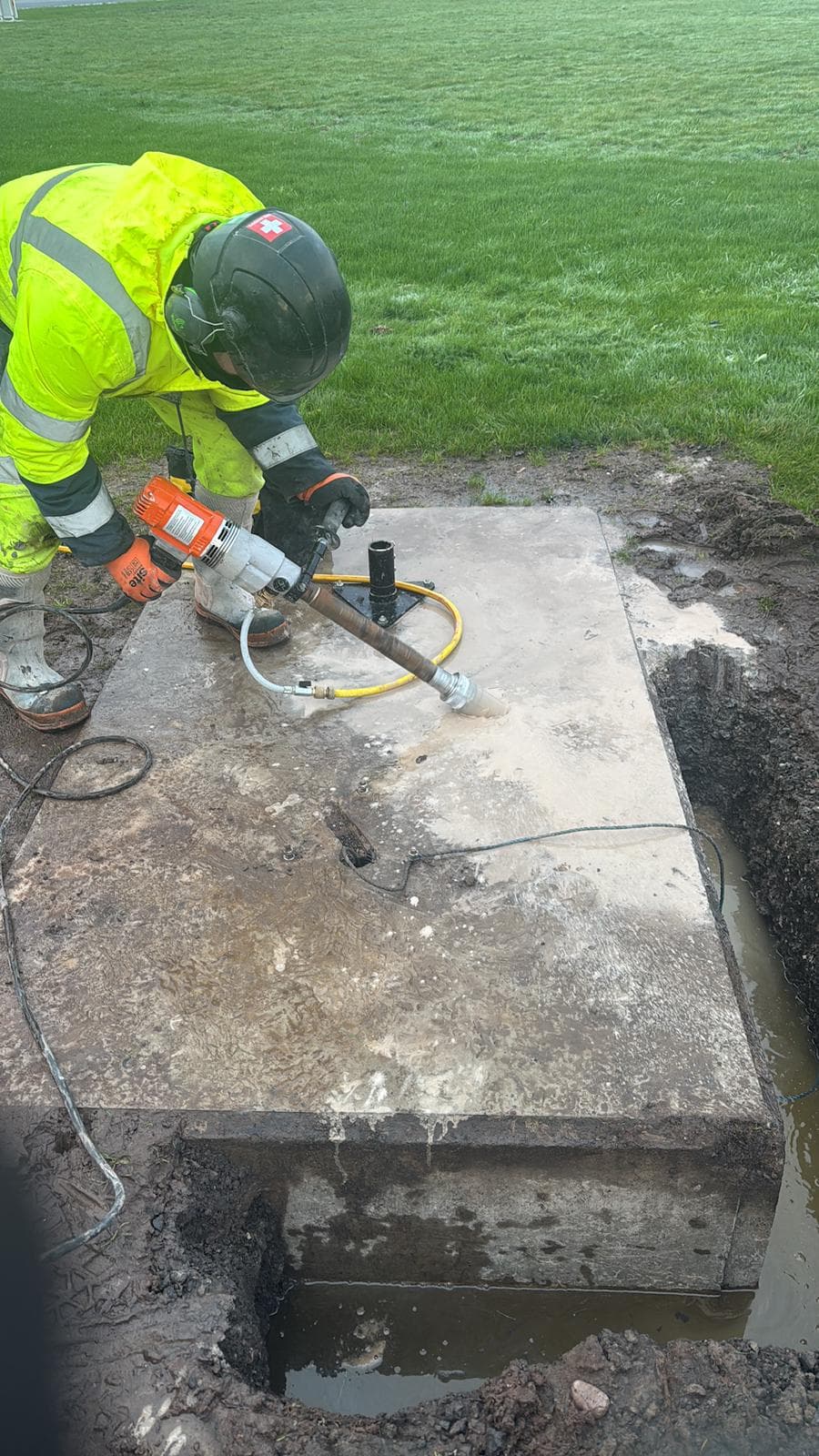
Diamond drilling in Essex is mostly done inside places that do not stop for you. The Thames Freeport terminals run to vessel calls rather than office hours. Stansted runs to possessions that do not move. In both, the reason drilling gets specified over cutting or breaking is the same. It is the method that leaves everything around the hole undisturbed.
At Shepherd and Sons we reach Essex from our yard near Maidstone across the Dartford Crossing. From working with clients on the north bank of the Thames and at Stansted, we've found the drilling is rarely the hard part of an Essex job. Getting permission to stand where the hole is, and keeping the operation running around you, is.
Where you cannot break out at all
Percussive breaking is ruled out more often in Essex than most counties, because so much of the work sits next to something live.
On a container terminal that means buried services, drainage and power runs under a surface that handling plant is still crossing. On an airfield it means fuel mains, lighting circuits and communications below the pavement.
Where breaking is not permitted, the cut line is formed as a row of overlapping cores and the sections lifted clear. That is stitch drilling. It leaves the surrounding concrete intact, produces cores that can be counted out and removed, and can be stopped and made safe at any point.
It is slower than breaking and considerably more expensive. It is also, frequently, the only method that will be signed off. In our experience, establishing whether breaking is permitted before pricing works better than assuming it is. The two methods are not close on cost, and the answer is rarely the contractor's to give.
Stansted, and coring at programme scale
Stansted is the county's aviation driver. It is one of the seven former BAA airports we work across, as sole contractor for the British Airport Authority since 2008.
We are currently part of a ten-week programme there with Lagan Aviation and Infrastructure. Our part is coring out 150 airfield ground lighting seating pots, inside restricted overnight possessions on a live operational airfield.
The arithmetic is what makes that a programme rather than a series of jobs. 150 pots across ten weeks of restricted possessions means a nightly rate has to be set and then held. A night that under-delivers has to be recovered from a later one.
A seating pot is cored rather than broken out for a specific reason. A percussive break-out fractures concrete beyond the intended line, and on an airfield pavement that turns a fitting replacement into a bay repair. A clean core leaves a sound, square shoulder for the new base to be grouted into.
The other airside constraint is what is left behind. A fragment of concrete on a taxiway is a hazard to an engine, not untidiness, so the sweep and the debris check are programmed operations with time allowed for them. A shift that cores well and hands back dirty has not finished.
Working inside a terminal that does not close
London Gateway and the Port of Tilbury both sit on the Essex bank, and both are tax sites within Thames Freeport. Neither closes because you have holes to drill.
The work happens in a fenced-off area inside a yard that is still running. That means a permit, an induction and usually an escort.
It also means an exclusion zone a straddle carrier driver can see and understand. Those machines are tall, the sightlines are poor, and the driver is not looking for a drilling rig.
We've found the constraint is rarely the drilling itself. It is how much of the yard the operator will give up, and for how long. That gets agreed before mobilisation rather than on the day.
Anchoring the rig is the practical follow-on. A vacuum base is quick, but it needs a smooth, sound, non-porous surface to hold on, and a weathered terminal apron rarely gives one. A seal that creeps mid-core binds the barrel. On a surface that has to be handed back serviceable, setting a bolt-down base costs a few minutes and buys certainty, which is usually the right trade.
The concrete is heavier than most counties
Port hardstanding runs 250 to 400mm and is reinforced accordingly. It is designed around the point loads of straddle carriers and rubber-tyred gantries rather than the spread axle loads a highway sees.
That changes drilling in two ways. The barrel is in the hole longer, and it meets more steel on the way through.
Depth is not the limit, because barrels extend sequentially as the hole deepens. What the reinforcement changes is the rate, and the rate is what a programme is built on.
Where drawings are unavailable, which on older terminal aprons is common, scanning before drilling is cheaper than meeting a service. It shows the reinforcement, so holes can be set out between bars rather than through them, and it shows the ducts and drainage that a yard accumulates over forty years of alterations.
What the diameter is for
Essex work spans most of the range, and the size of the barrel tells you what the hole is doing.
- Roughly 10 to 50mm: anchor and fixing holes, resin anchors, conduit, gantry and balustrade fixings.
- Roughly 50 to 200mm: service penetrations through slabs and walls for drainage, cable and ventilation.
- 100 and 150mm specifically: test cores taken for compressive strength, carbonation and chloride content.
- 300mm and above: manhole and shaft formation, and coring out seating pots for airfield lighting.
On the estuary the chloride test earns its keep. Salt attacks the reinforcement rather than the concrete around it, so a core taken from a terminal apron is often being read for what it says about the next decade rather than the current strength. There is more on core drilling and on how diamond drilling works in general.
The two sectors this covers in Essex are ports and aviation, and they ask for opposite things. A terminal wants the yard back in service and cares about hours. An airfield wants the pavement back to tolerance and cares about millimetres.
The road network, and the crossing
Away from the water, the M25, M11, A12, A13 and A127 all sit within mobilisation range. The A12 in particular carries north-east Essex on a corridor of ageing concrete and bridge structures. That brings drilling for dowels, drainage connections and gantry foundations, generally under night possession.
The Dartford Crossing is the only fixed point on the route in, and it does not care about the start time on a programme. Booking an Essex start for after the morning peak beats a nominal eight o'clock, and night possessions sidestep the problem entirely.
What to check before appointing anyone
- Is breaking permitted, or does the job need stitch drilling? That decides the price.
- Who arranges the permit and the escort on a terminal?
- Has the slab been scanned, or is the reinforcement being assumed?
- How is the rig anchored, given a brushed or weathered surface will not hold a vacuum base?
- What nightly rate is committed to, and how is a lost night recovered?
For diamond drilling across Essex, on terminals, at Stansted or on the A12 corridor, get in touch with our team.
Diamond Drilling in Essex
 Concrete Cutting
Port Concrete Cutting in Kent
Read More »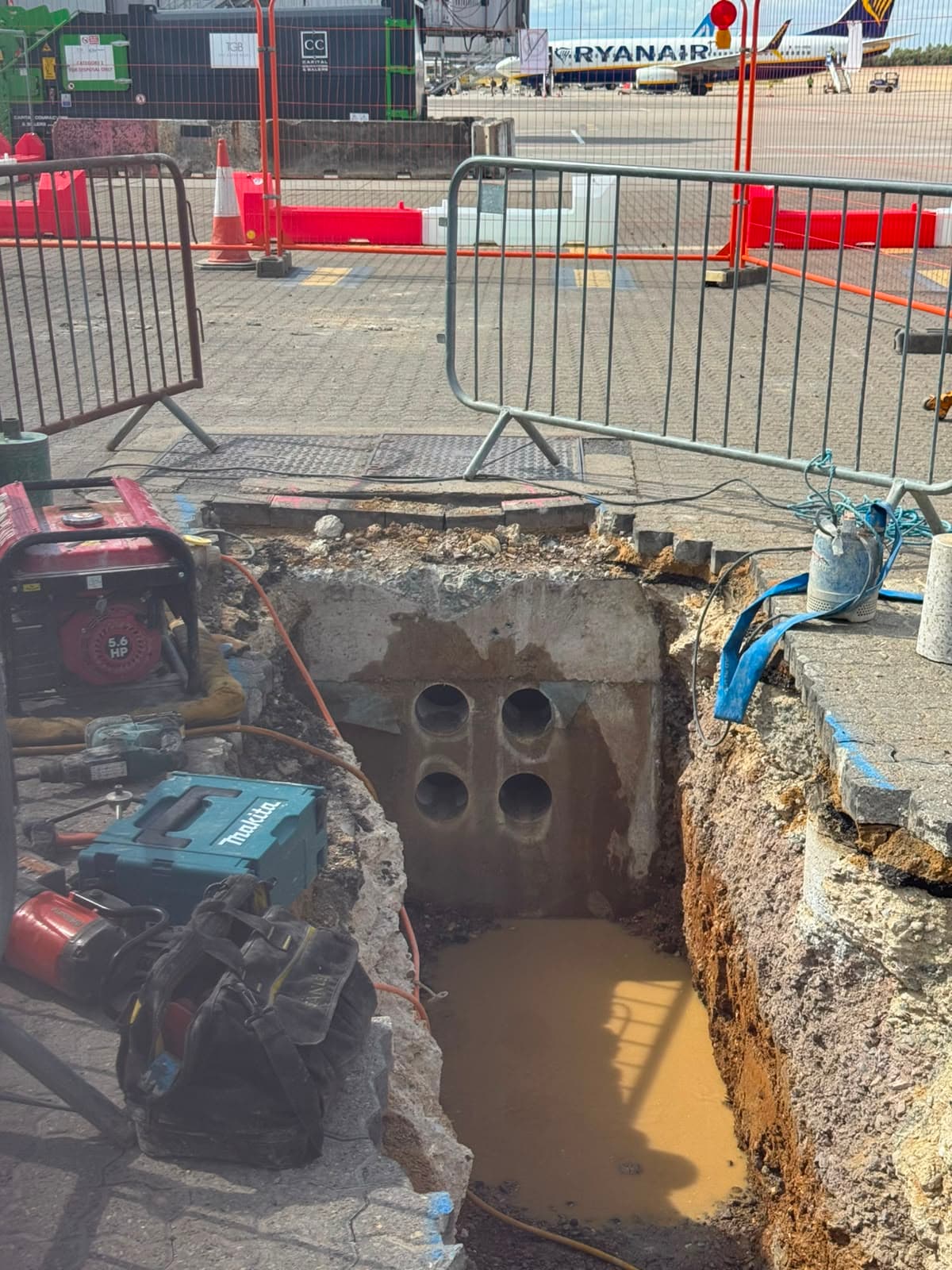 Concrete Cutting
What is Core Drilling?
Read More » Concrete Cutting
Floor Sawing Services in Kent
Read More »- Concrete Cutting
Concrete Cutting in London
Read More »  Concrete Cutting
What is floor sawing?
Read More » Concrete Cutting
Diamond Drilling Contractors in Kent
Read More »