
Service
Concrete Cutting Contractors in Kent
We are concrete cutting contractors based in Kent, at Little Westerhill Farm in Linton, a few minutes south of Maidstone. That is where the plant lives and where a crew starts the day. Kent is not a county we travel to. It is the one we work outward from, and that changes what is possible here in ways worth being specific about.
On the county's airfields, ports and trunk roads, the questions that matter are rarely about the saw. They are about who turns up, how quickly, and whether the same firm can finish the job after the cut. At Shepherd and Sons the answer to all three starts with the yard being here.
What being based here actually changes
Three things, and none of them is marketing.
Response. A crew that starts the day in Linton can be on a Kent site before the traffic builds. That is not true of work we take on in Surrey or the far side of London, and we say so on those pages.
Plant. Owning the saws rather than hiring them means the right machine goes on the lorry, rather than the one the hire yard had free. On a job where the slab turns out thicker than the drawing said, that is the difference between finishing and returning.
Scope. Cutting is rarely the whole job. A cut left open is a route for water into the slab. The sealing or reinstatement that follows therefore matters as much as the cut itself. We do both with the same team, which removes a handover that otherwise sits unowned.
The M20, and what a Kent night shift looks like
The clearest example of Kent work we can point at is the M20 between junctions 8 and 9, coastbound. It covers roughly 20 kilometres of concrete carriageway.
A concrete carriageway is a run of slabs, and the joints between them open and close with temperature. The sealant in those joints has a service life much shorter than the concrete. Once it hardens, debonds or is ploughed out by traffic, water reaches the sub-base and the slab edges begin to spall.
Over 20 kilometres that is not a defect to patch. It is a programme, and it ran as one: 20 night shifts producing 23,304 linear metres of reformed and resealed joint.
The window was 10pm to 3:30am. Five and a half hours on paper, with traffic management going in and coming out inside that, so the productive part is shorter again. Every operation has to be sequenced so nothing is left open when the road reopens.
The sequence itself is fixed, and each step depends on the one before it finishing properly:
- Saw cut the existing joint to reform it to the correct width and depth.
- Remove the old sealant and any spalled material from the joint faces.
- Clean and dry the joint, because a damp face will not bond.
- Prime the faces where the sealant system calls for it.
- Install the backing material to set the depth of the seal.
- Apply and finish the sealant, then hand back the lane.
Every one of those has to be closed out before the cones come off. That is the constraint people underestimate. Sawing 1,200 metres in a night is straightforward. Sawing only as much as can also be cleaned, primed, backed and sealed before 3:30am is the actual job, and it is what sets the nightly rate.
That same stretch is where Operation Brock is deployed when cross-Channel traffic backs up, running the contraflow between junctions 8 and 9. Working the M20 in Kent means planning around a road that periodically changes shape, which is a local constraint rather than a general one.
The four kinds of work Kent produces
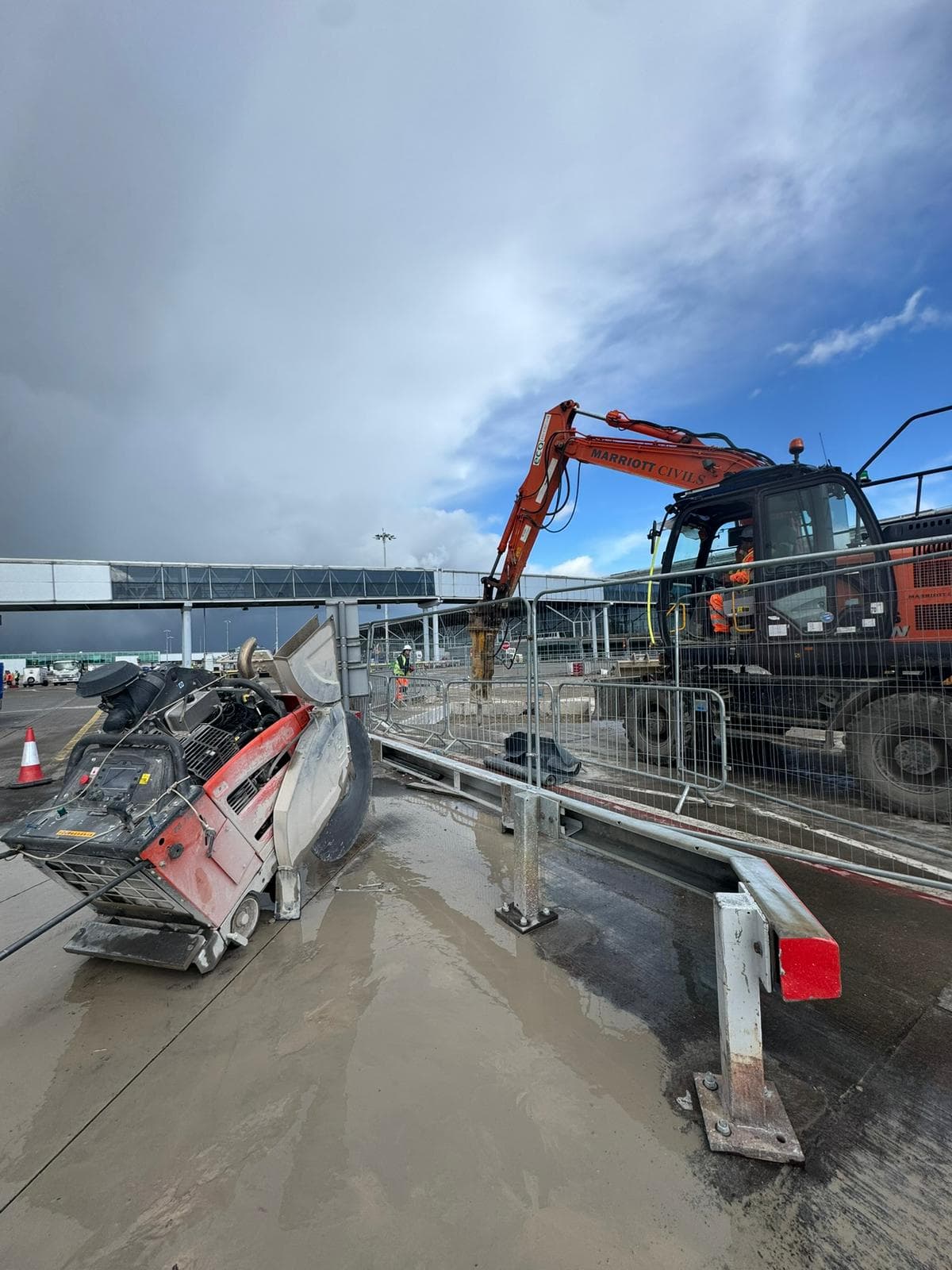
Aviation is the specialism underneath everything. We have been sole contractor for the British Airport Authority since 2008, working across all seven former BAA airports. The discipline that comes from airside work sets the standard for the rest.
Highway is the largest share by volume. The M20, M2, A20, A2 and A21 all run through the county. Concrete carriageway means joint reformation, slab replacement and drainage work under night possession.
Ports are what the Kent coast gives you that most counties do not. Sheerness, Ramsgate and Dover all bring heavy-duty hardstanding, laid for point loads rather than lorry axles, and thicker than an ordinary industrial floor.
Public sector work fills the rest: council depots, school car parks, vehicle workshops and training facilities. It carries the tightest constraints on noise and hours, because the buildings stay in use.
Which method, and why it is not one machine
Concrete cutting is a family of techniques rather than a single one, and the right question is which of them a job needs.
- Floor sawing for horizontal surfaces: carriageways, slabs, aprons and hardstanding. Our working maximum is 625mm.
- Wall and track sawing for vertical, horizontal and overhead planes, and for forming openings to line.
- Wire sawing where the section is beyond what a blade reaches from both faces, or where vibration rules a disc out.
- Diamond drilling for holes, penetrations and test cores.
- Stitch drilling, a line of overlapping cores, where mechanical breaking is not permitted at all.
In our experience, appointing one contractor who runs all of them works better than shortlisting on price for a single method. Most real jobs need two or three, and every interface between firms is somewhere a programme slips. How deep a saw can reach is set by blade diameter rather than by engine power. A contractor quoting a bigger number is usually describing a different method.
The Kent slab thicknesses that decide this in practice are narrower than people assume. Industrial floors run 150 to 250mm. Highway concrete runs 200 to 350mm. Bridge decks run 200 to 400mm. Only airfield aprons and taxiways, at 300 to 500mm, reach past a floor saw in a single pass, and that is exactly where the county's aviation work sits.
What to ask before appointing anyone
- Where is the yard, and where does the crew actually start the day?
- Is the plant owned or hired in, and what happens if the slab is thicker than the drawing?
- Who surveys the slab for embedded services, and when?
- Are operatives NVQ Level 2 in cutting and drilling, with CSCS cards and Drilling and Sawing Association competence?
- Can the same firm seal and reinstate afterwards, or does that need a second appointment?
The first and last are the ones that separate contractors. A registered office in the county tells you nothing about where the plant sleeps. A firm that only cuts leaves you holding the interface with whoever seals.
The survey question deserves more weight than it usually gets. A slab that has been in service for decades rarely matches its drawing. Services get added, ducts get diverted, and the record does not always follow. Scanning before the blade goes in costs an hour. Cutting a live cable costs a great deal more than that, and on a site that stays occupied it costs it twice.
For concrete cutting anywhere in Kent, from Maidstone out to the coast, get in touch with our team. The wider picture of how we work across the county sits alongside it.