Shepherd and Sons Ltd
CLASSIFIED NAME PROJECT
Shepherd and Sons
ABOUT THIS PROJECT
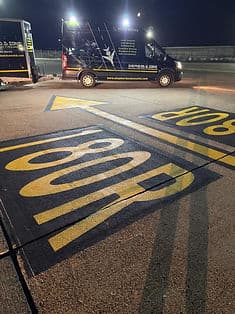
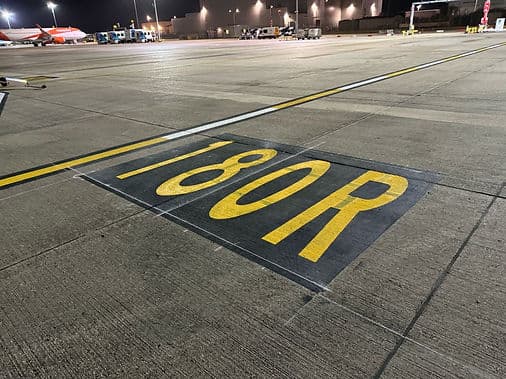
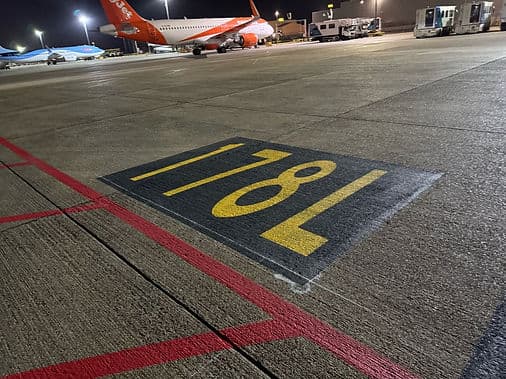
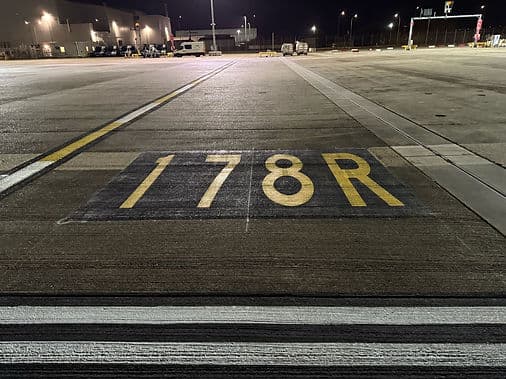
Shepherd & Son’s worked alongside Road Grip to complete an aircraft stand reconstruction project for Dyer and Butler.
Using the Graco Line Lazer, one part epoxy paint, and chalk lines, we completed…
- 5 Taxiway Lead On Arrows (2 Meter)
- 5 Taxiway Lead On’s
- 15 Black Box Backgrounds
- 54 – 2 Meter Stencils
- 4 Meter Taxi Stand Letters (Free Hand)
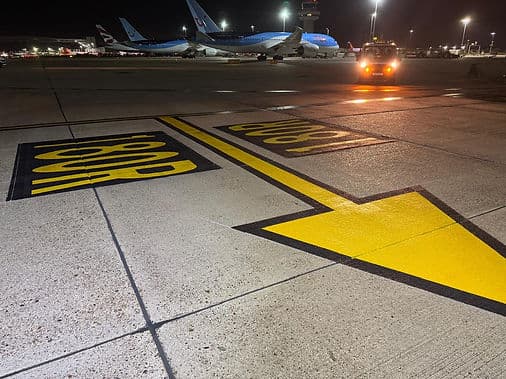
Here’s a few photos from the works!
Why the name is withheld
The client has not cleared the site name for publication, so we do not use it. The work is described exactly as it was done.
Aircraft stand marking, and why epoxy
An aircraft stand reconstruction ends with the markings that make the stand usable, and airside marking is not road marking. One part epoxy is used here rather than thermoplastic because it bonds to concrete, resists jet blast and spilt fuel, and lays a thin, hard film that will not pick up under a turning tyre. Applied with a Graco Line Lazer for the linework and set out from chalk lines beforehand, because on a stand the geometry has to be right before any paint is laid: a lead-on line in the wrong place is a lead-on line to the wrong place.
What was marked
Five 2 metre taxiway lead-on arrows and five taxiway lead-ons, which are the markings a pilot follows onto the stand. Fifteen black box backgrounds, which are laid first so that the marking on top reads at contrast against pale concrete rather than disappearing into it. Fifty-four 2 metre stencils. And the 4 metre taxi stand letters, cut in freehand, which is the part of the job that separates a marking crew from a painting crew.
Who we worked with
Alongside Road Grip, for Dyer and Butler. This is epoxy line marking in our aviation sector, and the standards behind it are covered on our airfield line marking page.
This was epoxy line marking on an aircraft stand, delivered as part of our airfield surfacing sector.