
Service
Airfield and Runway Line Marking Contractors
Airfield line marking is not road marking done at an airport. The standards are different, the tolerances are tighter, the colours mean specific things in law, and the whole job happens inside a window the aerodrome controls.
What the standard actually requires
UK licensed aerodromes work to the Civil Aviation Authority's CAP 168, Licensing of Aerodromes, which follows ICAO Annex 14. Two requirements shape the work more than any other. Runway markings have to be visible from a height of 300 metres in daylight, and they have to hold a minimum level of reflectivity at night. That is a performance specification rather than a description of a paint, and it is why marking on an airfield is measured and inspected rather than simply looked at.
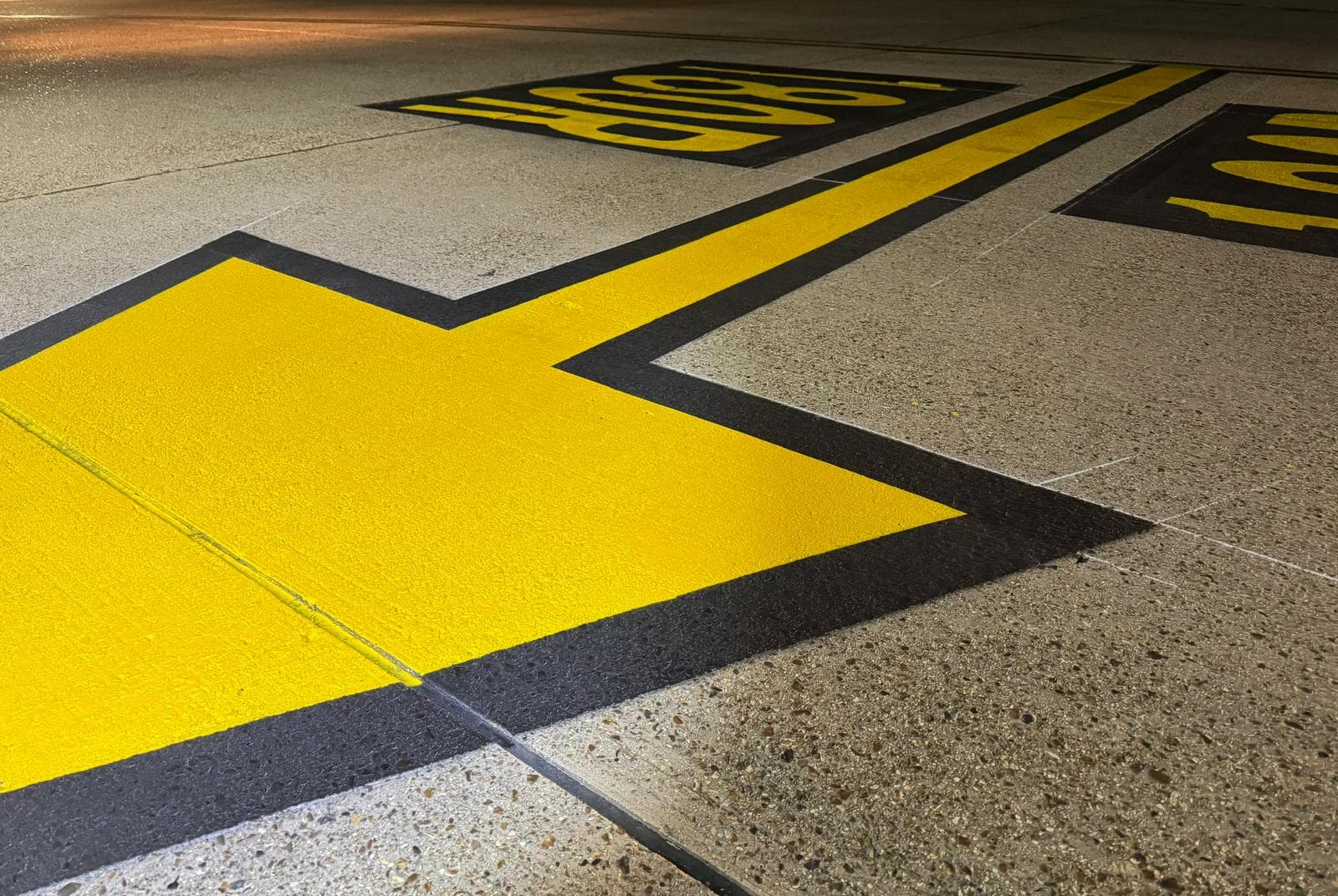
Colour is prescriptive. White is the mandatory colour for runway markings in the UK, and yellow is reserved for taxiways and apron areas. Getting that wrong is not an aesthetic error, it is a safety one, because a pilot reads colour before they read shape.
Why airfield markings need refreshing so often
Most aerodromes repaint runway markings every six to twelve months. Rubber deposition from touchdown, jet blast, de-icing chemicals and constant washing all degrade both the film and the retroreflectivity long before the paint has physically worn away. A marking that still looks acceptable from the ground can already be failing its night reflectivity requirement, which is why the inspection regime matters as much as the application.
Working airside
Airside marking is an out-of-hours trade. The runway or taxiway is closed, the crew is escorted, every operative holds an airside pass, and the surface is handed back serviceable before the first movement. Foreign object debris control governs everything: masking, tape, tins, cloths and offcuts are all counted out and counted back.
The weather window inside the closure is the other constraint. Paint needs a dry surface above temperature, and an airfield closure does not move because it rained. That is why the programme is built around forecast as tightly as it is around the shutdown, and why fast-cure materials earn their cost on aviation work in a way they do not always on a road.
Airfield line marking contractors in Kent and across the UK
We are based at Little Westerhill Farm near Maidstone in Kent. Kent, London, Sussex, Essex and the wider South East are covered from our own yard, and longer programmes are mobilised UK wide. Airfield work sits within our aviation sector, alongside airfield ground lighting and airfield joint sealing. For the materials themselves, see line marking.