
Service
Airfield and Runway Joint Sealing Contractors
A concrete airfield pavement is a field of slabs, and every joint between them is a designed movement gap that has to stay sealed. When one fails it does not simply look poor. It admits water to the sub-base, it lets fuel and de-icer into the structure, and it starts shedding material onto a surface where loose debris is a reportable hazard.
Why airfield joints are a different problem
Three things separate an airfield joint from a highway one. The loading is concentrated and repeated in the same places, because aircraft track far more precisely than road traffic. The chemical exposure is severe: spilt fuel, hydraulic oil and de-icing fluid all attack a sealant that would last a decade on a road. And jet blast applies a direct lifting force to the seal itself, which is why a joint that has begun to lift does not stay marginal for long.
That combination is what drives the material choice. Fuel-resistant polysulfides such as Thioflex 555 are specified where fuel contact is likely, on fuelling aprons, stands and hard standings. Hot applied bituminous sealants to N1 and N2 are used where movement rather than chemistry is the governing factor, with the grade matched to the calculated movement at that joint instead of defaulting to one across the pavement.
Preparation is most of the job
A joint seal fails at the interface far more often than it fails in the middle. That makes preparation the work: the reservoir cut to the correct width and depth ratio, the old sealant fully removed rather than skimmed, the faces cleaned back to sound concrete, the joint genuinely dry, and backer rod of the right diameter set to the right depth so the sealant can only bond on two faces and is free to move on the third. Sealant bonded on three faces will tear itself apart on the first cold night.
Working to the closure
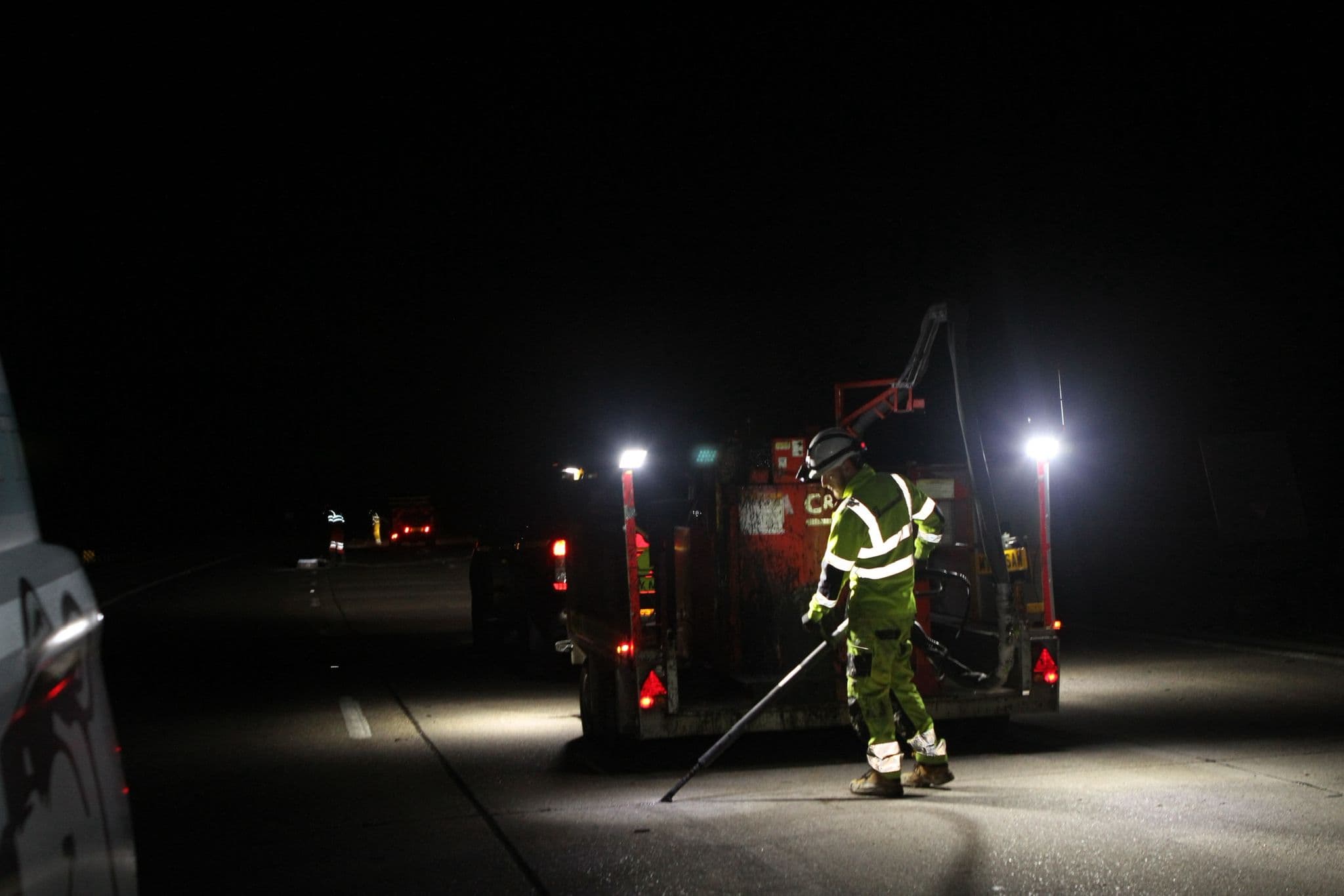
Airfield sealing is done inside the aerodrome's window, escorted, with an airside pass for every operative and a permit for every operation. Hot applied work needs a boiler on the airfield, which brings its own permit and its own fire precautions. Debris control is absolute: old sealant arisings are collected as they are produced, not swept up afterwards, because that material on a runway is exactly the hazard the work exists to prevent.
Airfield joint sealing contractors in Kent and across the UK
We are based at Little Westerhill Farm near Maidstone in Kent. Kent, London, Sussex, Essex and the wider South East are covered from our own yard, and longer programmes are mobilised UK wide. This work sits in our aviation sector, alongside airfield line marking and airfield ground lighting. For the materials in general, see joint sealing.