

Shepherd and Sons Ltd
What’s the Difference Between OBS 45 and OBS 60?
By Jordan Shepherd, Director. Published .
The difference is skid resistance, and the number tells you which grade you are getting. OBS 60 is the higher friction grade and OBS 45 the lower. The number refers to the polished stone value of the aggregate. That in turn sets the skid resistance value the finished band reaches in service. Both are hot applied bituminous overbanding compounds, melted in a boiler and laid over a crack or joint that has already been sealed. What separates them is the stone, not the bitumen.
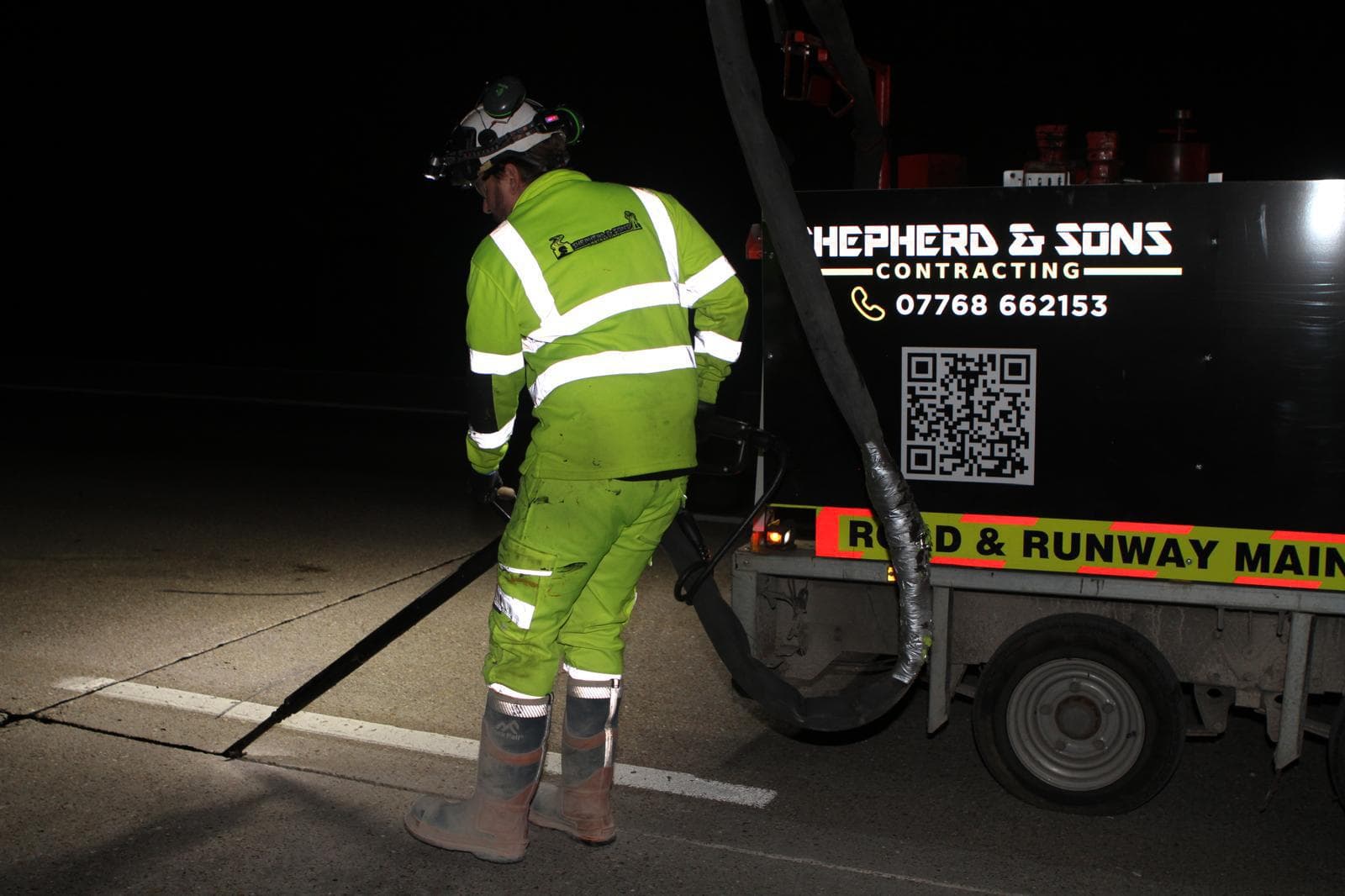
At Shepherd and Sons we overband cracks and joints on roads, car parks and airfield pavements, working days, nights and weekend possessions. From working with clients on highways and airside, we've found this number is the most misread thing in the overbanding catalogue. Get it wrong and you either overspend on a car park or lay a band that a highway authority will not accept.
The number is not a temperature
This is the assumption almost everyone makes, and it is worth killing first. Bituminous products are often graded by softening point, so 45 and 60 look like degrees.
They are not. In the published literature for hot applied overbanding compounds graded this way, softening point is given as 85°C plus or minus 15 to BS EN 1427. That same figure applies to both grades. Nor is it a penetration grade, because both sit around 25 dmm on cone penetration. Both pour at roughly the same temperature too, in the region of 180°C.
If the number were a temperature, the two grades would behave differently in the boiler. They do not. They behave differently under a tyre.
What the number does mean
Two related measurements sit behind it.
Polished stone value describes how well an aggregate resists being polished smooth by traffic. A PSV 60 stone holds its microtexture longer than a PSV 45 stone under the same wheels.
Skid resistance value is what the finished band actually delivers, measured with a pendulum tester to BS EN 13036-4. A 45 grade is designed to reach an in-service SRV of around 45, and a 60 grade around 60.
So OBS 60 carries a harder, more polish-resistant aggregate than OBS 45. It is not simply more grit. That distinction matters because grit content is not something you can specify or verify, whereas a stone value and a pendulum reading are.
It is also why the aggregate comes blended into the compound by the supplier rather than being dressed onto the surface by the gang. Bitumen on its own cannot deliver the friction figures, and grit scattered on afterwards does not hold.
The thresholds decide which grade you are allowed to use
This is the part that turns a preference into a specification.
On adopted highway in England, the Specification for the Reinstatement of Openings in Highways has been statutory since May 2021. Clause S6.8.8 requires an overbanding system to hold a current Product Acceptance Scheme certificate. It must also achieve an initial skid resistance of at least 55 SRV.
The Specification for Highway Works goes further on trunk roads. It asks for a minimum of 60 when newly installed, along with a HAPAS certificate or equivalent, and installation by an approved installer.
Read those two figures against the grades and the answer falls out. A 45 grade does not reach the 55 floor, so it is not the material for adopted highway. It is the grade for private and unadopted surfaces: car parks, yards, estate roads and taxiways. A 60 grade is what the highway specifications are written around.
The number that matters after the first year
There is a second figure behind the first, and it decides how long the band keeps working.
Certification does not stop at the initial reading. A certified overbanding system also has to hold at least 50 SRV after wheel tracking. It must keep a measurable texture depth too: at least 1.5mm initially and 0.75mm retained.
That is exactly why aggregate grade matters more than aggregate quantity. A soft stone can pass an initial pendulum test and then polish smooth within a season under the same traffic. A harder stone holds its microtexture, and that is what the higher grade is really buying.
Width and thickness, where overbanding earns its bad name
The same clause sets the dimensions, and they are tighter than most people quote.
An overband must be at least 3mm wide and no wider than 40mm, and no more than 3mm thick at the surface. The 40mm is repeated everywhere. The 3mm minimum is almost always dropped, and so is the thickness cap, which is the one that actually causes trouble.
One myth worth correcting: the specification does not require an overband to finish flush. Up to 3mm proud is expressly permitted. The flush requirement applies to the reinstatement itself, not to the band over it.
A band laid wide and thick because it was quicker is a raised strip of bitumen. A raised strip of bitumen is slippery when wet. Motorcyclists and cyclists carry that risk, not the contractor who laid it. The grade is half the answer and the dimensions are the other half.
The boiler difference is ours, not the material's
We run OBS 60 through a separate boiler, the same unit we use for high performance joint sealing. That is a fact about our plant rather than a property of the compound, and it is worth being precise about the difference.
What is true across the category is that an aggregate-filled hot overband wants an agitated boiler. Without a mixer keeping the stone in suspension, the aggregate separates. A band laid from a separated mix will not give the friction the grade promises.
How to specify it without naming a product
In our experience, specifying an overband by its required skid resistance and certification works better than specifying it by a trade name. The trade names vary between suppliers; the numbers do not. OBS 45 and OBS 60 are trade shorthand rather than universal catalogue designations, and the same grades appear under other names elsewhere.
There is a second reason to write the requirement rather than the name. A product that satisfies a specification today can be reformulated, and a certificate can lapse. A stated requirement does not move.
A specification that will not be argued with reads roughly like this:
- The required initial skid resistance in SRV, measured to BS EN 13036-4
- A current Product Acceptance Scheme or HAPAS certificate for the system
- Maximum width and thickness
- Whether the installer is approved by the certificate holder
That last point catches people out. Certificates are held by manufacturers, not by contractors, so no contractor is HAPAS certified. What a contractor can be is approved by the certificate holder to install a certified system, and that is the question worth asking.
Overbanding is also the closing operation rather than the repair. If the crack underneath has not been chased and sealed properly, the grade of the band over it makes very little difference. There is more on where overbanding sits in the sequence. The same logic of picking a grade by its classification applies to choosing between joint sealant grades.
For overbanding on highways, car parks and airfield pavements, get in touch with our team.
More on Joint Sealing
 Joint Sealing
N1 Sealant for High Movement Joints Explained
Read More »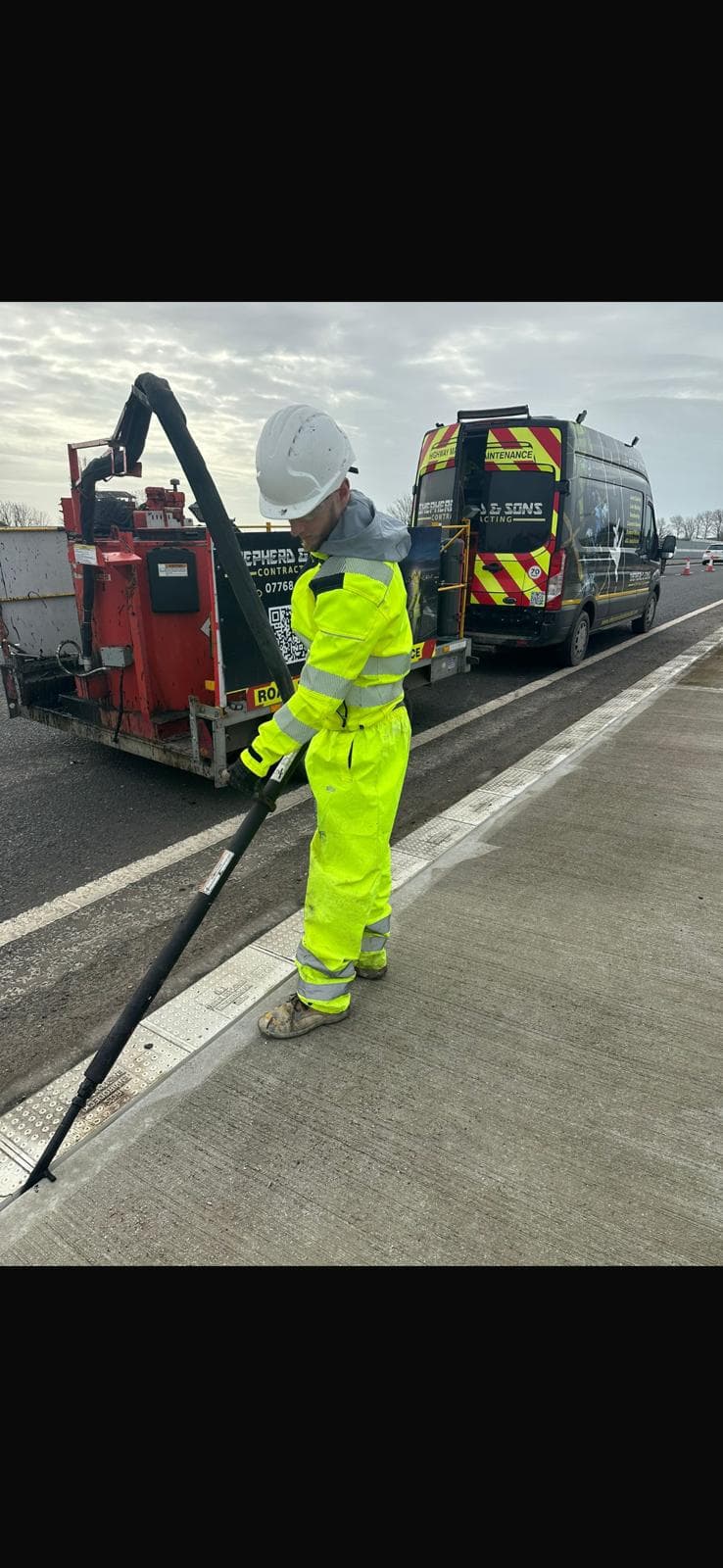 Joint Sealing
What’s the Difference Between N1 and N2 Sealant?
Read More » Joint Sealing
Sika Installers
Read More »- Joint Sealing
What is Sikaflex?
Read More » 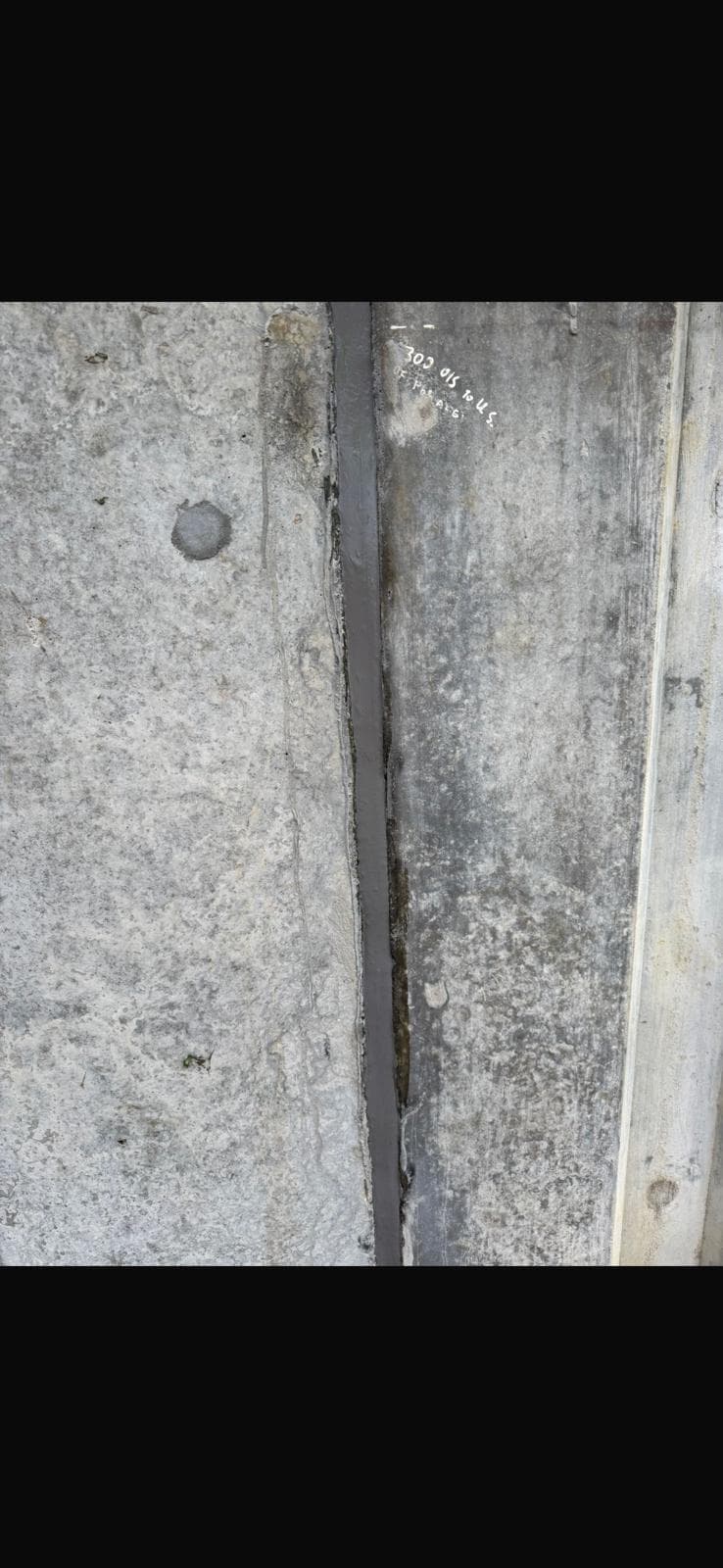 Joint Sealing
What is Thioflex 600?
Read More » Joint Sealing
What are the benefits of Thioflex 555
Read More »