
Service
What is Overbanding?
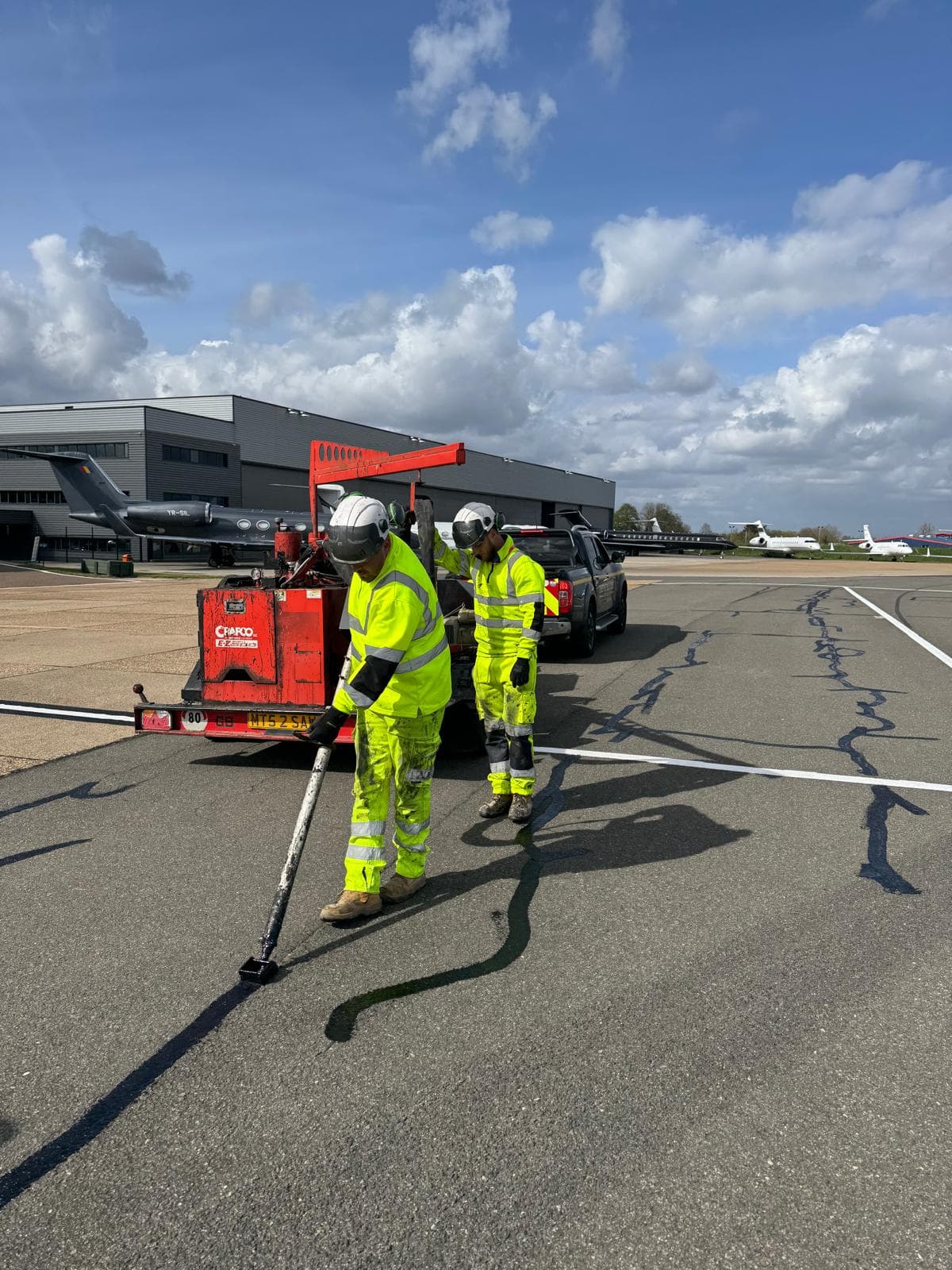
Overbanding is a band of hot applied bituminous material laid over a crack or joint after it has been treated. It is wider than the crack itself, and bonded to the surface either side. It does two jobs: it keeps water out of the crack, and it takes the traffic wear that would otherwise fall on the sealant underneath.
Where it sits in the sequence
Overbanding is the closing operation, not the repair. The crack is chased to a clean reservoir, cleaned, dried and sealed, and the overband goes over the top. Laid straight onto an unprepared crack it is cosmetic. It will bridge the gap for a while, then debond and peel. The crack underneath will be exactly as it was.
The materials
Overbanding compounds are supplied in blocks and melted in a boiler to application temperature, then applied hot and squeegeed or shoed to width and thickness. OBS 45 is the industry standard general purpose material. OBS 60 and Ultra-Band are in the same family with different performance characteristics. Where heat is not permitted, cold applied overbanding does the same job chemically.
Thickness and skid resistance
This is where overbanding gets a bad reputation, and it is worth understanding before specifying it. A band laid too thick becomes a raised strip. A raised strip of bitumen is slippery when wet, and it is a hazard to motorcyclists in particular. Highway specifications limit overband thickness and width for exactly that reason. Good practice is to dress the surface with grit, or to use a material carrying an aggregate content that restores skid resistance.
An overband applied to specification is a legitimate, long-lived treatment. An overband applied thick and wide because it was quicker is a liability. The difference is entirely in the workmanship.
When overbanding is the wrong answer
Overbanding treats a crack. It does not treat a failing slab. Where a bay has broken up, lost support or become an isolation point that could lift under load, no amount of surface sealing will hold it, and the work is structural surface repair instead. A contractor who overbands a slab that needs replacing has sold you a delay, not a repair.
What the specification actually requires
The dimensions are tighter than most people quote, and on adopted highway in England they are mandatory rather than advisory.
The Specification for the Reinstatement of Openings in Highways, at clause S6.8.8, requires an overband to be at least 3mm wide and no wider than 40mm. It must be no more than 3mm thick at the surface. The 40mm gets repeated everywhere. The 3mm minimum almost never does, and neither does the thickness cap, which is the one that actually causes trouble.
The system must also hold a current certificate from a Product Acceptance Scheme. It has to reach an initial skid resistance of at least 55 SRV, measured with a pendulum tester. Treatments must be black unless the authority directs otherwise.
One myth is worth killing here. The specification does not require an overband to finish flush. Up to 3mm proud is expressly permitted. The flush requirement applies to the reinstatement surface, not to the band laid over it.
On trunk roads the Specification for Highway Works goes further again. It asks for a minimum of 60 SRV when newly installed, a HAPAS certificate or equivalent, and installation by an installer the certificate holder has approved.
The grades, and what the numbers mean
Overbanding compounds are graded by friction rather than by temperature. That catches people out, because the numbers look like they might be softening points.
They are not. The number refers to the polished stone value of the aggregate in the compound. That in turn sets the skid resistance value the finished band reaches in service. OBS 45 and OBS 60 differ by the hardness of the stone, not by how much of it there is.
That distinction has a commercial edge. A grade targeting an SRV of 45 sits below every published UK threshold, so it belongs on private and unadopted surfaces: car parks, yards and taxiways. Adopted highway takes the higher grade.
The aggregate arrives blended into the compound by the supplier rather than being scattered on afterwards. Bitumen on its own cannot deliver the friction figures, and grit dressed onto the surface later does not hold. There is more on choosing between the two grades.
Certification, and who actually holds it
Crack sealing has its own specialist group within HAPAS, which tells you the trade treats it as a discipline rather than an afterthought.
A certified overbanding system has to reach at least 60 SRV initially and hold at least 50 after wheel tracking. It also has to keep a measurable texture depth: at least 1.5mm initially and 0.75mm retained.
The retained figures are the ones that matter over time. An aggregate that passes an initial pendulum test and then polishes smooth within a season has met the letter of the test and failed the job.
Worth knowing, because it is routinely got wrong in tenders: certificates are held by manufacturers, not contractors. No contractor is HAPAS certified. What a contractor can be is approved by the certificate holder to install a certified system, and those are two separate questions.
How it is actually laid
The compound is supplied in blocks and melted in a boiler to application temperature, then applied hot and shoed or squeegeed to width and thickness.
An aggregate-filled compound needs an agitated boiler with a mixer. Without one the stone settles out of suspension. A band laid from a separated mix will not deliver the friction its grade promises, whatever the datasheet says.
Getting the thickness right is most of the job. That is where the skid risk lives, and it is the one dimension a gang can quietly get wrong at speed.
Where it sits against the alternatives
Overbanding is one of three certified crack sealing system types, and they are separated by how wide the crack is.
An overband system covers cracks up to about 5mm, with the band laid over the top. A fill and overband system handles cracks from 5mm to 40mm, filling first and banding over. An inlaid system cuts a recess and seals within it, finishing flush.
Choosing between them is a question of crack width and what the surface has to do afterwards, not of preference. A 20mm crack treated as though it were a 3mm one will reopen.
Where the crack is in a concrete pavement rather than asphalt, the answer is usually joint sealing rather than overbanding, because a moving joint needs a sealant with extension rather than a band across the top of it.
What to check before it is laid
- Has the crack been chased and sealed first, or is the band going over a raw crack?
- What grade is being used, and does the surface it is going on require the higher one?
- Is the boiler agitated? An aggregate-filled compound needs it.
- What width and thickness is being worked to, against the 40mm and 3mm limits?
- Who holds the certificate for the system, and is the installer approved by them?
The first question decides whether any of the others matter. Overbanding is the closing operation on a repair. Laid over a crack nobody prepared, it is cosmetic. It will debond and peel, and the crack underneath carries on exactly as it was.
Overbanding contractors in Kent and across the UK
We are based at Little Westerhill Farm near Maidstone in Kent. Kent, London, Sussex, Essex and the wider South East are covered from our own yard, and longer programmes are mobilised UK wide. For the service itself see overbanding.