
Shepherd and Sons Ltd
What is Core Drilling?
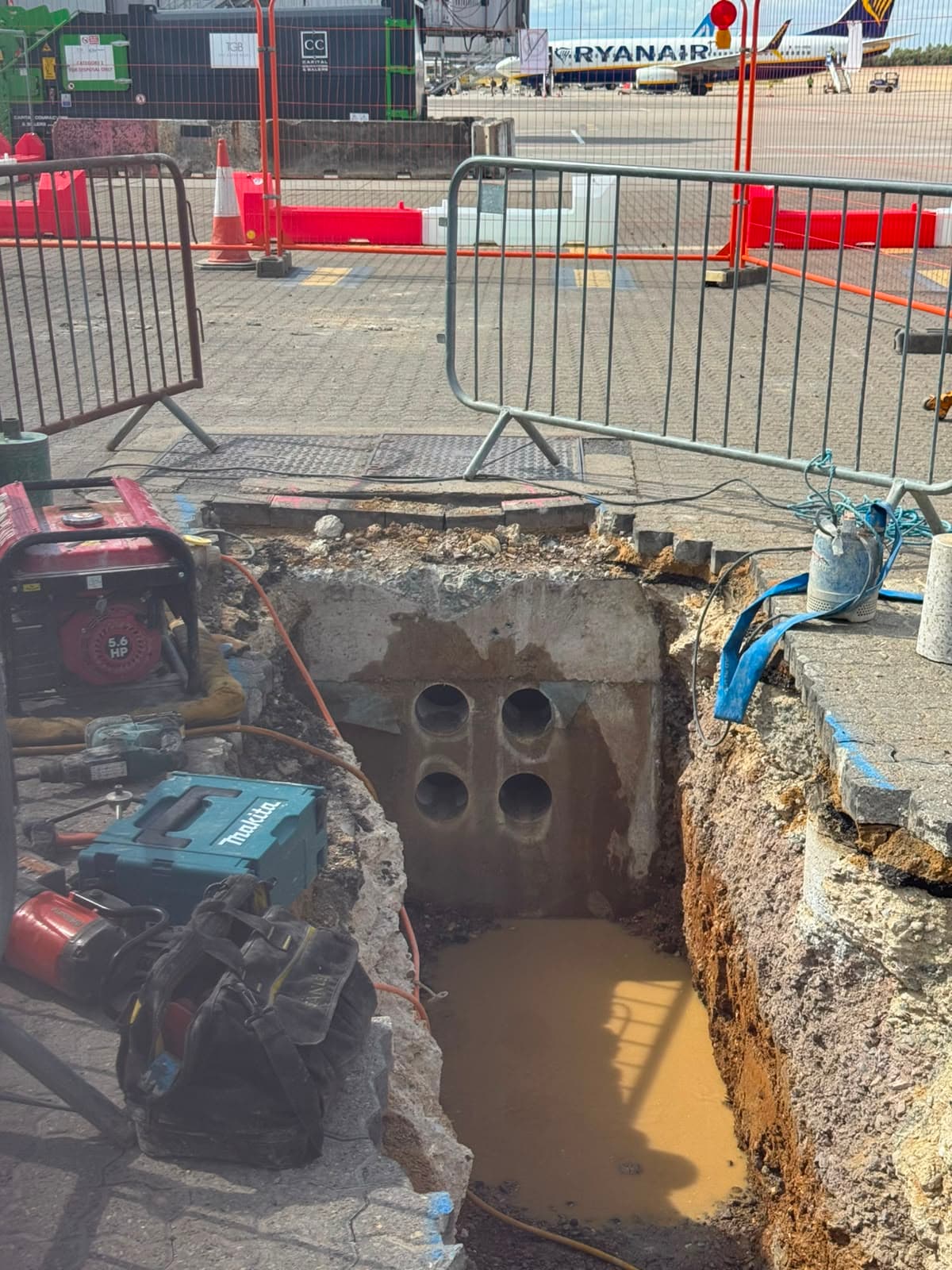
Core drilling is a cutting technique that uses a hollow, cylindrical drill bit to bore a circular hole through concrete, masonry, reinforced concrete or stone, removing a solid cylindrical core of material in the process. The bit is a hollow steel barrel with a cutting edge, most commonly tipped with industrial diamonds, which grinds through the material as it rotates. Because the bit is hollow, it cuts a ring rather than pulverising the whole hole, leaving a clean circular bore and an intact core that can be lifted out. Core drilling is used to form penetrations for services and fixings, and to extract concrete cores for laboratory testing. It’s the standard method for accurate, low-vibration circular holes through structural concrete.
At Shepherd and Sons, we deliver core drilling across UK airfields, highways, ports and infrastructure as part of our diamond drilling service, with more than 40 years of specialist experience. We’re based at Westerhill Farm in Kent, we hold SafeContractor and CHAS accreditation, and we’re members of the Extruded Sealant Association for the related joint sealing work. This article covers what core drilling is, how it works, the two distinct reasons it’s used, and what proper application involves.
How core drilling works
Core drilling works by abrasion, not impact. The cutting edge of the hollow barrel is embedded with industrial diamonds (or, for softer materials, tungsten carbide). As the barrel rotates against the surface, the cutting edge grinds a circular groove into the material. Because only the ring is being cut, the drilling is efficient, and the solid cylinder of material in the centre (the core) stays intact and can be removed once the bore is complete.
The defining feature of core drilling, and what sets it apart from solid-bit drilling, is that hollow barrel. Three things follow from it:
A clean, accurate bore. The hole is round, straight, and accurate to within millimetres of the marked position. The edge is clean and consistent, ready for service installation or sleeve fitting without further dressing.
An intact core. The removed cylinder is a solid specimen. For services work this is simply spoil, but for testing and investigation work the core itself is the whole point (more on this below).
Low vibration. The rotational cutting action transmits no percussive shock into the surrounding structure. This matters on sensitive buildings, live operational pavements, and structures where adjacent elements could be damaged by vibration.
Core drills run on three power sources: electric (the standard for internal and enclosed work), hydraulic (for heavy industrial and large-diameter drilling), and petrol or diesel (for remote sites without mains power).
The two distinct reasons core drilling is used
This is where core drilling divides into two quite different applications, and understanding the distinction helps in specifying the work correctly.
1. Forming penetrations
The most common application. Holes are drilled through slabs, walls, foundations and structures to install services and fixings:
- Drainage, water mains, fuel mains and gas lines
- Electrical conduit, cable ducting and fibre-optic networks
- Ventilation and air-conditioning ducts
- Structural fixings, anchor bolts and holding-down bolts
- Post-tensioning ducts and reinforcement starter bars
In this application, the core itself is spoil. What matters is the hole: its diameter, its position, its accuracy, and its clean edge condition ready for the service to be installed and sealed.
2. Concrete sampling and investigation
A distinct and specialist application. Here the core itself is the objective, not the hole. Cores are extracted from existing concrete pavements and structures to give engineers a real specimen to test and examine:
- Compressive strength testing. The extracted core is sent to a laboratory and crushed to determine the actual concrete strength, which is essential for structural assessment and remediation design.
- Slab thickness verification. Coring confirms the actual thickness of an existing pavement or slab, which drawings don’t always show accurately.
- Reinforcement location. The core reveals the depth and arrangement of the reinforcement mat.
- Petrographic and contamination analysis. The core is examined for carbonation depth, chloride ingress, alkali-silica reaction, fuel contamination or other degradation.
- Joint condition assessment. On pavement maintenance work, cores through joints reveal the condition of the sealant, backer rod and slab edges below the surface.
In our experience, core sampling works better than relying on original construction drawings when assessing an existing pavement for remediation because the drawings often don’t match what was actually built, particularly on older airfield and highway concrete where records are incomplete or the pavement has been overlaid multiple times. On an airfield apron assessment where the design build-up showed 300mm of concrete but the cores revealed a 380mm slab over an older 220mm layer, the coring evidence completely changed the remediation specification. Guessing from drawings would have produced the wrong repair.
Core drilling versus diamond drilling
The terms core drilling and diamond drilling are frequently used interchangeably in UK construction, and in most cases they refer to the same operation. The distinction, where one is drawn, is this:
Core drilling describes the technique: cutting a hollow circular bore that produces a solid core.
Diamond drilling describes the cutting medium: industrial diamonds bonded to the drill bit.
Because almost all core drilling in concrete and reinforced concrete uses diamond-tipped barrels, the two terms describe the same work in practice. A contractor offering diamond drilling and a contractor offering core drilling are, in nearly all cases, offering the identical service. The only meaningful exception is specialist geotechnical or rock coring, which may use other coring techniques, but for above-ground concrete and structural work, core drilling and diamond drilling are one and the same.
Core drilling capacity: diameter and depth
Core drilling covers a very wide diameter range. Standard core diameters run from 10mm (for small fixings and anchor bolts) to over 1000mm (for major services and structural openings). Common diameters in UK construction and civil work:
- 20mm to 50mm. Small fixings, anchor bolts, electrical conduit.
- 50mm to 150mm. Standard services, drainage, soil pipes, small ducting.
- 100mm to 150mm. Standard concrete test cores for compressive strength (typically 100mm or 150mm diameter under BS EN 12504-1).
- 150mm to 300mm. Major services, drainage stacks, ventilation ducts.
- 300mm to 600mm. Structural openings, large services, manhole formation.
- 600mm to 1000mm+. Specialist openings, drainage chambers, large ducting.
Drilling depth is effectively unlimited because barrels can be extended sequentially. The core is removed between extensions and the next barrel section is fitted to continue the bore. Deep cores through multi-storey foundations and bridge structures of several metres are routine specialist work.
What proper core drilling involves
The process is more than lining up the drill and pressing the trigger.
Site survey and services check. Before any hole is drilled, the substrate is surveyed for embedded services. Live cables, fuel mains, post-tensioning tendons, water and gas pipes, and reinforcement layout all influence drilling position and method. On airside work, this means liaising with the operator’s services drawings and confirming live fuel main locations physically before drilling. We’ve found that contractors who skip the services survey are the ones who eventually hit a live service, because the barrel cuts through whatever is in its path without discrimination.
Setting out. Hole positions are surveyed and marked precisely. On structural and airside work, tolerance is measured in millimetres because the hole has to align with mating fittings, embedded sleeves or service drawings. For sampling work, core positions are chosen to be representative and to avoid compromising the structure.
Rig mounting. The drill rig is anchored using bolt anchors, vacuum pad, or a wedge-and-strut frame depending on the substrate and environment. A securely mounted rig is essential for accuracy, because any movement during drilling deflects the bore and can jam or damage the barrel.
Water management. Core drilling in concrete is done wet, with continuous water feed cooling the diamonds, suppressing dust, and flushing out the cuttings. Slurry is collected and removed to prevent contamination and slip hazard. On internal work, water containment matters because spillage can damage finishes below.
Controlled drilling. The operator advances the barrel at a controlled rate matched to the concrete strength, reinforcement and diamond bond. Pushing too hard glazes the diamonds and slows the cut. Drilling too slowly wears them prematurely. Practised operators read the cutting feel and adjust accordingly.
Core retention and removal. As the bore completes, the core is held to prevent it dropping and damaging anything below. On overhead and horizontal cores, the core is supported and lifted out with appropriate plant. For sampling work, the core is carefully extracted, labelled and stored to preserve its condition for testing.
Reinstatement. For sampling work, the cored hole is reinstated with a matched repair mortar or concrete once the core is extracted. For services work, the penetration is sealed or fire-stopped once the service is installed.
Standards and compliance
Core drilling in the UK is governed by:
- HSE guidance\ for diamond drilling and sawing operations
- The Drilling & Sawing Association (DSA) Code of Practice
- BS EN 12504-1 (testing concrete in structures: cored specimens, taking, examining and testing in compression)
- BS EN 12390 series where cores are tested for hardened concrete properties
- CDM 2015 Regulations for construction projects
- CAA / ICAO / DIO standards for airfield applications
Operator competence is governed by NVQ Level 2 in cutting and drilling, with operatives holding CSCS cards and supervisors holding SSSTS. For airside work, additional airside familiarisation and CAA-aligned method training is needed.
Where core drilling fits alongside cutting work
Core drilling is one technique within the broader concrete cutting family, and it frequently works alongside floor sawing and wall sawing on the same project. On pavement work, cores are taken to assess slab condition before a cutting and reinstatement programme is designed. On stitch drilling operations, overlapping cores form a cut line where mechanical breaking isn’t permitted, which is the standard method for cutting around live aviation fuel mains. The coring, cutting and sealing specifications are linked, and specifying them together produces better outcomes than treating them as separate scopes.
Sectors where core drilling is specified
Aviation clients specify core drilling for airfield service penetrations, AGL fitting installations, pavement assessment coring, and stitch drilling around fuel mains. Pavement condition coring is particularly important on airfields, where accurate slab build-up data drives the maintenance specification.
Highway authorities and Tier 1 contractors use core drilling for bridge deck fixings, drainage installations, structural fixings and concrete carriageway assessment coring on motorway and trunk road work.
Port operators at Sheerness, Ramsgate and Dover use core drilling for quayside service installations, fender fixings, and hard standing assessment work.
Public sector clients including councils, schools, hospitals and government facilities specify core drilling for building services, structural alterations and infrastructure penetrations.
We’ve delivered core drilling across these four sectors, with the largest volume in aviation work.
Specifying core drilling properly
A meaningful core drilling specification will identify the purpose (penetration or sampling), the hole diameter and depth, the substrate type and reinforcement, the access constraints (internal versus external, live versus closed site), the services survey requirement, the mounting method, the slurry management requirement, and the interface with any following work (fire-stopping, sealing, service installation, reinstatement, laboratory testing).
If you’re specifying or commissioning core drilling work, whether that’s service penetrations, structural fixings, or concrete sampling for assessment, get in touch. We’ll assess the substrate, the services, the access constraints and the follow-on works, and quote the full scope properly. You can see recent project work on our LinkedIn and Instagram.
If you are looking for the service rather than the explanation, we are core drilling contractors working across airfields, highways, ports and infrastructure.
More on Concrete Cutting
 Concrete Cutting
Port Concrete Cutting in Kent
Read More » Concrete Cutting
Floor Sawing Services in Kent
Read More »- Concrete Cutting
Concrete Cutting in London
Read More »  Concrete Cutting
What is floor sawing?
Read More » Concrete Cutting
Diamond Drilling Contractors in Kent
Read More » Concrete Cutting
What is concrete cutting?
Read More »