
9525 is a grade of oxidised bitumen. It is not a standard number and not a brand. Written properly it is 95/25, and the two figures are its defining properties. A ring and ball softening point of about 95 degrees, and a penetration of about 25. It is a hard, rigid bitumen. In pavement work its place is below the running surface rather than on it.
At Shepherd and Sons we have been sole contractor for the British Airport Authority since 2008, working across all seven former BAA airports. From working with clients on airfield pavements, we've found 9525 is the material most often misunderstood on a sealant schedule. Usually because the number looks like a specification reference when it is really a grade.
There is no such standard as BS EN 9525
This is worth saying first, because the mistake appears in tender documents. 95/25 is a designation of the material's properties. It is not a British Standard. It is not a European Norm. It is not a classification anyone certifies against.
The standards that do apply sit elsewhere. Oxidised bitumens are covered by the framework specification BS EN 13304. Hot applied joint sealants are a different family of material entirely, covered by BS EN 14188-1 with its N1, N2, F1 and F2 types.
Writing BS EN 9525 into a specification therefore asks a supplier to certify against something that does not exist. In practice they will supply what they think you meant, which is exactly the situation a specification is supposed to prevent.
What the numbers mean
The first figure is the softening point in degrees Celsius, measured by the ring and ball method. The second is penetration, measured in tenths of a millimetre. So 95/25 is a bitumen that stays solid to a high temperature and is hard at ambient.
Compare that with a road bitumen at 40/60 or 70/100. Those are soft and flexible by comparison. 95/25 is neither, and that is deliberate.
It is also chemically altered rather than raw. Oxidised bitumen is made by blowing air through penetration-grade bitumen at high temperature. That raises the softening point and changes how the material behaves under load.
It carries no polymer or rubber, so it is unmodified in that sense. Calling it pure bitumen understates the processing, though. Air blowing is a manufacturing step, not an absence of one.
Why it goes below the surface
The properties that make 95/25 useful are exactly the ones that rule it out at the running surface.
It is hard. It is brittle at low temperature. It has effectively no elastic recovery. A sealant at the surface has to accommodate daily thermal movement and take traffic directly. A rigid bitumen in that position cracks, and usually in its first winter.
Below the surface the demands invert. What you want there is a material that stays put, resists displacement, and protects what it covers through the full depth of the construction. Rigidity stops being a fault and becomes the reason to choose it.
Where we use it
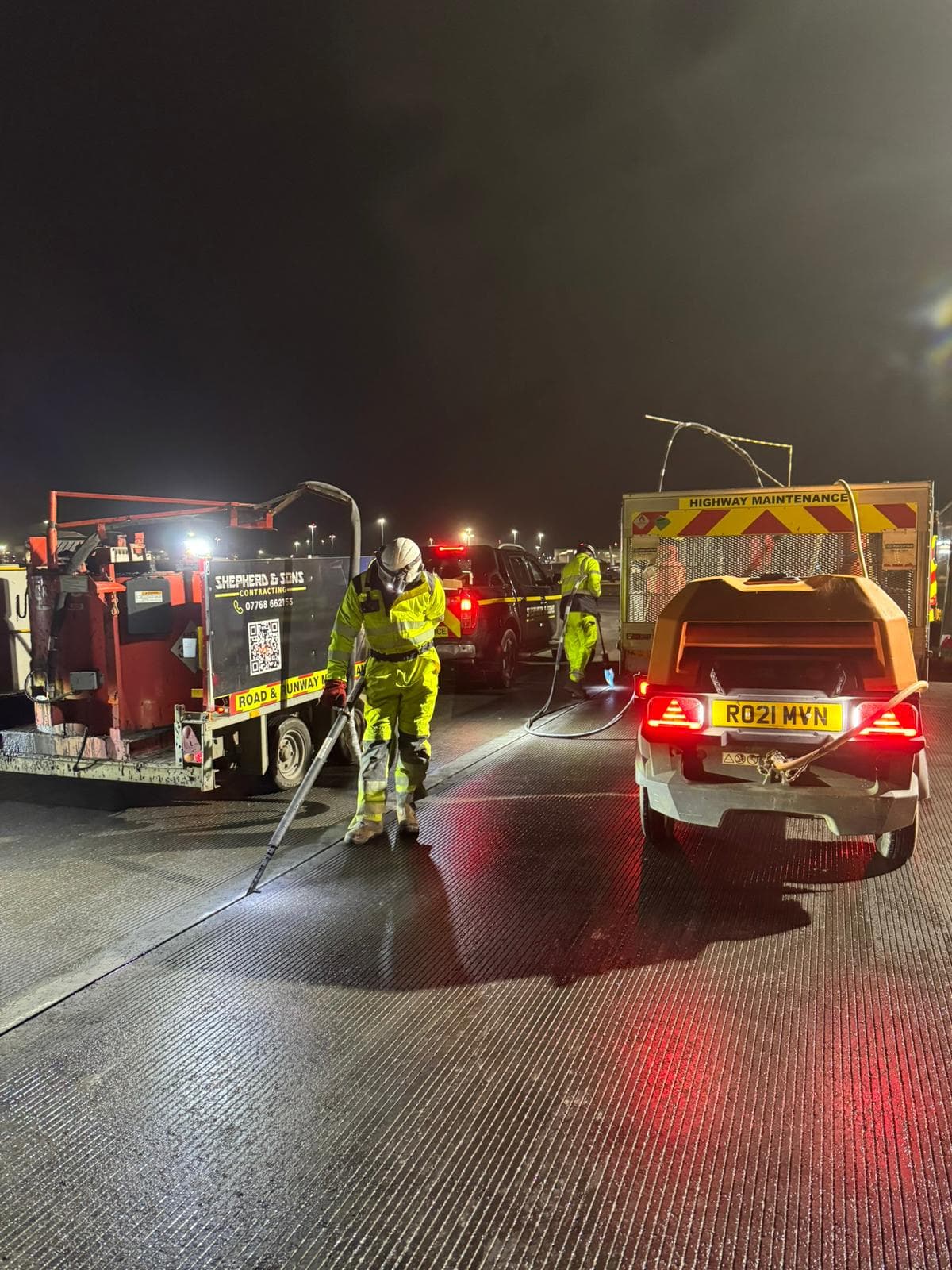
Our main use is sealing cable chases on airfields. A chase is cut into the pavement to carry airfield ground lighting cable. Where that pavement is being resurfaced, the chase is sealed and then buried under the new asphalt.
That is the case 95/25 is right for. The seal will never see a tyre. It will never see direct sunlight. It needs to hold its shape while an overlay is laid over it at temperature.
Where the chase stays at the surface, the answer changes completely. There it wants a sealant with extension and recovery, which means an N grade hot applied sealant instead. The two materials genuinely compete for the same job. What a cable chase is matters less to the decision than what happens to it afterwards.
In our experience, choosing between 95/25 and an N grade on whether the chase will be overlaid works better than choosing on price or habit. The material that is correct under an overlay is the wrong material at the surface, and the failure takes a season to appear.
How the chase is actually sealed
The sequence matters as much as the material does.
The chase is cut to width and depth, then cleaned out. Debris left in the slot stops the bitumen wetting the sides. A seal that has bonded only to the bottom of a chase is not a seal.
The bitumen is heated in a boiler to pouring temperature and run into the chase over the cable. A hard grade needs more heat than a surface sealant does. That is one practical reason the two are not interchangeable on the same shift.
Overfilling is the common mistake. The chase is filled to the line the overlay will sit on, not proud of the surrounding surface. Anything standing above that line becomes a bump under the paver.
Then the overlay goes on. From that point the seal is inaccessible for the life of the surfacing. That is why the inspection happens before the asphalt arrives rather than after it.
On a live airfield all of that happens inside a possession, with the pavement handed back serviceable before the first movement.
The confusion worth clearing up
9525 is not a harder version of N1 or N2. It is a different class of material, governed by a different standard, doing a different job in a different part of the pavement.
N1 and N2 are hot applied joint sealants designed to move. N1 is the elastic, high extension grade. N2 is the normal, low extension one. Neither is fuel-resistant, because that belongs to the F grades. 95/25 sits outside that classification altogether.
The other thing worth knowing is that 95/25's largest commercial market is not roads at all. It is roofing and waterproofing, where the same grade is sold as a bonding compound. Its airfield use is a real but specialist application of a widely available material.
That also explains why searching for it online returns roofing suppliers. It is the same grade of bitumen, sold to a bigger market, and there is no separate airfield product line behind the name.
It is worth being sceptical of what you read about it for the same reason. Search results for the term are thin, and a good deal of what appears simply repeats a contractor's own description back at you. The grade designation and the framework standard are the parts that can be checked.
Specifying it properly
- Say 95/25 oxidised bitumen, not BS EN 9525, which does not exist.
- State whether the seal will be overlaid or left at the surface, because that decides the material.
- Where it stays at the surface, specify an N grade to BS EN 14188-1 and say which.
- Confirm the chase depth and width before anyone orders, since a rigid bitumen is unforgiving of a slot cut to the wrong section.
- Ask what happens at the joint between the chase and any adjacent movement joint, because the two materials behave differently.
- Agree who inspects the filled chase, and when, since it is buried as soon as the overlay starts.
For joint sealing and airfield cable chase work across the UK, get in touch with our team.
More on Joint Sealing
 Joint Sealing
N1 Sealant for High Movement Joints Explained
Read More » Joint Sealing
What’s the Difference Between N1 and N2 Sealant?
Read More » Joint Sealing
Sika Installers
Read More »- Joint Sealing
What is Sikaflex?
Read More »  Joint Sealing
What is Thioflex 600?
Read More » Joint Sealing
What are the benefits of Thioflex 555
Read More »