
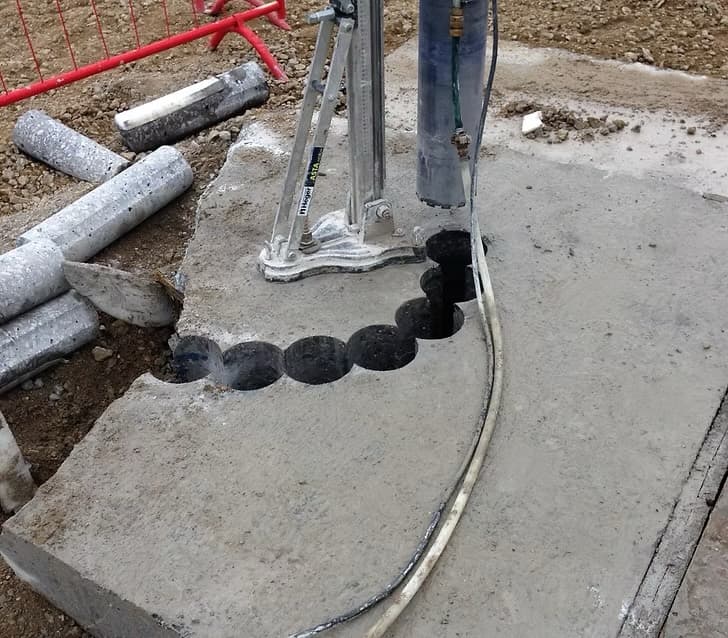
Stitch drilling is a way of cutting through concrete with a line of overlapping diamond cores instead of a saw blade or a breaker. Each core is drilled so that it overlaps the one before, and the holes join up into a continuous cut. Once the line is closed, the section inside it can be lifted out in one piece. The cut can follow a straight line, a curve or a closed shape, and it goes through whatever thickness the core barrel can reach.
It is chosen when sawing or breaking would cause a problem. That means a saw that cannot reach or would overcut a corner, concrete too thick or too awkward for a blade, a structure that must not take the shock of percussive breaking, or live services buried in the slab. It is slower than sawing on a long straight run, so it earns its place where those constraints exist. We carry it out as part of our diamond drilling work.
How a stitched cut is made
The work is done with a diamond core drill on a rig, anchored to the slab or wall so the operator is guiding the drill rather than holding it. The rig is set up on a marked line, the first core is drilled, and the rig is moved along so the next core cuts into the edge of the last. The cores come out as solid cylinders of concrete, which is why a stitched line is surrounded by a stack of them by the end of a shift.
Water is fed through the barrel to cool the diamond segments and carry the cutting debris away. That turns the spoil into a slurry, which on our jobs is vacuumed and contained rather than left to run across the surface. The method generates minimal dust and virtually no vibration, and both matter for the reasons below.
Why not just saw it?
For a long straight cut in a slab of ordinary thickness, a saw is usually the faster tool, and a floor saw or a full depth cut is what we would use. A saw has limits, though. A circular blade reaches only so far below the surface, and how deep you can cut concrete with a saw comes down to blade diameter. It cannot turn a tight curve. And because the blade is round, a saw cut that has to meet another at a corner either stops short or overcuts past it, which is the corner problem that wall sawing runs into on every opening.
Stitch drilling has none of those limits. A core barrel goes as deep as the barrel reaches, follows any line the rig can be set to, and stops exactly where the line stops. For very large sections or the deepest structures, wire sawing is the other option, and the two can be used together.
Why not break it out?
A breaker is quicker to bring to site, but it is blind and it shakes everything around it. It cannot tell a fuel main from a drainage pipe, and the shock travels into the concrete that is meant to stay. The difference between cutting and breaking is set out in full elsewhere, but stitch drilling sits firmly on the cutting side. In our experience, diamond coring works far better than percussive breaking on a live apron because it protects the fuel mains, drainage and lighting buried beneath the slab.
There is a health reason too. HSE's brief guide to hand-arm vibration lists powered hammers for demolition and road breaking among the tools whose users often exceed the daily exposure action value, which it says a hammer action tool can reach in about fifteen minutes. Its first control is to look for ways of working that avoid holding vibrating equipment at all. A core drill clamped to a rig does exactly that.
Cutting around fuel mains and other services
This is where stitch drilling earns most of its reputation on airfields. An apron or a fuelling area can carry fuel pipework, drainage and ground lighting circuits within or beneath the slab. In our experience, stitch drilling works better than continuous sawing on cuts around live aviation fuel mains because the depth control and the lateral isolation of each core protects the embedded service in a way that no continuous blade can match. Each core is a separate, measured hole. It can be stopped short of a known service, and the concrete next to it is never touched by a blade travelling along the line.
None of that replaces finding the services first. HSE's guidance HSG47, Avoiding danger from underground services, applies to drilling and to any work that penetrates the ground at or below surface level. It says to assume services are present, that plans alone are not sufficient to locate them, and that plans should not be relied on for distances or depths. It also points out that flammable liquids carry a risk of fire and explosion if a pipe is damaged. So the order on a job is records and service owner information first, then detection on site, then the cut. Where the answer matters, a single investigation core settles what the slab and its build-up actually contain before the stitching starts.
On a live airfield there is also the permit and the possession to work within, which is covered in what is different about airside working.
Getting the section out
A stitched section is free once the last core closes the line, but it still has to be lifted, and it is heavier than people expect. A full depth piece of airfield slab can weigh several tonnes. The lifting method, the lifting points and the route out are all agreed before the first core is drilled, because a section that has been cut free and cannot be moved is a hole with a lid on it at the end of a possession.
Removing the concrete in one piece is also kinder to what is left. The edges of the opening are the clean faces of the cores, with no shattered concrete and no exposed reinforcement bent back by a breaker. That makes the reinstatement simpler, whether the opening becomes a pit, a duct route or a new section of slab.
Dust, water and slurry
HSE's page on construction dust states that over 500 construction workers are believed to die from exposure to silica dust every year. Wet coring keeps that dust in the water, which is one reason wet coring suits occupied buildings as well as open sites. The water then becomes the issue. Slurry from a stitched cut has to be collected and disposed of properly, not swept to a drain, and on an apron it must not be left where it can dry and blow about as debris.
Where it gets used
On airfields it is the method around fuelling areas, ground lighting and drainage, where a breaker would be a risk to services and an airside debris hazard. In ports and industrial yards it is used to form pits and openings through thick hard standing without disturbing the slab around them. In buildings it forms openings in walls and floors where vibration and dust have to be kept down, and where a saw cannot get to the line.
Coring at programme scale is part of the same skill. At Stansted our team cored out 150 ground lighting seating pots over a ten week project, all inside restricted overnight possessions on a live airfield. At Luton we used a bolt-down coring rig over four night shifts to form cable routes through reinforced concrete 320mm deep. Neither was a stitched opening, but the discipline of coring accurately, at depth, next to live operations is the same.
What to tell a contractor before pricing
The number and depth of cores drive the time on site, so the information that decides the price is mostly about the concrete and what is in it. Have the slab or wall thickness, and whether it is reinforced. Say what services are recorded nearby, who owns them, and whether you hold drawings. Give the shape and size of the opening and how the piece will be lifted out. Describe access for the rig, a water supply and where the slurry can go. And on an airfield, give the possession times and the permit regime.
If the drawings are old or missing, say so, and allow for an investigation core first. It costs little next to the price of finding a service with a core barrel. What core drilling is explains how a single core is used for exactly that.
Shepherd and Sons carry out stitch drilling across Kent and the South East from Little Westerhill Farm in Linton, near Maidstone, and on airfields nationally. Our diamond drilling page for Kent has more on the local work. Send us the thickness, the shape and what you know about the services, and we will tell you whether stitch drilling is the right method or whether a saw will do. Ring 07768 662153 or contact us with the details.
More on Concrete Cutting
 Concrete Cutting
Port Concrete Cutting in Kent
Read More » Concrete Cutting
What is Core Drilling?
Read More » Concrete Cutting
Floor Sawing Services in Kent
Read More »- Concrete Cutting
Concrete Cutting in London
Read More »  Concrete Cutting
What is floor sawing?
Read More » Concrete Cutting
What is concrete cutting?
Read More »