
Service
What is Crack Chasing?
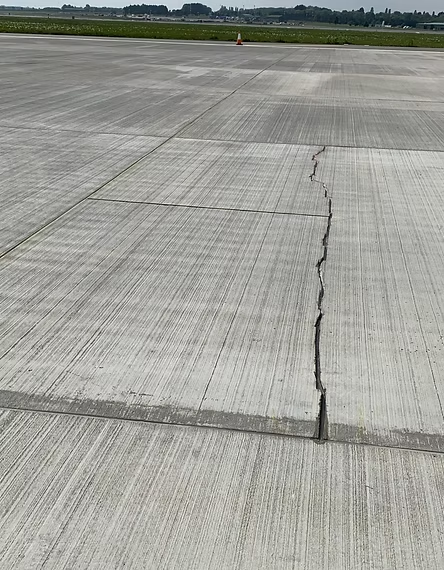
Crack chasing is the preparation stage of a crack repair. A crack in concrete or asphalt is a rough, tapering, contaminated void of no consistent width, and no sealant will bond reliably to that. Chasing cuts it out into a clean rectangular reservoir of known width and depth, which is a shape a sealant can actually work in.
Why you cannot just fill a crack
Three reasons, and they are the reasons crack repairs fail. First, the faces are contaminated with dust, oil, water and vegetation, so a sealant has nothing sound to bond to. Second, the width varies along the crack, so the sealant is over-extended in the narrow parts and under-supported in the wide parts. Third, and most importantly, a crack moves. A sealant needs a designed width-to-depth ratio to accommodate that movement without tearing, and an unchased crack does not offer one.
Pouring sealant into a raw crack produces something that looks repaired and fails in the first cold snap. The material has not failed. It was never given a joint to work in.
How it is done
A chasing machine is essentially a saw with a set of cutting wheels. It is run along the crack line to route it out to a consistent width and depth. Depth and width are chosen for the movement expected. The reservoir has to be deep enough to hold sealant that can stretch, and shallow enough not to waste material.
The reservoir is then cleaned out, usually by compressed air or vacuum, and has to be genuinely dry before anything goes in. Where the crack is live and moving, backer rod is set to the correct depth. That way the sealant bonds on two faces only, and is free to move on the third. Sealant bonded on three faces tears itself apart.
What happens next
Chasing is almost never a visit of its own. It is the operation immediately before sealing, and on roads and airfield pavements it is usually followed by overbanding, which lays a band of hot applied material over the sealed crack to waterproof it and take the traffic wear.
Where the chase is carrying a cable rather than a sealant, the technique is similar but the tolerances are not: see what a cable chase is.
The geometry that decides whether it lasts
A chase is not just a groove. Its dimensions are what allow the sealant to do its job.
The Extruded Sealant Association Code of Practice sets the shape. Slot faces should be within 10 degrees of vertical, because a tapered slot puts the sealant into a wedge it cannot stretch out of.
Width to depth matters as much. A hot applied sealant typically wants around 2:1, and a cold applied one nearer 1:1. Get the ratio wrong and the sealant is either too thin to survive or too deep to move.
The sealant also has to sit below the surface rather than level with it. The Code asks for at least 5mm of recess on a transverse joint under normal traffic. That becomes 7mm where the joint is wider than 25mm, and 10mm where it is sealed in cold weather. The tolerance is plus or minus 2mm.
That cold weather figure catches people out. Concrete contracts when cold, so the slot is at its widest as you seal it. Fill it level then, and the sealant is squeezed proud when the slab expands again.
Cleaning, and why it is not a formality
A chased reservoir has to be genuinely clean before anything goes into it.
Compressed air is the usual method. The Code specifies it should be oil-free and delivered at a minimum of 0.5 newtons per square millimetre. Oil in the line contaminates the faces it is supposed to be cleaning, which is a failure that looks like a materials problem months later.
The slot then has to be dry. Sealing into a damp slot is one of the most reliable ways to produce a joint that fails inside a season. The sealant never properly wets the faces it is meant to bond to.
Where a slot is being re-sealed rather than cut fresh, the old sealant is removed mechanically without damaging the faces. Freshly sawn faces are then roughened to roughly the texture of fine sandpaper before priming.
Backer rod, and the three-sided bond
Most chases need a backer rod, and it does two jobs at once.
It sets the depth of the sealant, so the width to depth ratio is achieved rather than hoped for. And it stops the sealant bonding to the bottom of the slot.
That second job is the important one. A sealant bonded on three sides cannot stretch. It tears instead, usually at the weakest face, and usually in its first winter.
The rod should be slightly wider than the slot so it stays where it is put. For hot applied work it has to be a heat-resistant grade, because standard closed-cell polyethylene simply melts at pouring temperature.
Checking the work
Depth is measured rather than eyeballed. The Code asks for readings at three locations along a transverse joint, or at one metre spacing. They are taken mid-width to within half a millimetre, using a metal ruler and a 150mm straightedge laid across the joint.
On a textured surface the measurement is taken from the lowest point of the texture rather than the highest. That distinction changes the number, and it is the sort of thing that gets argued about after the event rather than agreed before it.
Sampling runs alongside it. For extruded cold applied work, samples are taken at not less than one per 1,000 metres of joint or one per day, whichever is the more frequent. The same applies to hot applied.
What to check before anyone starts
- Is the chase being cut to a specified width and depth, or to whatever the machine happens to do?
- What sealant is going in, and does the slot geometry match what that sealant needs?
- Is there a backer rod, and is it the right grade for hot or cold applied?
- How will the slot be dried, and what happens if it rains?
- Who is measuring the depth, and against what tolerance?
The pattern in all of those is the same. Chasing is cheap and quick relative to what follows it. Most of the joint sealing failures we are asked to look at trace back to a decision made at this stage, rather than to the sealant itself. Widening an existing joint follows the same logic, which is covered under joint widening.
Crack chasing contractors in Kent and across the UK
We are based at Little Westerhill Farm near Maidstone in Kent. Kent, London, Sussex, Essex and the wider South East are covered from our own yard, and longer programmes are mobilised UK wide. For the service itself see crack chasing.