
Shepherd and Sons Ltd
How Cold Is Too Cold for Joint Sealing?
There is no single temperature that switches joint sealing on and off. Ask for one on site and you will usually be given 5°C. That figure comes off the data sheets and it is not wrong. It is simply the least useful number in front of you. Air temperature is quick to measure, so it is the one everybody quotes. It tells you very little about whether a joint will still be sealed next summer.
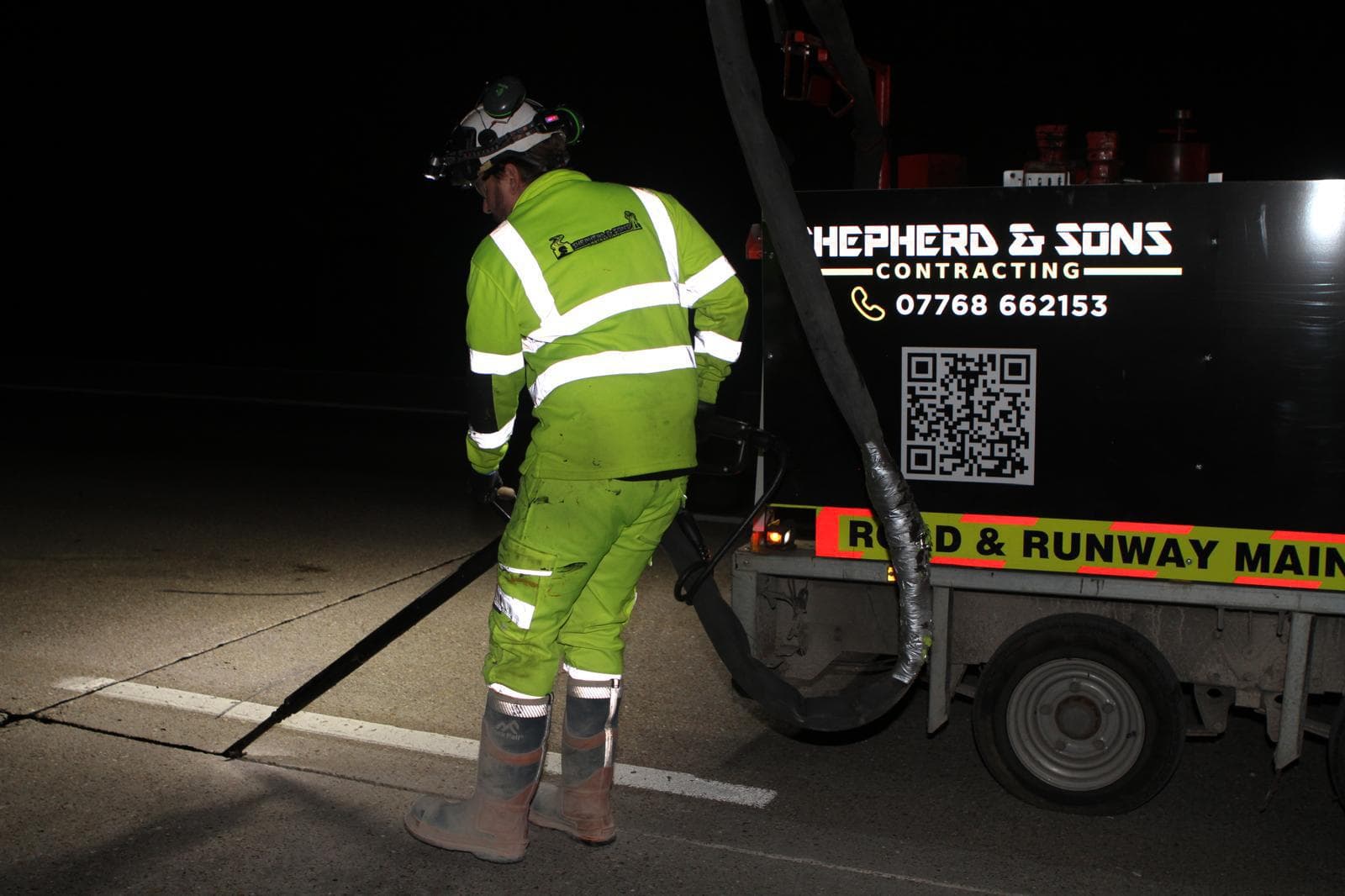
Shepherd and Sons have been sealing pavement joints for more than 40 years, much of it on night possessions between October and March. Three numbers decide whether a winter seal holds. The substrate temperature, the dew point, and the joint width at the moment you pour. None of them appears on a weather app. This article covers what each one does to the work. It also covers how hot applied and cold applied behave differently in the cold, and when the right call is to leave a joint for another night.
The sealant never touches the air
A sealant bonds to concrete, not to the atmosphere. Adhesion happens at the two slot faces, and those faces are part of a slab. Their temperature is what governs the bond. Ambient is quoted on data sheets because it is an easy proxy, and on a mild afternoon it is a reasonable one. On a clear night in Kent it stops being reasonable at all.
Radiant cooling is the reason. On a still night with no cloud, a concrete surface sheds heat to the sky and drops below the air above it. Ground frost forms at air temperatures of 3°C or 4°C for exactly that reason. So the thermometer on the van reads 5°C, the specification says 5°C, and the joint face you are about to pour into sits at 1°C. Nothing in that sequence is dishonest. It is measuring the wrong thing.
Substrate temperature, and how badly it lags
Concrete is a thermal store. Highway pavement runs 200mm to 350mm thick, and airfield taxiways and aprons run 300mm to 500mm. That mass changes temperature over days, not hours. A slab that has sat at 3°C through a cold week does not warm up because the sun came out at ten in the morning.
This is why a bright February day flatters a programme. The air comes up quickly. The slab follows a long way behind, and the joint face is still cold at four in the afternoon. Then the sun goes off it and it cools again, faster than the air does.
Take the reading where the work is. An infrared thermometer pointed at open surface a metre away is not the same as a reading taken in the slot after sawing. Shaded bays, the north side of a building, the underside of a bridge deck and anything in the shadow of a hoarding all read colder than open pavement. In our experience the coldest joint on a site is the one nobody thought to check, and it is where the first failure shows.
Dew point, the number most gangs never take
This is the one that quietly costs money. Air holds a certain amount of water vapour. Cool a surface to the dew point and that vapour condenses onto it. The film is thin enough to be invisible, and the joint face feels dry to a gloved hand. It is not dry. The sealant will not bond through it.
The working rule we borrow from protective coatings is simple. Keep the substrate at least 3°C above the dew point, and check it again as the shift goes on. Dew point moves through a night. Air temperature falls, relative humidity climbs towards 100%, and a joint that was safe at eleven can be carrying condensation by two.
A digital hygrometer reading air temperature, relative humidity and surface temperature costs very little and settles the argument in seconds. Over a lot of winters we've found the same pattern. The gangs taking that reading every hour, rather than once at the start, are the ones whose joints are still sealed three years later. It is a two minute job. It is also the difference between a proper bond at the slot face and a bead that peels off one side in its first spring.
In winter the joint is at its widest, so everything gets compressed
Concrete contracts as it cools. A slab shortens, and every contraction joint in it opens. Seal a joint at two in the morning in January and you are sealing it close to its annual maximum width. That has a consequence people rarely think through.
Everything installed at that width spends the following summer being squeezed rather than stretched. The slab expands, the joint closes, and the sealant has nowhere to go but up. That inverts the usual failure mode. The familiar summer failure is tension: the bead tears down the middle, or lets go of a face as the joint opens in the cold. The winter failure is compression, and the bead extrudes proud of the surface.
Proud sealant does not stay put. Tyres pick it up, sweeper brushes catch it, plant tracks drag it, and on an airfield a lifted strip of sealant is foreign object debris. This is why the recess is deepened for cold weather work. Normal practice on a transverse joint is a minimum 5mm recess below the surface. Applied in cold weather, the Extruded Sealant Association Code takes that to 10mm. It reads as an odd detail until you accept that the joint is going to close on it.
Movement range matters just as much. A joint with genuine thermal range needs the high extension grade, which is N1 sealant, elastic and high extension. Backer rod depth sets the shape of the bead and has to be right in any season. Where the slot faces are damaged or unsound, the answer is joint widening back to clean concrete before anything is poured.
Hot applied carries its own heat, cold applied does not
Hot applied sealant arrives in the joint at pour temperature and sets by cooling rather than by chemical reaction. That is a real advantage in winter. The material brings its own heat with it, and it comes back into service faster in the cold than it does in August.
The catch is at the slot face. Poured against very cold concrete, the material chills at the interface before it has properly wetted the face. You get a bead that looks perfect and is barely bonded. Moisture makes it worse. Water in a cold slot flashes to steam under the pour and blows the seal open behind the surface.
Cold applied systems have the opposite problem. They cure chemically and draw heat from their surroundings, so a cold slab slows the reaction down. A two part cold applied system such as Thioflex 555 returns to service in about 30 minutes at 20°C. At 5°C it wants considerably longer, and the figure that matters is the one on that product's data sheet at the slab temperature you actually have, not the headline number at 20°C. Nothing has gone wrong there. A possession planned on the summer figure will simply overrun on a February night.
The priming window is the other cold applied trap. Sealant goes in after the primer inside a defined window, and the clock does not care that it is dark and cold. Prime a run you then cannot seal and you have bought yourself a grinding job. There is more on the material in the benefits of Thioflex 555, which is the pavement grade polysulphide and a different product from Thioflex 600.
Waiting for a dry day is not an option on a possession
On a live carriageway or an airfield, the work happens when the possession says so. On the M20 between junctions 8 and 9 we reformed and resealed 23,304 linear metres of joint over 20 night shifts. The window was 10pm to 3:30am on the coastbound carriageway. That job is set out on the M20 project page. Traffic management is booked weeks ahead. A dry Tuesday afternoon is not on the menu.
Night possessions also sit in the coldest part of the day. Air temperature bottoms out shortly before dawn, and the slab has been shedding heat since the sun came off it. So the hours you are given are the hours least suited to sealing, every time. Airside work adds a hard handback on top. At Stansted we cored 150 airfield ground lighting seating pots across ten weeks of restricted overnight possessions. The pavement goes back into service swept and clear at a stated time.
The way through is to stop treating the shift as one operation. Sawing, joint preparation, drilling and cleaning tolerate cold and wet. Sealing does not. Put the weather tolerant work at the exposed end of the possession and hold the sealing for the part of the night you can control. On highway programmes that single decision saves more nights than any material choice.
Drying and pre-heating the joint
A damp joint can usually be recovered. A frozen one cannot. A slot with ice in it has to be thawed first and then dried, which is a slower job than most programmes allow for.
Drying is done with oil free compressed air and, where it is needed, a hot air lance run along the slot. Pre-heating does two jobs at once. It drives off the surface film, and it lifts the slot face above the dew point so the film does not come straight back. It also gives the sealant a warmer face to bond to, which matters most with hot applied material.
There are two ways to get it wrong. The first is heating too hard and scorching the arris or the concrete face, which leaves you bonding to damaged material. The second is treating drying as a job to be done in advance. Dry a run at eleven and pour it at two, and the face has had three hours to cool and pick moisture back up. Dry it, check it, then seal it behind you.
Tenting a working length is worth the trouble more often than people expect. It holds heat in, keeps sleet off an open slot, and buys back time on cold applied cure. It costs money on the night. It costs a good deal less than a return visit with fresh traffic management behind it.
Some nights the answer is not to seal
This is the part clients do not enjoy hearing, and it is the part that protects them. A joint sealed into the wrong conditions fails, and it fails quietly. It looks perfect at handback. It lets go of one face over the winter and takes water in. Then it surfaces as a failure eighteen months later, with the full traffic management cost to put it right.
These are the conditions where we stop and say so:
- The slot face is within 3°C of the dew point and there is no practical way to lift it
- There is frost or ice in the joint, or frost is forecast before the material has set
- Rain, sleet or snow is due inside the cure or cooling window
- A cold applied return to service at the real slab temperature will not fit the possession
- The face comes back damp on a second reading after drying
- The material has been held at temperature beyond the permitted duration
Standing the sealing down does not mean standing the shift down. Cutting, coring and preparation carry on, and the sealing moves to a night that will hold it. What matters is that somebody on site has the authority to make that call. A contractor who will seal in any conditions is not being helpful. They are moving the risk onto you, and it lands after the defects period rather than during it. We hold SafeContractor and CHAS accreditation, and we are members of the Extruded Sealant Association. Our operatives are trained and experienced in both machine grade and hand grade application, which is the competence that decides a cold-weather pour. The standing instruction is that the joint face decides, not the programme.
What to ask before booking winter joint sealing
- Who takes the substrate temperature and dew point readings, and how often through the shift?
- Is the system hot applied or cold applied, and does its return to service at the real slab temperature fit the possession?
- What recess is being worked to, given the joint is at its widest in the cold?
- How is the slot being dried, and how much time will pass between drying it and sealing it?
- Who has the authority to stand the sealing down, and what happens to the rest of the night?
Cold weather does not rule out joint sealing. It rules out guessing. Take the substrate temperature and take the dew point. Allow for a joint sitting at its widest, and plan the possession around the material rather than the other way round. Winter joints sealed on that basis last as long as summer ones.
For joint sealing, concrete cutting and drilling across Kent, London and the South East, get in touch with our team. Call 07768 662153.
More on Joint Sealing
 Joint Sealing
N1 Sealant for High Movement Joints Explained
Read More » Joint Sealing
What’s the Difference Between N1 and N2 Sealant?
Read More » Joint Sealing
Sika Installers
Read More »- Joint Sealing
What is Sikaflex?
Read More »  Joint Sealing
What is Thioflex 600?
Read More » Joint Sealing
What are the benefits of Thioflex 555
Read More »