
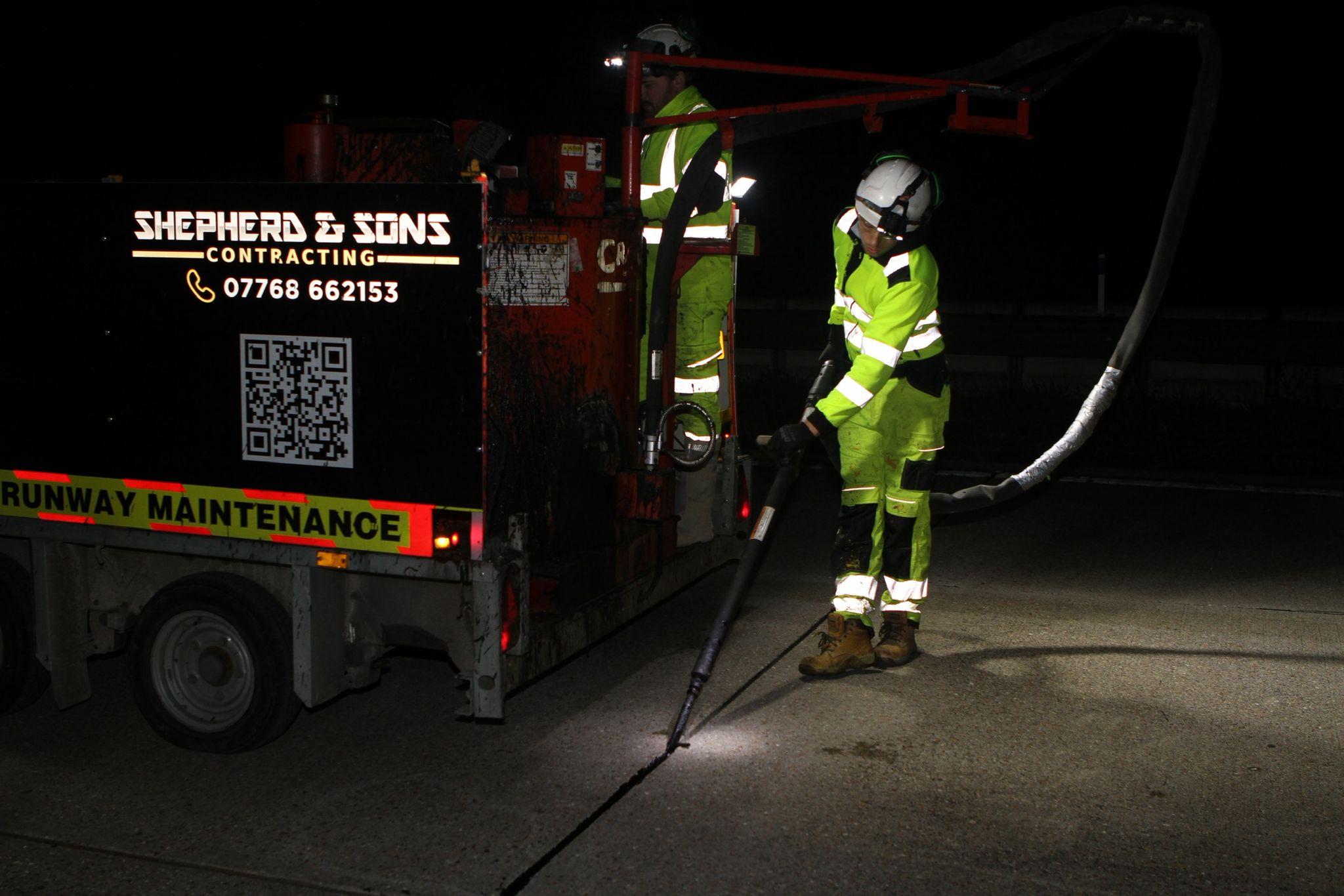
Joint sealing is the closest thing we have to a home job. The yard is at Little Westerhill Farm in Linton, south of Maidstone, and the biggest sealing programme on our project list is a few miles up the road: the M20 between junctions 8 and 9, where twenty night shifts produced 23,304 linear metres of reformed and resealed joint. In Maidstone we seal joints in concrete roads, service yards, car parks and industrial floors, hot applied or cold applied depending on what the joint has to put up with.
What gets sealed in the borough
Concrete pavements with joints are found wherever heavy vehicles turn and park, which in Maidstone means its employment land more than its streets. The industrial estates at Park Wood, Aylesford, Lordswood and Tovil, the 20/20 Business Park at Allington and the storage and logistics sites out at Lenham and Detling all carry concrete yards and floors whose joints fail in the same way: the old seal hardens, splits away from one face, and water and grit get into the slot. Once grit is in, the joint cannot close properly in summer, and the arrises start to spall.
Resealing stops that. The old sealant is cut out, the slot is widened or reformed where it has broken down, the faces are cleaned and dried, a backer rod sets the depth, and new sealant goes in. Our page on joint sealing covers the method; on a yard that has to stay open, the question is usually how much can be done between deliveries.
Hot or cold applied for a Maidstone site
On a road or a busy yard, hot applied sealant is usually the answer because it can take traffic within about half an hour, so a lane or a loading bay can be handed back the same night. Where fuel, oil or hydraulic fluid reaches the joint, such as a refuelling point or a plant yard, the specification moves to a fuel resistant grade or a two part cold applied polysulphide. BS EN 14188-1 has four hot applied types, and only the F1 and F2 grades resist fuel; we will tell you which the joint needs before it is ordered.
Sealing on Maidstone's roads
Kent County Council is the highway authority for the borough's roads apart from the M20, which is National Highways'. Sealing on a public road needs a permit under the Kent Permit Scheme, normally with ten days' notice, and most of Maidstone's main routes are also on the Kent Lane Rental Scheme list in its top band. Heath Road through Linton, close to our yard, is one of them, charged between 7am and 7pm on weekdays, along with Loose Road, Linton Road at Loose, Tonbridge Road, London Road and Sittingbourne Road. That is why highway sealing here is almost always a night or weekend job.
Night work brings in the noise rules. Kent's noise agreement means the district's environmental health team is contacted before a permit is issued for road works outside 7am to 7pm on weekdays and 8am to 1pm on Saturdays. Hot applied sealing is a quiet process compared with the sawing that comes before it, and we plan the noisiest part of the night accordingly.
Weather and timing
Sealant only bonds to a clean, dry joint face above its minimum application temperature, which narrows the calendar in a wet Kent winter. Our guide on how cold is too cold for joint sealing sets out the limits, and how long joint sealant lasts explains what a good reseal should give you.
Related pages
Our other services in Maidstone, and what the town's roads and rules mean for a job, are on our Maidstone page.
For the county as a whole see joint sealing contractors in Kent. If the slot needs cutting first, see concrete cutting in Maidstone. Request a quote with the joint lengths, the surface and what the area is used for, and we will price it.