
There is no single figure for how long joint sealant lasts, because the same product can last twice as long on one pavement as on another. A seal fails when it stops bonding to both faces of the joint or stops stretching with it, and that depends on how far the joint moves, what crosses it, the weather it sees and, most of all, how well it was installed. The best long term evidence comes from a US federal highway study that tracked resealed joints on five busy roads until a quarter of each joint had failed. The better hot applied sealants averaged roughly eight to ten years and the silicones roughly ten to fourteen.
So a sensible planning figure for a well installed seal on a trafficked pavement is around a decade, with a wide spread either side. The more useful question is how to tell when your seal has gone and what resealing involves, because a joint is resealed when the seal stops keeping water and grit out, not on a date. This article covers both.
What the long term evidence says
The study was part of the Strategic Highway Research Program in the United States, reported by the Federal Highway Administration in its technical brief on resealing concrete pavement joints. Joints were resealed with a range of hot applied and silicone sealants using different installation methods, then monitored. A joint counted as failed once less than 75 per cent of it was still sealing effectively, and service life was the time taken to reach that point, interpolated or extrapolated to a maximum of 200 months.
The averages for the better hot applied sealants ran from about 99 to 126 months depending on how they were installed. The silicones averaged about 127 to 167 months. The spread between sites was larger than the spread between products. One hot applied sealant, installed the same way, reached the failure point at 63 months on one highway and 156 months on another. With the sealant recessed below the surface, the silicones also showed significantly less partial depth adhesion failure than the hot applied sealants.
Two cautions apply. These were American highways and the products of the 1990s, and the study did not test the fuel resistant polysulphides used on UK airfields. Treat the figures as evidence of the range and of what drives it, not as a promise for any product. For a specific sealant, the manufacturer's data and the conditions on the job are what count.
Why the same sealant lasts different lengths of time
Movement comes first. A sealant is stretched every time the joint opens and squeezed every time it closes, through every daily and seasonal temperature cycle. Long bays and big temperature swings open joints further, and a sealant worked beyond its extension limit tears or pulls away from the face. What pavement joints are explains why some joints move far more than others.
Traffic and exposure come next. Heavy wheels, snow ploughs, fuel, de-icer and jet blast all attack a seal, and a bitumen seal that meets fuel softens. Then there is age. The FAA's guidelines for maintaining airport pavements list the causes of joint seal damage as improper joint width, the wrong type of sealant, incorrect application, not cleaning the joint properly before sealing, and climate, meaning ageing. Four of those five are decided on the day the joint is sealed.
Installation decides more than the product
The US study found the same point in its own way. How the joint faces were prepared and how the sealant was placed changed the results by years, and it recommended sandblasting each joint face with two passes rather than one. Why joint sealants fail goes through what goes wrong in the slot.
The basics are not complicated, but each one has to be done every time. The reservoir is cut to the width and depth the sealant needs. The faces are clean, sound and dry. A backer rod sets the depth and stops the sealant bonding to the bottom of the slot. The sealant is recessed below the surface so traffic does not pull it out. And it is not poured onto a cold, damp face, which is covered in how cold is too cold for joint sealing.
Signs your joint seal has failed
You do not need instruments to spot most of it. Walk the joints and look for these.
- Loss of bond. A gap between the sealant and one face of the joint, often a hairline that opens wider in cold weather.
- Splitting down the middle of the bead, where the sealant itself has torn.
- Hardening. Sealant that has gone brittle and no longer gives under a thumb or a blade.
- Extrusion or pick out, with sealant pushed above the surface in summer or pulled out of the slot by traffic.
- Missing sealant, or a joint full of stones and grit.
- Staining beside the joint after rain, which is fine material being pumped up from the sub-base.
The last two matter most. The FAA notes that water getting in through damaged joint seals can cause pumping or deterioration of the base, and that grit packed into a joint stops the slabs expanding and can cause buckling, shattering or spalling. Once a joint is pumping, the problem is no longer only the seal, and deciding between repair and bay replacement becomes the next question.
Look in cold weather if you can. Concrete contracts as it cools, so joints are at their widest in winter, and a seal that has lost its bond shows it far more clearly then than on a warm afternoon.
Can you reseal an old joint?
Yes. The key is that resealing is a complete job, not a top up. New sealant poured over old sealant is bonded to something that has already failed. BS 10948, the UK code of practice for hot and cold applied joint sealants in concrete pavements, covers resealing as well as new work.
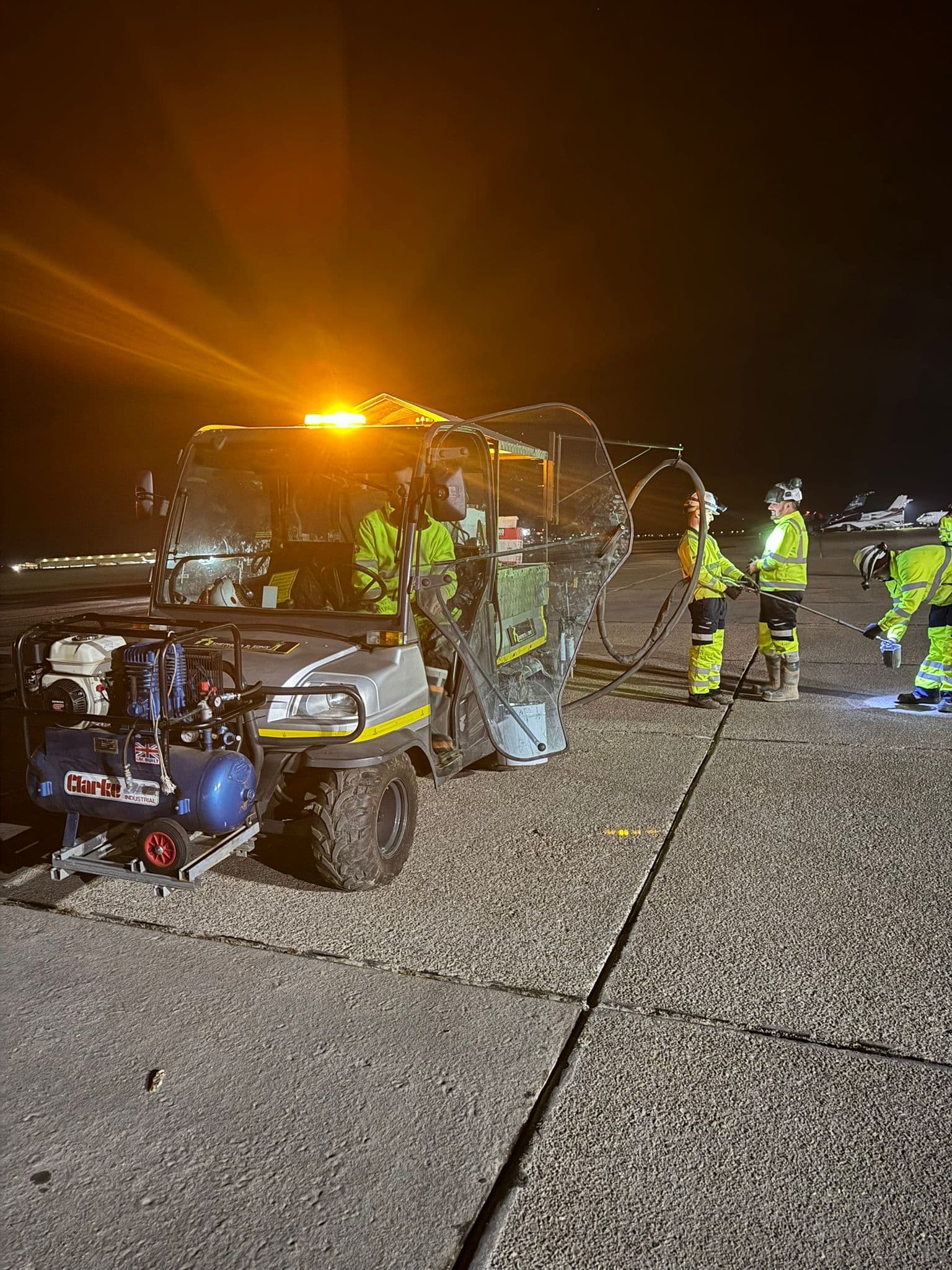
On the M20 between junctions 8 and 9 the sequence was ploughing out the old sealant, sawing, drying, grit blasting, caulking and then sealing, and it came to 23,304 linear metres over twenty night shifts. Sawing the slot again gives clean faces and a reservoir of known size. Where the old reservoir was too narrow for the movement, it is cut wider, which is joint widening. Where the arris has broken away, the damaged concrete is repaired before the joint is resealed, because sealant cannot bridge a spall.
A reseal is also the moment to change the material. If the use of the pavement has changed, or the old seal failed for a reason the material could not cope with, hot applied or cold applied is worth deciding again rather than repeating.
Making the next seal last longer
Choose the grade for the movement. Under BS EN 14188-1, N1 is the elastic, high extension hot applied grade and N2 the normal, low extension one. In our experience, an N1 sealant works better than N2 on joints with high movement because its greater extension accommodates slab expansion without splitting, whereas N2 suits stable, low movement joints. The difference between N1 and N2 sets out the choice in full.
Match the sealant to the exposure. A fuel resistant cold applied sealant such as Thioflex 555 on stands and fuelling areas, and a hot applied grade where there is no fuel. Spend on preparation rather than saving on it, because preparation is where the years are won or lost. And inspect once a year, ideally in winter, so a failing joint is resealed before water has had time to work on the sub-base.
The FHWA makes a point worth repeating for anyone with a maintenance budget. It says longer life sealants are worth considering even at a higher initial cost, because joint sealant maintenance is often deferred or ignored. A seal that lasts longer is a seal that is still working when the reseal gets postponed.
Getting your joints looked at
Shepherd and Sons reseal joints on highways, airfields and ports from Little Westerhill Farm in Linton, near Maidstone, and our joint sealing covers hot applied and cold applied systems. Send us photographs of a few joints, the bay size and what uses the pavement, and we will tell you whether the seal has life left in it, whether it needs resealing, or whether something more is going on underneath. Ring 07768 662153 or contact us with the details.
More on Joint Sealing
 Joint Sealing
N1 Sealant for High Movement Joints Explained
Read More » Joint Sealing
What’s the Difference Between N1 and N2 Sealant?
Read More » Joint Sealing
Sika Installers
Read More »- Joint Sealing
What is Sikaflex?
Read More »  Joint Sealing
What is Thioflex 600?
Read More » Joint Sealing
What are the benefits of Thioflex 555
Read More »