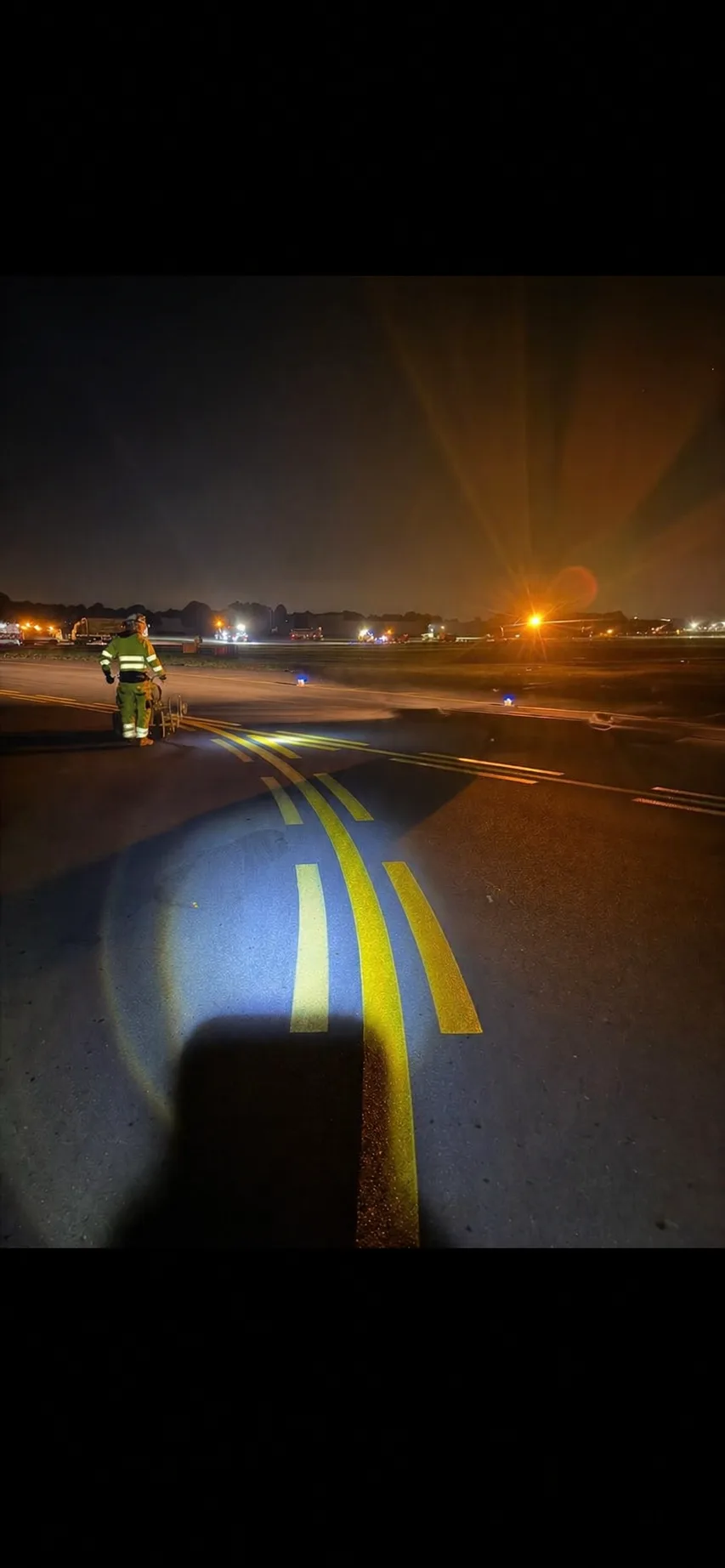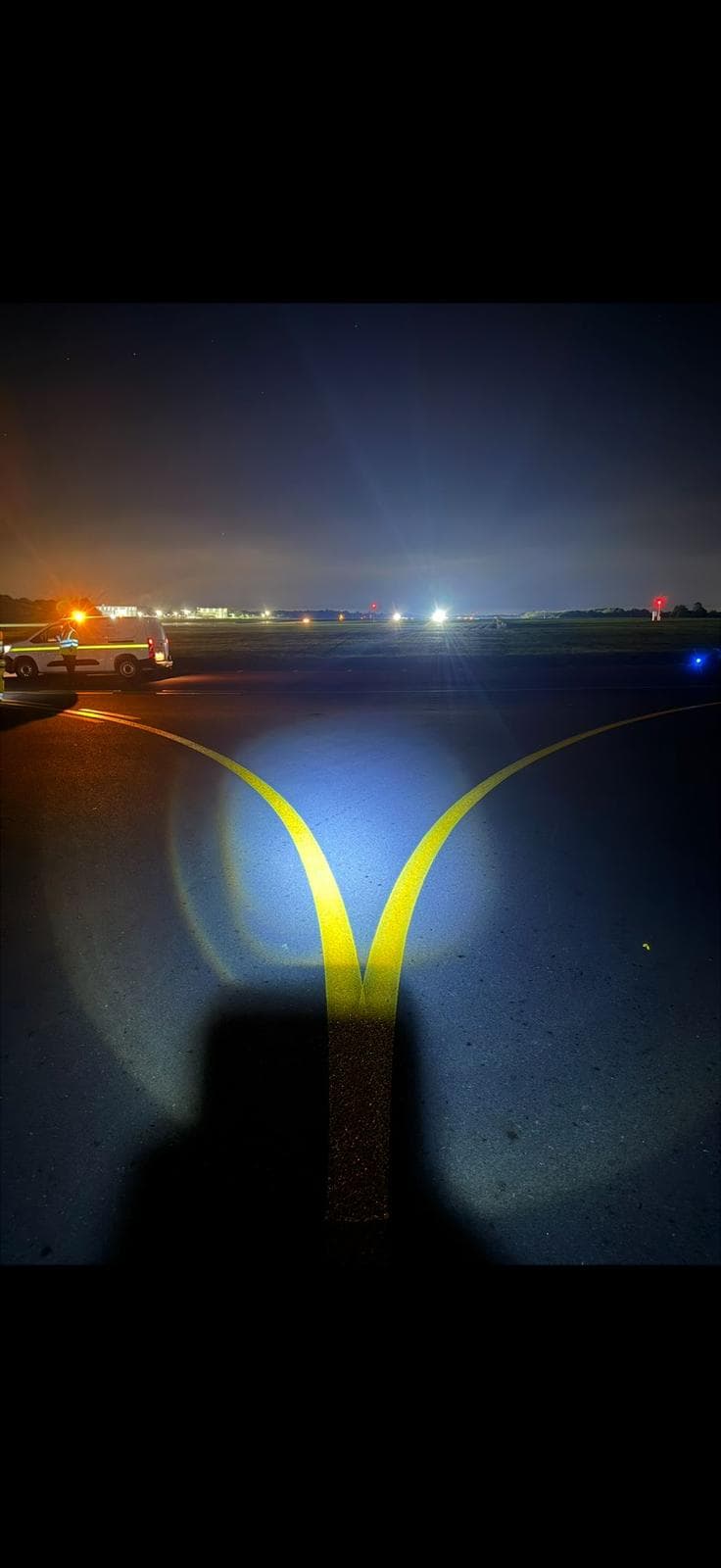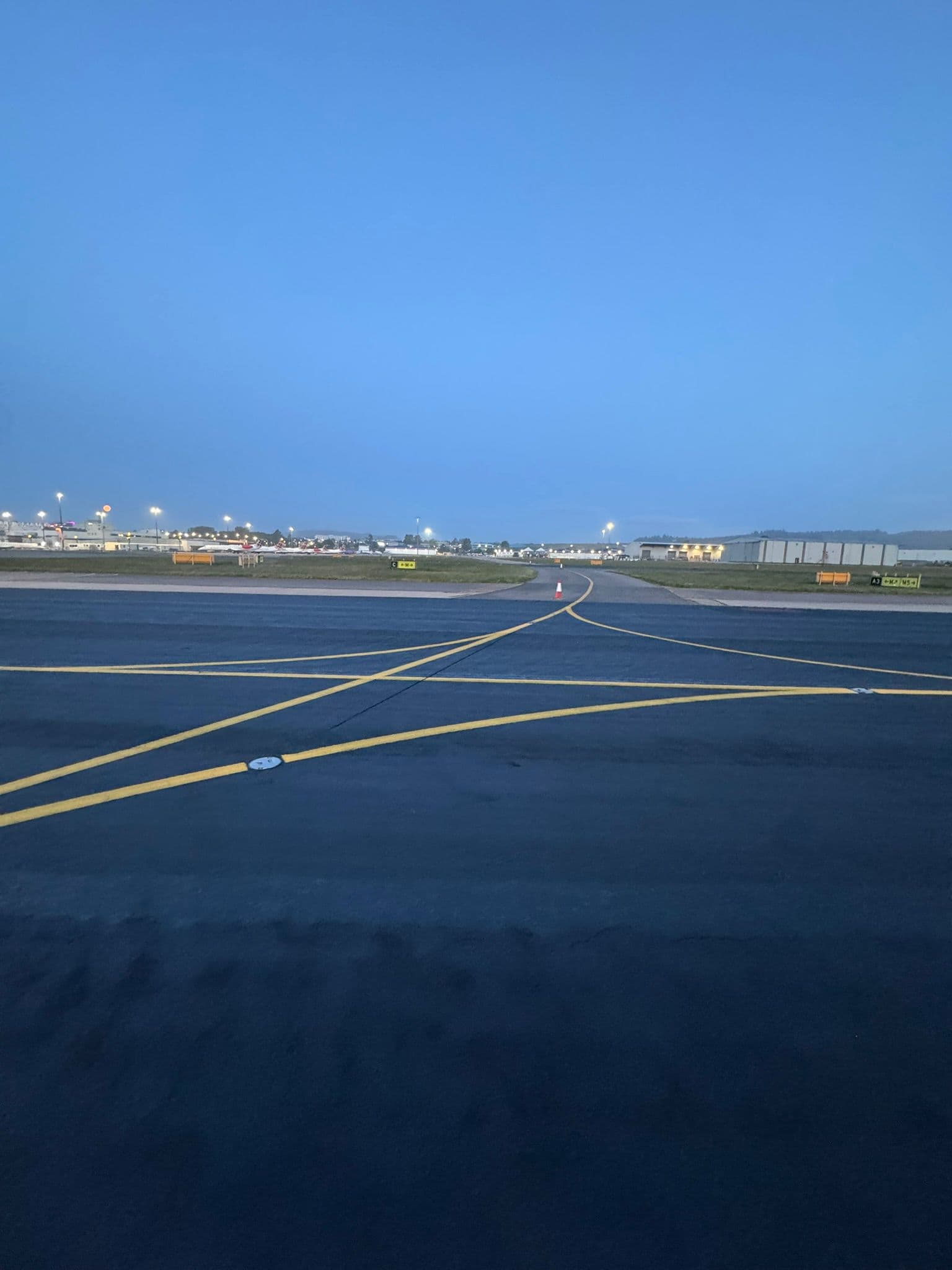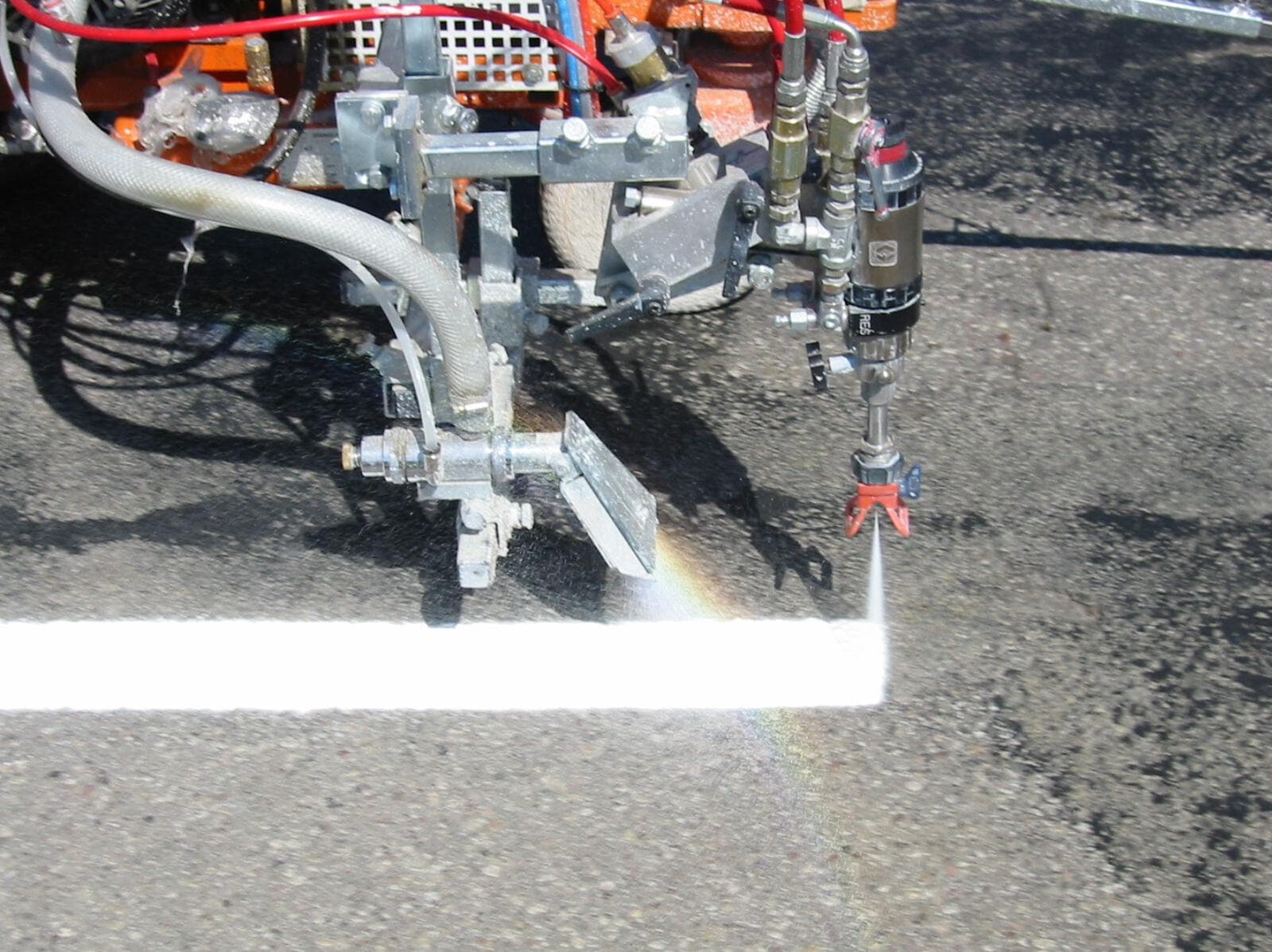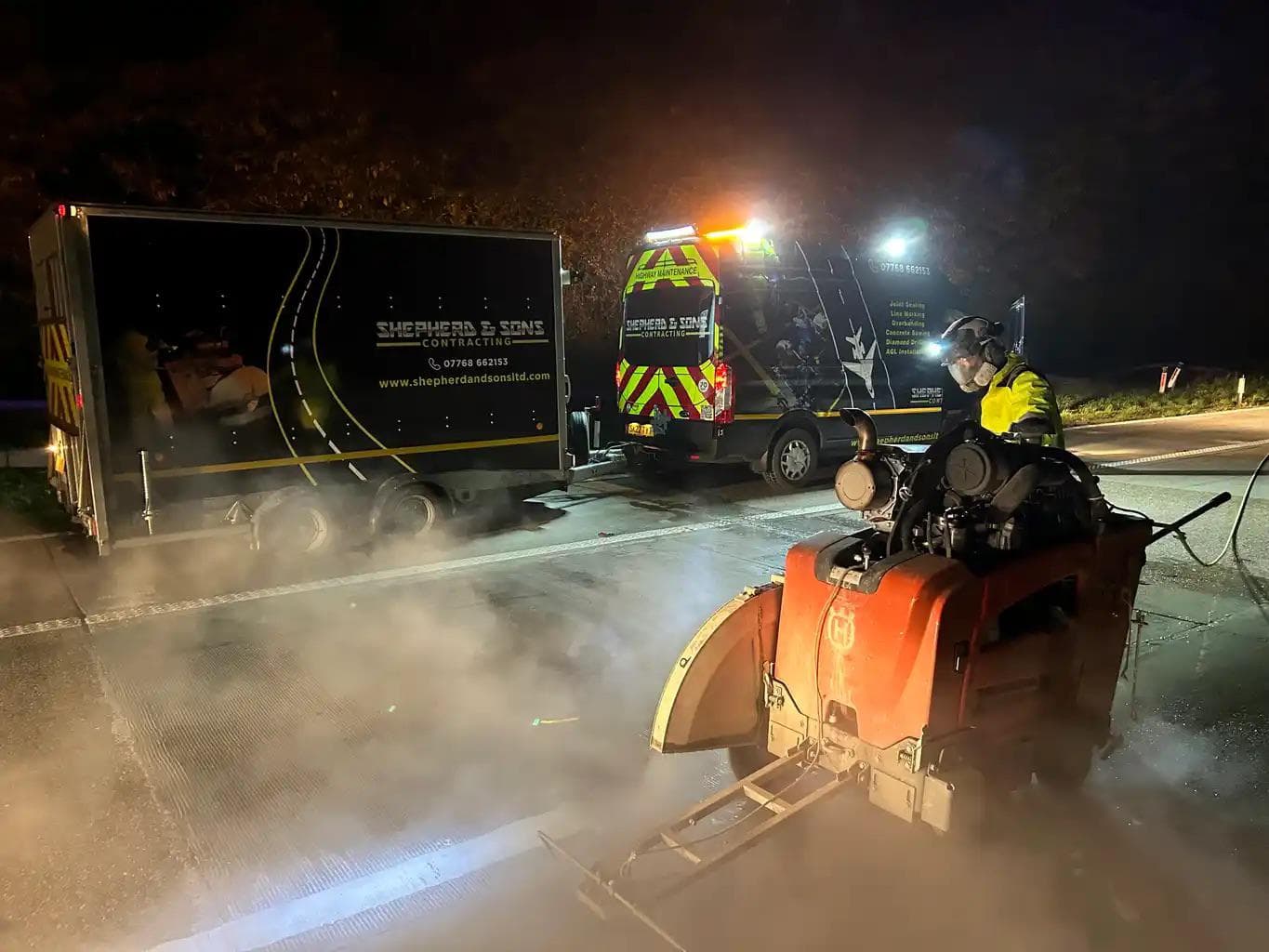
Car park line marking is the setting out and laying of bays, aisles, arrows, walkways and hatching on a car park, in a material chosen for that surface. Most of it is decided on paper long before anyone opens a tin. How many bays fit, which way traffic runs round the deck, where people walk and how a delivery vehicle gets back out without a three point turn. The painting is the last and shortest part of the job.
Shepherd and Sons are a third generation family firm at Little Westerhill Farm in Linton, just outside Maidstone, and line marking sits alongside our joint sealing and concrete cutting. Car park marking falls between traffic engineering and surfacing, and it is easy to specify as neither. The car park line marking page covers the service itself.
Setting out is most of the work
A bay grid is one measurement repeated forty or fifty times, and every repetition inherits the error of the one before. Be two centimetres out per bay and nobody notices for the first ten. The row simply runs short at the far end, where there is nothing left to borrow. So the grid comes off a datum, strung or chalked across the area and checked back against the drawing. Nobody measures a bay from the one before it.
On the CLdN container terminal at Purfleet, part of our ports work, the marking ran to 220 lorry bays, 36 container bays, over 450 stencils and nine roadways with their own centre lines and give ways, all in one part epoxy laid through a Graco LineLazer. A row that wandered there would not just lose a bay at the end. It would put a give way out of position on ground where loaded trailers and handling plant cross all day.
The decisions made at that stage are the ones paint cannot undo. Aisle width against bay depth, because each takes space from the other. One way or two way circulation. Sight lines at the corners and the exit. Where the pedestrian route goes, and whether it is marked or kerbed. Marking can change a layout, tighten a grid, reverse a flow and make a walking route obvious, but it cannot move a column, widen a ramp or shift a drain. A car park relined without touching any of that is a bad car park with fresh paint on it.
The bays that are not ordinary bays
The value in a scheme sits in the bays that are not standard.
- Accessible bays. The Department for Transport's Inclusive Mobility guide recommends an off-street accessible bay at least 4800mm long and 2400mm wide. Where bays sit at right angles to the aisle it adds a 1200mm zone on each side, which can be shared with the next bay, and a further 1200mm zone at the back for rear access and a hoist. It also recommends a raised sign at the head of the bay, so its purpose still reads when the markings fade.
- Parent and child bays. Wider than standard, so a door can open fully and a child seat can come out through it. Sited near the entrance or the lift core, or they get ignored.
- Electric vehicle charging bays. Placed by the reach of the cable from the unit, not by where a space happens to be free. A lead lying across a footway is a trip hazard for every day the charger is in use, and it is cheapest to solve on the drawing.
- Motorcycle areas, loading bays and hatched keep clear areas. Small in area, and the first things squeezed out by somebody chasing a bay count.
A bay marked to the right size with its side zones left off is a wide bay, not an accessible one, and side zones marked and then parked in are no better. That is a signage and enforcement question as much as a marking one, and it is worth raising with the operator while the scheme is still a drawing.
Where the rules apply, and where guidance does
On a public road, markings are prescribed. The Traffic Signs Regulations and General Directions 2016 set out what each marking looks like and means, and chapter 5 of the Traffic Signs Manual explains how they are used. Most car parks are private land, and Inclusive Mobility recommends that off-street car parks follow the same regulations anyway, for consistency for the people using them.
Beyond that, a car park's grid is set by the layout drawing, the client's own estate standard, any planning conditions attached to the development and, for anyone providing a service to the public, the duty to make reasonable adjustments for disabled people under the Equality Act 2010. In practice the dimensions come off the layout drawing, agreed before work starts, and that is where any argument about them belongs. We mark to the figures on it and will say so if something looks wrong, but a marking contractor is not the right party to invent an accessible bay size on site. On a new scheme, settle the accessible and charging provision early, because both change the bay count.
The material follows the deck, not the drawing
On external asphalt the volume answer is hot laid thermoplastic. It lays quickly over long runs, costs least per metre and carries the glass beads that send headlight back to a driver at night. Indoors, and on concrete generally, it stops being a candidate. It is laid hot, which is not something to do inside an occupied building, and the bond it forms on a trowelled deck is not one to rely on.
That leaves epoxy or MMA, which both harden by chemical reaction and both survive a turning tyre. Neither goes straight onto a power floated slab, which carries a weak skin of fines and cement paste that has to come off first. MMA also wants a primer on concrete, and IKO's data sheet for its PMMA marking system calls for one because of the porosity of concrete.
A multi storey deck adds somebody else's system to the problem. Where the deck is waterproofed or resin coated, the marking goes on top of a system warranted by another firm, and compatibility is their question. Ask for the data sheet and the primer that system accepts, in writing, before anything is ordered. Where that cannot be produced, a trial patch left a week and then attacked with a scraper tells you more than an assurance on the phone. A marking that lets go can bring the coating up with it, and the reline then becomes a waterproofing repair.
The materials are compared in full in thermoplastic road marking, epoxy line marking and MMA line marking, and what line marking is puts them side by side.
Old markings are the problem, not the background
Relining is mostly a question about the layer nobody can see. A fresh line over a thermoplastic one that has lost its grip is holding onto something on its way off, and it fails to the old marking's timetable rather than its own. That is why most relines start by taking the old lines off, by blasting or grinding, and making good the scar before anything is laid. A bay that has been overpainted twice already is a removal job with a reline at the end of it.
Thermoplastic is also thick enough to read through whatever covers it, and on a wet night under lights an old bay edge can show nearly as brightly as the new one. Drivers follow the line they can see, which is how a relined deck ends up with cars parked on two grids at once.
Clean and dry is a condition to be met, not a description of how the deck looks. A deck that has dried in the wind after overnight rain can still hold water in the low spots and in the groove the old marking left, which is exactly where the new line goes. Blasting grit and grinding dust have to be collected, not swept towards the edge.
Marking a car park that stays open
Almost none of this work happens in an empty car park. The operator needs the income and the tenants need the spaces, so a scheme is phased. A zone, a level or a block of bays at a time is barriered off, set out, marked and left alone until it can take traffic again, usually overnight or on the quietest day.
What decides when it reopens is cure, and cure has two stages that get run together. A marking can be firm enough to walk near long before it can take a turning tyre, and a car driven onto an uncured bay leaves a print, picks material up on the tread or drags the line out of shape. So the barriers come down on a timed basis, not on somebody's judgement.
Cure is also the case for MMA where a car park cannot give up a level for long. IKO gives about 30 minutes at 20°C for its system, with the hardener dose adjusted to the temperature and a working range starting at 5°C. Thermoplastic sets quickly as it cools, but it wants a warm, dry surface to bond to, and a cold car park deck in December rarely offers one. MMA's smell during laying is the trade-off, and on an enclosed deck or under occupied windows it is better mentioned beforehand than explained afterwards.
What makes a reline last
Three things decide it, and the material is not one of them. The first is the substrate. A marking cannot be better attached than the surface under it, so fretting asphalt, concrete breaking up at the face or a deck cracked through will take the marking with it. Surface repairs come first, and cracks that are still moving want chasing and sealing rather than a line painted across them.
The second is preparation, the first thing to go when a price is tight and the last thing anyone can see afterwards. The third is water. Standing water keeps the film wet for hours and, in winter, freezes and thaws on it, so a bay that ponds is always the first needing doing again. The answer there is falls and drainage, not a better paint.
What to have ready before you ask for a price
- A layout drawing, or failing that a bay count and a measured sketch of the area.
- What the deck is. Asphalt, bare concrete, power floated concrete, or a coated or resin surface, and if it is coated, whose system it is.
- What is there now, roughly how old it is, and whether it has been overpainted before.
- Whether the accessible, parent and child or charging provision is changing, because that moves the grid, not just the lines.
- When the area can be taken out of use, and for how long at a time.
On a council, school or hospital estate the paperwork is part of what is being bought. Batch numbers, mix ratios, the surface temperature when a line went down and the date each phase came back into use can all be asked for later, so they are recorded phase by phase as the job runs. That side of it sits in our public sector work. Kent, London, Sussex and Essex are covered from our own yard at Linton.
If you have a car park due for relining, a photograph of the existing markings and a rough bay count is the quickest way to a straight answer. That is usually enough to tell whether you are looking at a reline, or repairs first and marking second. Ring 07768 662153, or contact us and we will come and walk the deck with you.