Shepherd and Sons Ltd
What Is Epoxy Line Marking?
Epoxy line marking is a two-part, cold applied paint system used to create durable floor and pavement markings. A base resin and a hardener are mixed on site in a controlled ratio, then applied by airless spray, roller or brush. The two components react chemically to form a hard, cross-linked coating that bonds directly to the prepared substrate. Unlike thermoplastic, which is melted and laid at around 180 to 200°C, epoxy cures at ambient temperature, which makes it the standard specification for internal environments where heat application isn’t viable. It’s used across warehouses, distribution centres, industrial floors, food production facilities, hospital service yards and internal car parks, with a typical service life of five to ten years under industrial traffic.
At Shepherd and Sons, we deliver epoxy line marking as part of our wider line marking service, with more than 40 years of surfacing experience across UK airfields, highways, ports and industrial sites. We’re based at Westerhill Farm in Kent, and we hold SafeContractor and CHAS accreditation. This article covers what epoxy line marking is, how the chemistry works, when it’s the right specification, why surface preparation determines the outcome, and how to specify it properly.
How epoxy line marking works
The chemistry is a cross-linking reaction, not a drying process. Conventional floor paints dry by solvent or water evaporation, leaving a film sitting on the surface. Epoxy is different. The base resin contains epoxide groups, and the hardener contains reactive amine groups. When the two are mixed, they react to form a dense, three-dimensional polymer network.
Three things follow from that chemistry:
Mechanical toughness. The cross-linked structure is significantly harder and more abrasion-resistant than a solvent-dried paint film. It withstands forklift wheels, pallet truck traffic, dragged pallets and general industrial abrasion.
Chemical resistance. Epoxy resists oils, greases, hydraulic fluids, fuels, mild acids and alkalis, and most cleaning chemicals. This matters in food production, chemical handling and vehicle workshop environments where wash-down regimes destroy standard floor paints.
Adhesion to prepared concrete. Epoxy bonds into the surface profile of a properly prepared concrete slab rather than sitting on top of it. That bond is why a correctly installed epoxy marking outlasts a painted one by years.
The trade-off is that the reaction has a defined pot life. Once mixed, the material has to be applied within the manufacturer’s stated working window, typically 20 to 45 minutes depending on ambient temperature. Beyond that, it begins to gel in the container and can’t be used.
When epoxy line marking is the right specification
Five scenarios drive the specification towards epoxy.
Internal industrial floors. Warehouses, distribution centres, manufacturing plants, cold stores. A thermoplastic applicator running at 200°C isn’t viable indoors, and the ventilation, fire risk and fume management issues rule it out entirely in food-grade and pharmaceutical environments.
Heavy forklift and pallet truck traffic. Epoxy resists the point loading and turning scuff of solid-tyre plant far better than conventional paint.
Chemical and wash-down exposure. Food production, brewing, chemical handling, vehicle workshops and hospital service areas where the floor is regularly cleaned with detergents, degreasers or sanitisers.
Power-floated concrete. Most modern industrial floors are power-floated to a smooth, dense finish. That finish is difficult for many marking systems to bond to. Epoxy, applied over correctly prepared and profiled concrete, develops a genuine mechanical and chemical bond.
Long-life internal markings. Where the layout is settled and the client wants a marking that lasts rather than one that needs annual reapplication.
In our experience, epoxy line marking works better than thermoplastic on internal warehouse floors because epoxy cures chemically at ambient temperature and bonds into the prepared concrete profile, where thermoplastic relies on heat to key into the surface and simply cannot be applied safely inside an occupied building. On a Kent distribution centre reline where the racking aisles carry continuous counterbalance forklift traffic, the epoxy markings were still clearly legible at year six. The equivalent conventional floor paint on the adjacent mezzanine, applied at the same time, needed redoing inside eighteen months.
That said, for a 2km stretch of external A-road lining, thermoplastic is faster, cheaper per metre, and delivers the retroreflectivity that highway specifications demand. Epoxy isn’t the answer to every marking job.
Epoxy compared to the alternatives
For specifiers weighing the options, the practical comparison is:
Epoxy versus thermoplastic. Epoxy is cold applied, suits internal use, and offers better chemical resistance. Thermoplastic is faster on long external runs, cheaper per metre, and carries the glass bead retroreflectivity required for highway work. Thermoplastic cannot be used internally.
Epoxy versus MMA. MMA cures in 15 to 30 minutes even at low ambient temperature, which makes it the specification for overnight relines and cold-weather work. Epoxy takes four to twenty-four hours to cure depending on temperature. MMA carries a strong odour during application that rules it out in some occupied buildings. Where turnaround speed is the constraint, MMA wins. Where chemical resistance and cost matter more, epoxy does.
Epoxy versus conventional floor paint. Not a close comparison. Single-pack floor paints are cheaper and easier to apply, but the service life on trafficked industrial floors is typically measured in months rather than years.
Why surface preparation determines the outcome
This is the part specifications routinely under-cover, and it’s where most epoxy marking failures originate.
Epoxy needs a clean, sound, dry, profiled substrate. Applied over a surface that doesn’t meet those conditions, it will delaminate regardless of how good the product is.
Laitance removal. Power-floated concrete has a weak surface layer of fines and cement paste called laitance. Epoxy bonded to laitance is bonded to a layer that will itself detach from the slab beneath. Laitance has to be removed, normally by shot blasting or diamond grinding, to expose sound concrete and create a surface profile.
Moisture testing. Epoxy is largely impermeable. Applied over concrete with high moisture content, or over a slab without an effective damp proof membrane, water vapour pressure builds beneath the coating and pushes it off. We’ve found this is the single most common cause of epoxy marking failure on new-build industrial floors, because the slab looks dry to the eye long before it is dry enough to coat. Relative humidity testing before application is not optional on new concrete.
Contamination removal. Oil, grease, rubber deposits, curing compounds and previous coatings all prevent adhesion. Degreasing followed by mechanical preparation is standard.
Existing marking removal. Where old markings are incompatible or in poor condition, they’re removed by shot blasting, grinding or scarification. Overpainting a failing marking simply transfers the failure to the new coating.
Priming. Some substrates require a primer to seal porosity or improve adhesion. The requirement is product-specific and set by the manufacturer’s technical data sheet.
Working around joints and movement
On concrete floors with induced or expansion joints, a marking applied straight across a moving joint will crack along the joint line within the first seasonal cycle. Epoxy is a hard, relatively inflexible coating with limited movement accommodation, so it doesn’t bridge joints.
The practical approach is to stop the marking either side of the joint, or to accept and design for a break in the line. Where the joint itself is being sealed as part of the same programme, the sealing and marking sequence has to be coordinated, and cold applied joint sealing is normally the appropriate system for internal floor joints because it also cures at ambient temperature.
The application process
Setting out. Line positions are surveyed and marked with chalk lines or temporary marker before application. On industrial floors, the layout is agreed against the traffic management plan rather than simply copying the previous markings, which may no longer reflect how the site operates.
Masking. Edges are masked to produce a clean line. Masking is removed before the epoxy skins over.
Mixing. Base and hardener are combined in the manufacturer’s specified ratio and mixed mechanically until uniform. Incorrect ratio is a failure cause: too little hardener and the coating stays soft, too much and it becomes brittle. Material at the bottom and sides of the container must be fully incorporated.
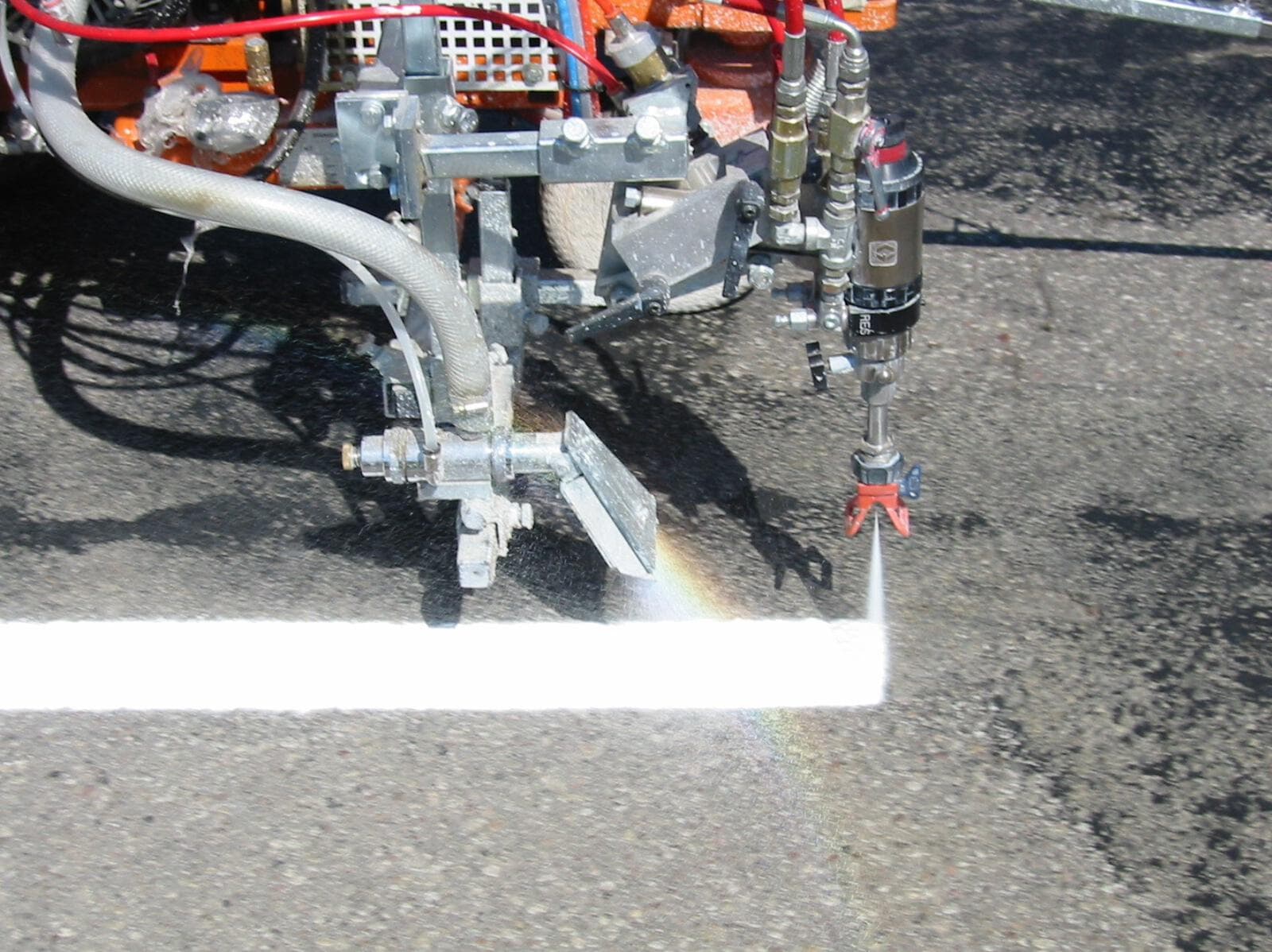
Application. Airless spray for large areas and long runs, roller for narrower lines and detail, brush for edges and awkward geometry. Wet film thickness is controlled to the specification, because under-application reduces service life and over-application extends cure time and can trap solvent.
Cure and return to service. Foot traffic is typically possible after 8 to 12 hours at 20°C. Full mechanical cure and vehicle trafficking usually needs 24 to 72 hours. Low ambient temperature extends cure significantly, and below about 10°C many epoxy systems cure very slowly or not at all.
Colour, safety marking and compliance
Industrial floor marking colours carry meaning, and the specification should reflect the site’s traffic management plan and safety signage scheme rather than aesthetic preference. Yellow is conventionally used for pedestrian walkways and general caution, yellow and black chevrons for hazard areas, red for fire equipment and emergency access, white for general demarcation and bay marking, and blue or green for information and safe condition areas.
For workplace floor marking, the relevant framework is the Workplace (Health, Safety and Welfare) Regulations 1992, which requires traffic routes to be suitable and appropriately organised, supported by HSE guidance document HSG136 on workplace transport safety. Where epoxy is used on external road or car park markings subject to highway performance requirements, BS EN 1436 sets the performance characteristics for retroreflection, colour and skid resistance.
It’s worth being clear that painted markings are a visual control, not a physical barrier. HSE guidance is explicit that where the risk warrants it, physical segregation should supplement markings rather than markings replacing barriers.
Sectors where epoxy line marking is specified
Public sector clients specify epoxy for hospital service yards, council depot floors, school sports halls, fire and rescue vehicle bays and NHS estate internal markings. Port operators use it in warehousing, cargo handling buildings and internal plant areas where chemical exposure and heavy plant loading combine. Aviation clients specify epoxy in maintenance hangars, cargo sheds, baggage handling halls and internal airside buildings. Highway authorities and contractors use it in depot buildings, gritter loading bays and vehicle workshops.
We’ve delivered line marking across the UK, spanning external highway and airfield work through to internal epoxy schemes.
Specifying epoxy line marking properly
A meaningful epoxy line marking specification will identify the substrate type and age, the required surface preparation method, the moisture testing requirement on new concrete, the primer requirement, the product and colour scheme mapped to the traffic management plan, the line widths and layout, the wet film thickness, the ambient temperature window, the cure and return-to-service requirement, and the treatment of joints and movement.
A specification that lists “epoxy line marking, £X per metre” tells you nothing about whether the substrate has been assessed or whether the marking will still be there in five years. For the broader picture of how epoxy sits alongside the other material options, what is line marking? covers the full range and where each system fits.
If you’re specifying or commissioning epoxy line marking work, whether that’s a warehouse floor scheme, a hospital service yard, a hangar or a depot building, get in touch. We’ll assess the substrate, the traffic loading, the chemical exposure and the programme, and quote against the actual specification. You can see recent project work on our LinkedIn and Instagram.