
Shepherd and Sons Ltd
Concrete Cutting at UK Airports
Concrete cutting at UK airports is one of the most technically demanding categories of cutting work in the country. It combines heavily reinforced airfield concrete (typically 300mm to 500mm thick), embedded live services including high-pressure aviation fuel mains and AGL cabling, extremely narrow operational access windows measured in hours rather than shifts, and strict CAA and ICAO compliance requirements that govern everything from cut geometry to slurry management. The techniques used are largely the same as ordinary concrete cutting (floor sawing, wall sawing, wire sawing and diamond drilling), but the methodology, risk assessment and operative competence sit at a completely different level.
At Shepherd and Sons, we’ve been delivering concrete cutting at UK airports for more than 40 years, working across runway, taxiway, apron and airside civil pavement programmes. We’ve been the sole BAA PLC contractor since 2008 alongside the BAA pavement team, and our operatives hold the airside familiarisation, CAA-aligned training and services survey competence required for live airfield work. We’re based at Westerhill Farm in Kent, and we hold SafeContractor and CHAS accreditation alongside our Extruded Sealant Association membership. This article covers what airport concrete cutting involves, why it’s different from ordinary cutting, the methods used, and how to specify it properly.
Why airport concrete cutting is different
Airport concrete cutting differs from standard highway or industrial cutting in five specific ways.
Heavy reinforcement. Airfield pavements are engineered for aircraft wheel loads that far exceed anything on a highway. Slabs are typically 300mm to 500mm thick, with dense reinforcement mat and dowel bar arrangements at joints. Cutting through this concrete requires the right blade specification for the reinforcement density, not just the depth.
Embedded live services. Aviation fuel mains, hydrant pit lines, AGL cabling, FID (fuel isolation valve) circuits, drainage and communications cabling all sit within or immediately below the pavement. Every cut has to be planned around these services. The consequence of cutting into a live 40-bar aviation fuel main is not comparable to nicking a road drain.
Narrow operational windows. Airport pavements can rarely be closed for extended periods. Runway cutting typically happens in short overnight closures, sometimes as brief as four hours between last-departure and first-arrival. Taxiway and apron work is often carried out inside operational hours with rolling closures and immediate handback requirements.
CAA and ICAO compliance. All airfield surface work has to comply with CAP 168 (aerodrome licensing) and ICAO Annex 14 (aerodrome design). This includes surface tolerances, drainage requirements, edge conditions, foreign object debris (FOD) management and reinstatement quality standards.
Foreign object debris control. Every offcut, slurry droplet and dust particle is a potential FOD risk on a live airfield. FOD control on airport cutting work is at a level ordinary construction cutting simply doesn’t operate at.
In our experience, ESA-member specialist contractors with genuine airside experience work better than general concrete cutting contractors on UK airport work because the combination of live-services awareness, FOD discipline, airside protocol competence and reinstatement interface knowledge is what determines whether a job is delivered safely within the closure window, or whether it overruns and disrupts operations. On a live airside apron programme where a fuel main runs 600mm below the slab and stitch drilling is the only permitted method, the difference is real and measurable.
The cutting methods used at UK airports
Airport concrete cutting draws on the full family of concrete cutting techniques, matched to the specific work.
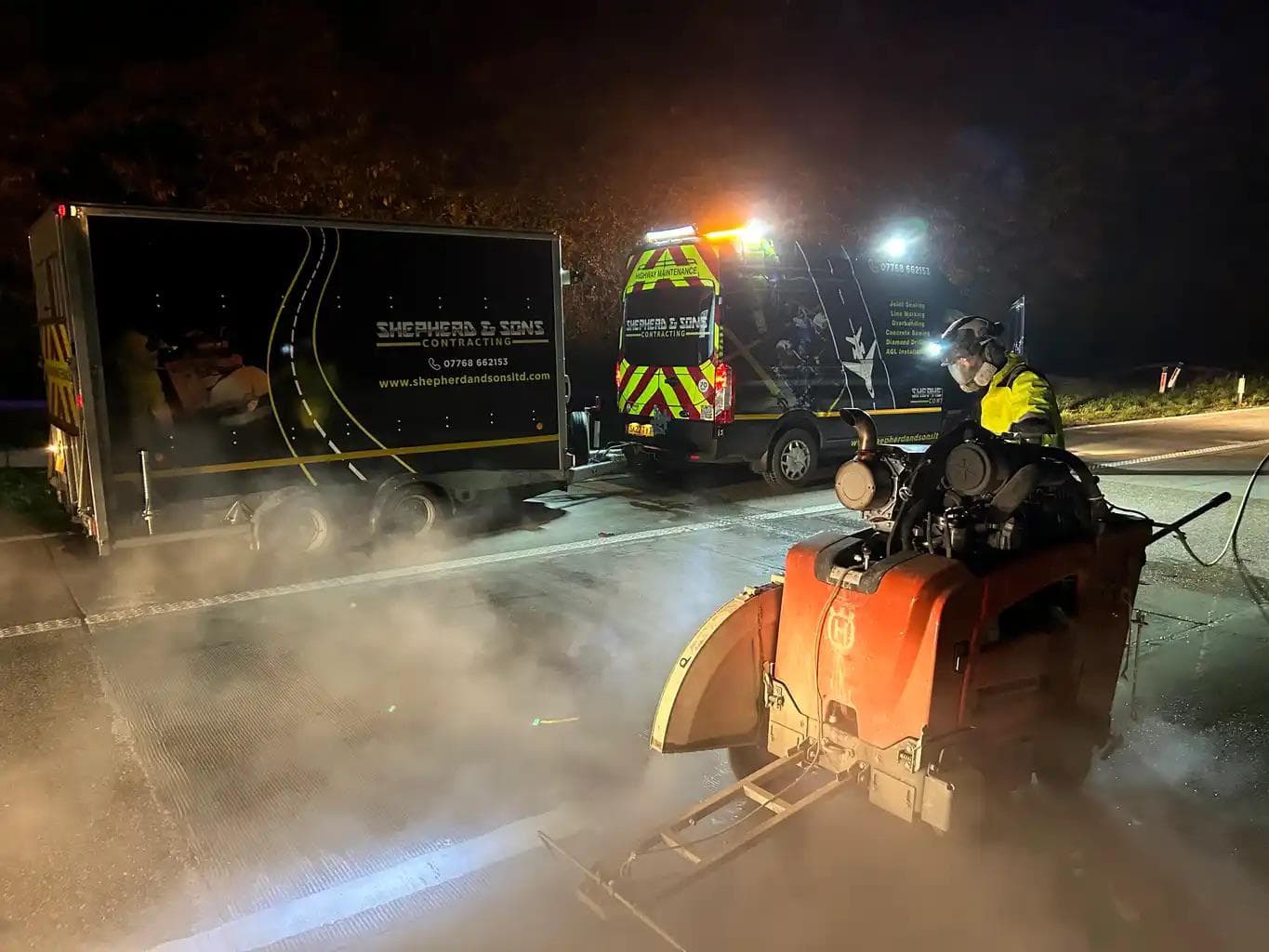
Floor sawing. Walk-behind diesel and electric floor saws with large-diameter blades for horizontal slab cuts. Used for joint reformation, slab isolation before replacement, service trenching and pavement modification work. Standard airport slab thicknesses of 300mm to 500mm are within the capability of specialist floor saws with the right blade specification.
Wall sawing. Track-mounted circular blade for vertical cuts in structural walls, aircraft stand kerbs, apron edges and hardened facilities. Less common than horizontal cutting on airports but essential where structural modification is needed.
Wire sawing. Continuous diamond wire fed through pulleys around the section being cut. Used where heavy reinforcement, depth beyond blade capacity, or unusual geometry rules out conventional sawing. Common on heavy hardened facilities and older concrete structures where reinforcement density exceeds standard cutting parameters.
Diamond drilling. Hollow diamond core barrels for circular penetrations. Used for AGL fitting installations, service penetrations, fuel line access points, and post-tensioning ducts. Diameters range from 50mm for small fixings to 600mm for major services.
Stitch drilling. Overlapping cores drilled side by side to form a cut line, with the narrow webs between them broken out and the section removed by vacuum lifting plant. This is the specialist method for cutting around live high-pressure aviation fuel mains, where continuous sawing risks puncturing the main and mechanical breaking is prohibited. Stitch drilling is arguably the single most important cutting technique in airport work.
Where concrete cutting is specified at UK airports
Concrete cutting is specified across every operational area of a UK airport.
Runway work. Joint reformation, slab replacement, threshold work, touchdown zone repair, and grooving reinstatement. Runway cutting operates within extremely short overnight closure windows and requires the highest specification for edge quality, reinstatement compatibility and surface tolerance.
Taxiway work. Slab replacement, joint reformation, service trenching, AGL fitting installation and rolling maintenance programmes. Taxiways typically have longer closure windows than runways but still operate under airside protocols.
Apron and stand work. Aircraft parking aprons, cargo aprons, fuelling stands and remote stands all need periodic cutting for slab replacement, fuel main access, hydrant pit reinstatement, and joint reformation. Aircraft fuelling aprons are the environment where stitch drilling is most often specified because of the density of embedded fuel infrastructure.
Airside civil pavement. Perimeter roads, service roads, ground handling routes and airside vehicle areas. These pavements sit between runway/taxiway grade and standard highway concrete, and the cutting work reflects that.
Airfield ground lighting (AGL). Cutting for new AGL fitting installations, replacement of failed fittings, and cable route modifications. AGL work is a specialist tie-in between cutting, drilling and electrical installation. We deliver AGL installations as a linked service.
Fuel infrastructure. Fuel main access work, hydrant pit surrounds, fuelling apron modifications, and fuel storage hardstanding work. This is where stitch drilling and specialist services survey competence matter most.
We’ve delivered concrete cutting work at UK airports including Heathrow, Gatwick, Stansted, Luton, Manchester, Birmingham and Edinburgh, alongside regional airports across the network. Our aviation work covers all seven former BAA PLC airports plus a range of independent and MoD-adjacent facilities.
Airport concrete cutting: the CAA and ICAO framework
Airport cutting work is governed by a specific regulatory and specification framework that doesn’t apply to ordinary construction cutting.
- CAP 168 (Licensing of Aerodromes) covers all licensed UK airport surface work
- ICAO Annex 14 (Aerodrome Design and Operations) sets international pavement standards
- CAP 232 (Aerodrome Survey Information) covers survey and setting-out requirements
- DIO Design and Maintenance Guide 03/13 for MoD airfield work
- HSE guidance for diamond drilling and sawing operations
- The Drilling & Sawing Association (DSA) Code of Practice
- BS EN 14188 series and ESA Code of Practice where cutting interfaces with joint sealing
- CDM 2015 Regulations for construction projects
Airside competence is verified through airside familiarisation training, airport-specific inductions, and operational protocol training that has to be completed at each individual airport before work can commence.
What proper airport concrete cutting involves
The methodology on airport cutting operates at a higher level of discipline than ordinary construction cutting.
Pre-works services survey and coordination. Every cut is planned around embedded services drawings, physical services verification, and coordination with the airport engineering, fuel and AGL teams. Live fuel main locations are typically confirmed both from drawings and physically before any cut commences.
Airside protocol adherence. Vehicles, plant and personnel entering airside operate under strict escort, radio and visibility protocols. All operatives hold current airside passes and complete airport-specific induction.
FOD control. Every tool, offcut, water droplet and slurry particle is treated as potential FOD. Cutting is done wet, with continuous water feed and immediate slurry containment. Loose material is not left on the surface. FOD walks are conducted before handback.
Closure window discipline. Runway and taxiway closures come with immediate handback requirements. The cutting programme is planned to complete the cut, remove the section, undertake the reinstatement, and return the surface to operational status inside the closure. Overruns aren’t tolerated.
Reinstatement interface. Airport cutting rarely stops at the cut. It feeds into slab replacement, joint sealing, AGL reinstatement or line marking reinstatement. The cutting specification has to align with what comes next. The ESA Code of Practice Section 5.1 specifies joint slot faces should be within 10° of vertical for proper sealant performance, and airport joint sealing specifications typically use high-performance products like 9525 hot applied or Thioflex 555 cold applied. A poorly cut joint can’t be properly sealed regardless of the sealant grade.
Records and handover. Airport work is documented at a level that ordinary construction rarely reaches. Sample records, service survey confirmations, reinstatement specifications, and closure records all form part of the handover pack.
We’ve found that contractors who treat airport cutting as an enhanced version of ordinary highway cutting produce work that overruns closure windows and creates operational disruption. Airport cutting is a different discipline, and it needs to be delivered by contractors who operate at that discipline as standard.
Specifying concrete cutting at UK airports properly
A meaningful airport concrete cutting specification will identify the pavement type (runway, taxiway, apron, airside civil), slab thickness and reinforcement, the cut linear metres and geometry, the required depth and width, the services survey requirement, the airside protocol requirements, the FOD control regime, the closure window, the section removal method, and the reinstatement interface (joint sealing, slab replacement, AGL, line marking).
If you’re specifying or commissioning concrete cutting work at a UK airport, whether that’s runway joint reformation, apron slab replacement, taxiway service trenching or stitch drilling around fuel infrastructure, get in touch. We’ll work with your engineering, operations and airside teams to assess the pavement, the services, the closure window and the reinstatement scope, and quote the full package properly under CAA-compliant working. You can see recent aviation project work on our LinkedIn and Instagram.
More on Aviation
 Aviation
What Is a Cable Chase?
Read More » Aviation
What Is Airfield Ground Lighting?
Read More »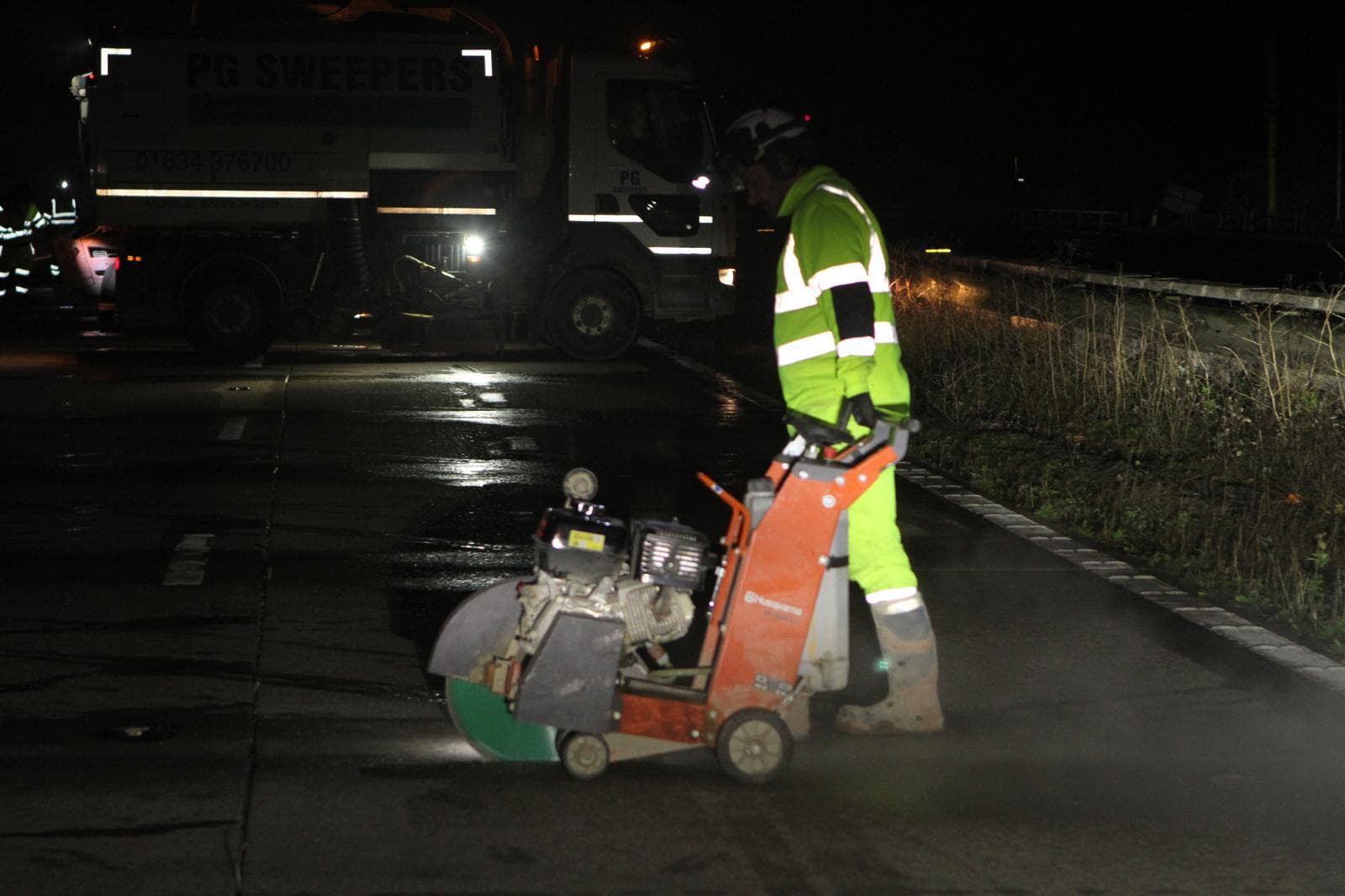
What is joint widening?
Read More » Line Marking
What Is Epoxy Line Marking?
Read More » Joint Sealing
N1 Sealant for High Movement Joints Explained
Read More »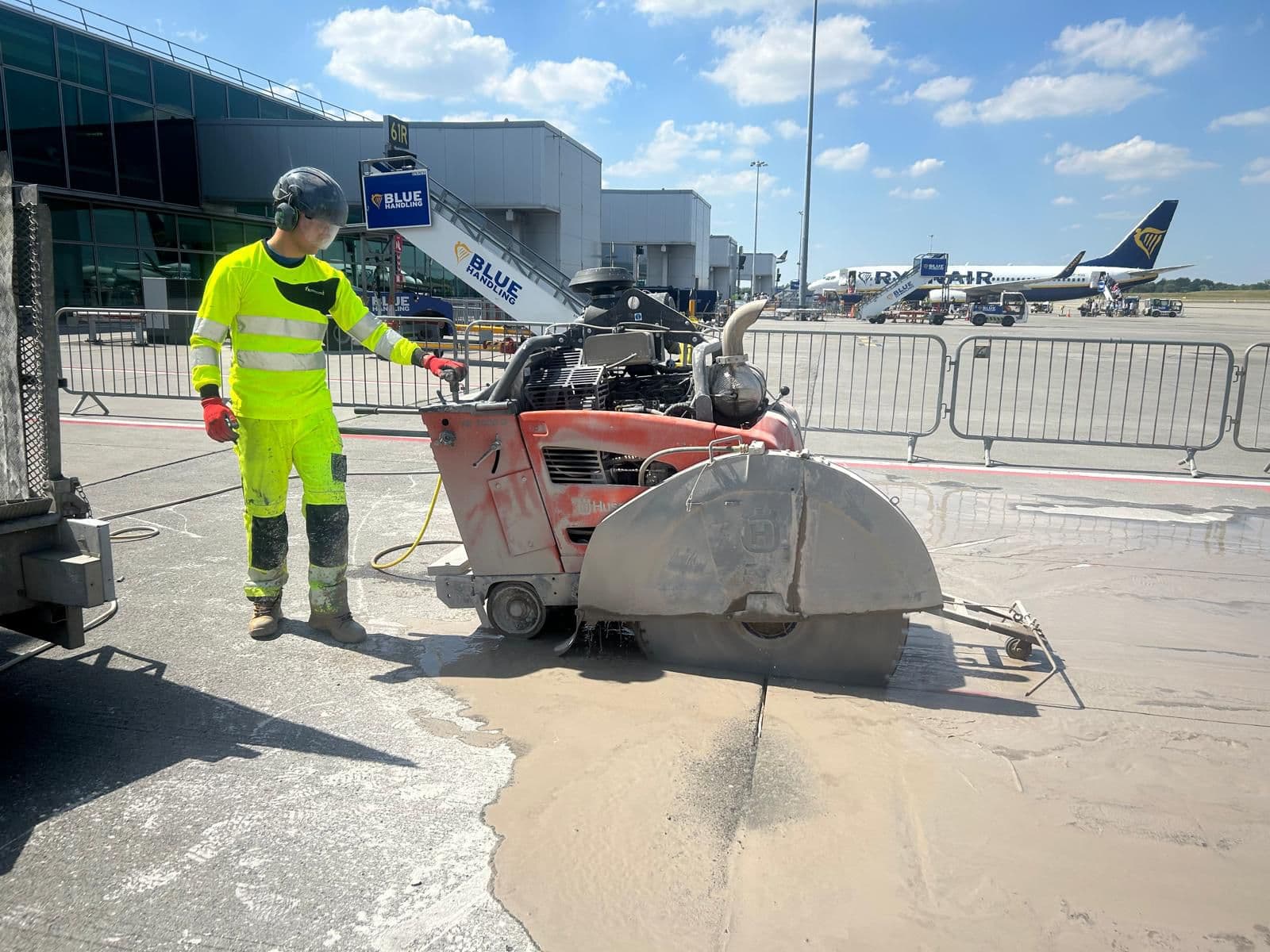 Concrete Cutting
Port Concrete Cutting in Kent
Read More »