Yes. Concrete is cut inside buildings all the time, for drainage runs and service trenches across a ground floor, for openings in walls, for lift pits and for taking out a damaged section of slab. The cutting itself is the same diamond work as outside. What changes indoors is how the saw is powered, how deep that power will take you, where the water and slurry go, and the people who are still in the building while it happens.
Most indoor cuts in a floor are floor sawing, with a walk-behind saw running a diamond blade along a marked line. Walls and openings are wall sawing or core drilling. This article goes through the questions that decide whether an indoor job is straightforward or needs a different plan, starting with the one that rules out half the plant on a yard.
Power comes first
The big floor saws used on roads and airfields run on diesel because they need the torque for deep cuts through heavy reinforcement. Inside a building an engine is a problem before it is anything else. HSE's guidance on carbon monoxide in construction names cut-off saws and generators used indoors as a cause of poisoning, and warns that even after a few minutes this can create significant levels of carbon monoxide which can kill. Its instruction is plain. Never use petrol powered equipment indoors or in enclosed spaces unless the ventilation needs have been fully assessed, and use electric tools where possible.
That is why our own rule on floor sawing is diesel outside and electric inside. Inside warehouses, food production sites, hospitals and occupied buildings, an electric saw is the only sensible choice. The same thinking applies to the plant around the saw. A generator belongs outside, well away from doors, windows and air intakes, so its exhaust cannot drift back in. HSE also points to carbon monoxide detectors where there is any doubt, because the early symptoms are easy to put down to a cold or tiredness.
Electric saws cut shallower
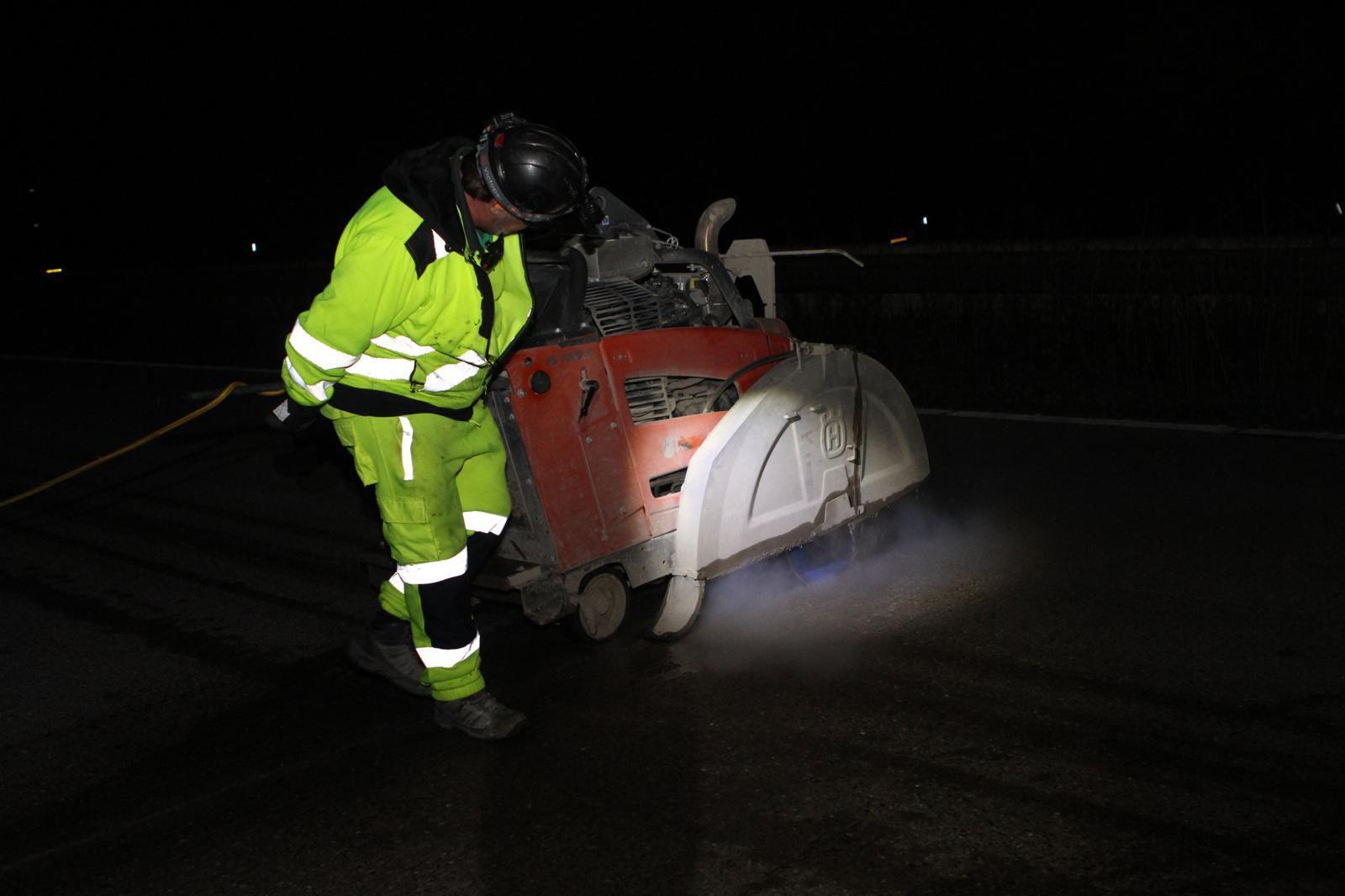
Choosing an electric saw has a cost, and it is depth. A floor saw cuts to a little under half its blade diameter, and electric machines carry smaller blades than the large diesel saws. Husqvarna's electric floor saws show the scale. Its FS 600 E takes a 600mm blade and cuts to a maximum of 240mm, and the FS 500 E reaches 190mm. Both are corded 7.5kW machines with no emissions in use, which is exactly why they are built for indoor work such as cutting trenches in a concrete floor.
Outside, our working maximum is 625mm in one pass, which is set out in how deep can you cut concrete. Indoors the useful question is whether the slab is thinner than the saw that is allowed in the room. Many ground floor slabs are, but a thickened slab under racking, a slab over a pit, or a floor with a screed and an old slab beneath it can all be deeper than they look from the surface. A core taken before the job, which is a small job for core drilling, settles the thickness and shows what is inside it.
When the floor is deeper than the saw
There are three ways round a slab that an electric floor saw cannot get through.
- Wall sawing. A wall saw runs on a track bolted to the concrete and, despite the name, cuts horizontal faces as well as walls. Husqvarna's wall saws use high frequency electric motors, and the largest in its range cuts 730mm from one side. Our wall sawing page covers where it fits.
- Wire sawing. A diamond wire is looped round the section and drawn through it, so no blade size limits how deep it can go. It suits large or very thick sections, and what is wire sawing explains how it works.
- Stitch drilling. A line of overlapping cores drilled side by side forms the cut, with no saw at all. It is slower, but the drill rig bolts down beside the line, so it works in places a saw cannot reach. What is stitch drilling covers the method.
Each of these is a different rate and a different crew from floor sawing, so it is worth knowing which one a price is based on before comparing quotes.
Water and slurry inside a building
Diamond cutting is done wet as standard. The water cools the blade, flushes the cut and keeps the dust down. On a road the water runs to the verge or is vacuumed up at the blade. Indoors it is a liquid on a finished floor, in a building that may have electrics at floor level, a lift pit, carpet in the next room or stock on the racking.
What comes off the blade is a grey slurry of water and fine concrete. It is alkaline, and it must not go into a gully, a floor drain or a sink. The government's pollution prevention guidance for businesses says only clean water should drain into a surface water drain, and contaminated water from a business's activities belongs in the foul drain. Concrete slurry is neither clean water nor something to pour away, so an indoor cut is planned around recovery. A wet vacuum follows the saw, the work area is sheeted and edged so the slurry cannot spread, drains nearby are covered, and the method statement says where the collected slurry goes before the first cut is made.
Water is also why a building's own systems need checking. Floor boxes, trunking and anything electrical near the cut line are isolated or protected before the water goes on.
Dust where water is not allowed
Some rooms cannot take water at all, because of live equipment, records, or a finish that will not tolerate it. Dry cutting is possible, but it changes the dust control completely. Concrete is full of crystalline silica, and cutting it produces respirable dust that HSE treats as one of the serious health risks in construction. Silica dust and the EH40 limit sets out the exposure limit and what HSE expects.
In short, a dry cut indoors needs extraction at the tool, with a vacuum rated for the dust, plus suitable respiratory protection for whoever is cutting, and the area closed off from everyone else. It is slower and dustier than cutting wet, so it is kept for the rooms that genuinely cannot take water.
Noise and the people still in the building
A floor saw is loud, and inside a building the noise has nowhere to go. In an empty unit that is a hearing protection question for the crew. In an occupied office, school, hospital or shop it is a programming question. Floor sawing noise and vibration covers how BS 5228 approaches it, and the practical answer is usually to agree the noisy hours with the building's manager, so the cutting happens early, late, or at a weekend.
Vibration is less of a worry than people expect. A diamond blade grinds through the concrete rather than hammering it, so it does not send the shock through the structure that a breaker does. That difference is covered in the difference between concrete cutting and concrete breaking, and it is one of the main reasons cutting is chosen inside buildings that stay open.
What is inside the floor
An indoor slab often carries more than steel. Heating pipes, conduits, drainage, earthing and old services that nobody recorded can all sit in the depth of the cut, and in a suspended or post-tensioned floor the steel itself may be doing structural work that a cut would undo. Can you cut through reinforced concrete and rebar covers what the steel is doing and when an engineer has to approve a cut through it. A suspended floor or a post-tensioned slab needs the structural engineer's agreement before the line is marked.
Getting the sections out
Cutting a slab is half of the job. The other half is moving what has been cut. Normal concrete weighs roughly 2,400kg a cubic metre, so a one metre square of a 200mm slab is close to half a tonne. Outside, a machine lifts it. Indoors the size of each piece is set by what will fit through the door, what the floor on the route will carry, and what lifting gear can work under the ceiling. So the cut pattern is drawn to suit the way out, with sections small enough to move on a pallet truck or skates, or to be broken down further once they are free.
How long it takes
Indoor cutting is usually slower per metre than outdoor work. The saws are smaller, the slurry has to be recovered as you go, and the building usually decides the working hours. How long does concrete cutting take explains the parts of a programme that are not the saw running, and indoors those parts are a larger share of the day.
What to tell us before we price an indoor job
- What needs cutting, where, and the depth or slab thickness if it is known.
- Whether the building will be occupied, and which hours are free for noisy work.
- What power is available on site, and where it is.
- Whether water is allowed, and anything in the room that must stay dry.
- The route out for the cut sections, including doors, lifts and floor loadings.
- Any drawings showing services, heating or structural steel in the slab.
Shepherd and Sons work from Little Westerhill Farm in Linton, near Maidstone, across Kent, London and the South East, on concrete cutting indoors and out. Send us the details above and we will tell you which saw fits the room and how the job would run. Ring 07768 662153 or contact us with the details.
More on Concrete Cutting
 Concrete Cutting
How Long Does Concrete Cutting Take?
Read More » Concrete Cutting
Can You Cut Through Reinforced Concrete and Rebar?
Read More » Concrete Cutting
Silica Dust From Concrete Cutting and the EH40 Limit
Read More » Concrete Cutting
Floor Sawing Noise and Vibration Under BS 5228
Read More » Concrete Cutting
What Is Stitch Drilling?
Read More » Concrete Cutting
Emergency Concrete Cutting: What Happens When You Call Out of Hours
Read More »