
Shepherd and Sons Ltd
Can You Cut Through Reinforced Concrete and Rebar?
By Jordan Shepherd, Director. Published .
Yes. A diamond blade, a diamond core bit or a diamond wire cuts through steel reinforcement as well as the concrete around it, so a reinforced slab, wall or pavement can be cut, cored or sawn through. The steel makes the cut slower and wears the diamond faster, but it does not stop it. Our own diamond drilling rigs are equipped with diamond tipped core bits for exactly that, cutting through reinforced concrete and other hard construction materials.
Whether the steel can be cut is rarely the real question. What matters is what the bars are doing, where they are, whether the slab is post-tensioned, and which method suits the cut. Those decide whether an engineer needs to approve the work, how long it takes and what it costs. This article goes through each, from floor sawing a reinforced pavement to coring through a structural wall.
What the steel is doing
Concrete is strong in compression and weak in tension, and reinforcement is there to carry the tension. In a suspended slab, a beam or a wall, cutting the bars changes how the element carries its load, so an opening that removes steel is a structural decision. The designer or a structural engineer decides where it can go, how big it can be and whether the opening needs trimming or strengthening around it. A contractor cutting without that answer is guessing on somebody else's behalf.
Ground-bearing slabs and pavements are a different case. A floor slab on the ground often carries steel mesh to control cracking, and a concrete pavement carries dowel bars across its joints and tie bars along its longitudinal joints. The US Federal Highway Administration's advisory on concrete pavement joints places both at mid depth of the slab, which is exactly where a full depth saw cut passes. Cutting a bay out for replacement goes through that steel as a matter of course. Cutting across a joint by accident takes the load transfer out of it, which is covered in what pavement joints are.
Find it before you cut
The drawings say where the steel was meant to go. Site tools say where it actually is. BS 1881-204 gives recommendations on using electromagnetic covermeters to estimate the position, depth and size of reinforcement buried in concrete, and ground penetrating radar adds a picture of what lies deeper. On a thick slab, or where the answer really matters, a core settles it, and taking and examining cores is covered by BS EN 12504-1.
Steel is not the only thing inside a slab. Ducts, cables, drainage and on airfields fuel pipework can all be cast in or run beneath. HSE's guidance HSG47 applies to drilling and any work that penetrates the ground, and it is blunt that plans alone are not sufficient to locate services and should not be relied on for depths. In our experience, diamond coring works far better than percussive breaking on a live apron because it protects the fuel mains, drainage and lighting buried beneath the slab.
Post-tensioned slabs are a different matter
Some suspended floors are post-tensioned. As the Concrete Society explains, steel strands or high tensile rods are threaded through ducts in the concrete and tensioned once it has gained enough strength, then either grouted in place as bonded tendons or left in grease filled sheaths as unbonded ones. Those tendons are under high stress for the life of the floor, and they are part of what holds it up.
Cutting a stressed tendon releases that force and removes part of the slab's strength at once, so a post-tensioned floor is never cut blind. Openings can be formed in one, but where and how is for the slab's designer to decide, with the tendon positions established first. The Concrete Society's Technical Report 43, Post-tensioned concrete floors, published in its third edition in 2025, has a chapter on alterations and demolition and is the UK reference for that work. If anyone is unsure whether a floor is post-tensioned, the drawings or a scan answer it before any blade or bit touches it.
What rebar does to the cut
Steel cuts more slowly than concrete and wears diamond segments faster, so heavy reinforcement changes the rate and the blade rather than whether the job is possible. The blade or bit is chosen for the steel actually in the section, which is one more reason to know what is there before pricing. A run of saw cut through a lightly meshed ground slab and the same length through a heavily reinforced airfield or bridge section are different jobs, even at the same depth.
Wet cutting matters here as everywhere. Water cools the diamond, carries away the cutting debris and keeps the silica dust down, which silica dust and the EH40 limit goes into in full.
Which method for which cut
The method follows the shape and the thickness of the cut, not the presence of steel. Floor sawing cuts horizontal slabs and pavements, and our working maximum is 625mm in one pass, in concrete and asphalt. Wall sawing cuts vertical and overhead faces on a track mounted saw. Wire sawing takes sections too thick or too awkward for a blade, including heavily reinforced structures. Core drilling makes round holes through any thickness the barrel reaches, and stitch drilling joins cores into a continuous cut where a saw cannot reach or would overcut.
Thicker sections than a single pass allows are cut from both faces, in stages, or by wire. How deep you can cut concrete sets out where each method stops.
Two airfield jobs, cut rather than broken
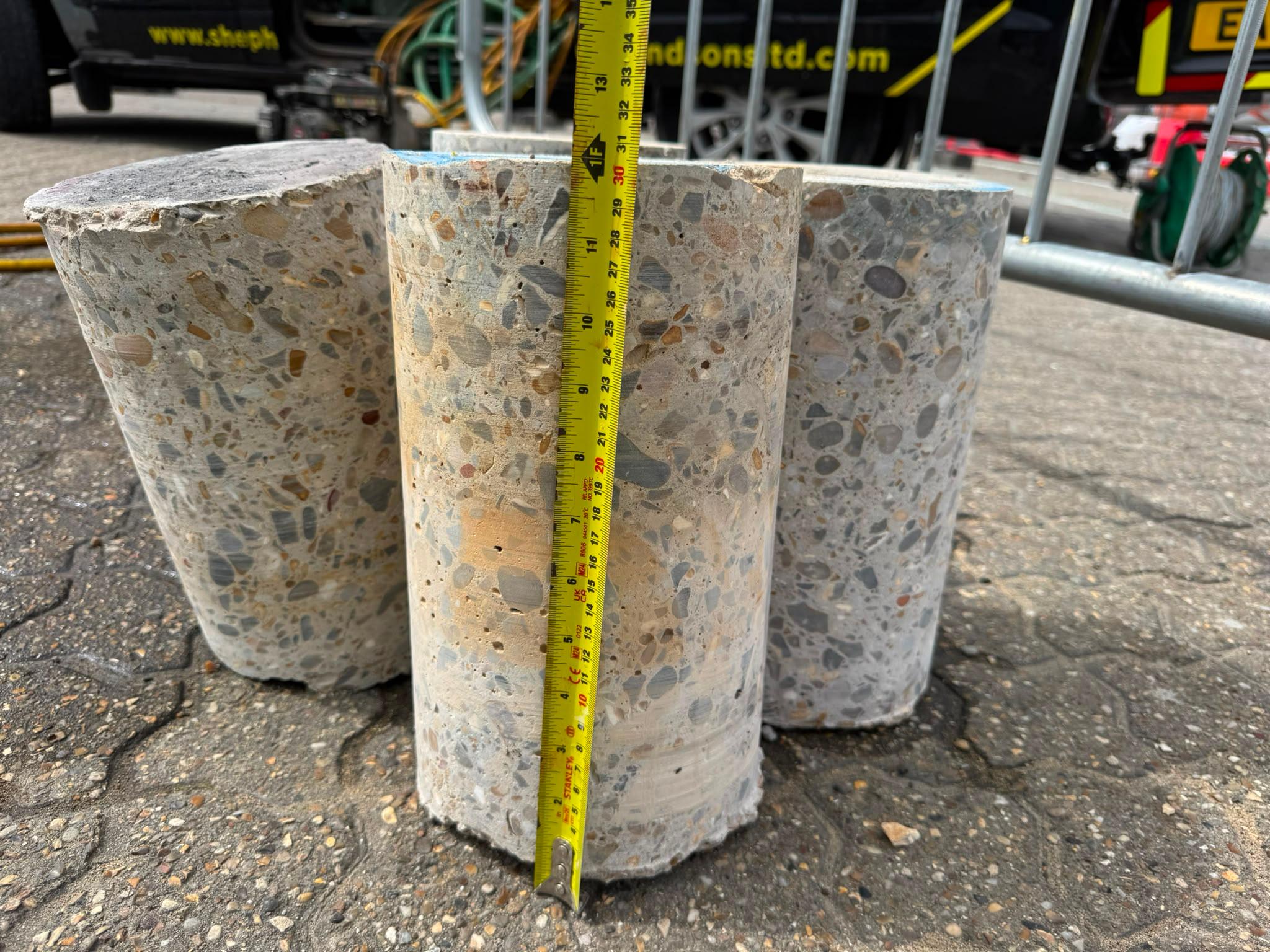
At London Luton Airport, working with Lagan Aviation and Infrastructure on runway verge signage, our operatives used a bolt-down coring rig over four night shifts to drill cable routes through reinforced concrete at a depth of 320mm. At the Stansted terminal extension, Jordan Shepherd cut channels, pits and trenches to a depth of 300mm with a Husqvarna FS 7000 D floor saw and Diaquip blades, inside a live airfield. Luton's 320mm cores went through reinforcement; the Stansted case study records the depth and the plant rather than the steel.
Exposed steel after the cut
Every cut through reinforcement leaves bar ends in the face of the opening. Steel exposed to air and water corrodes, and corroding steel expands and cracks the concrete around it. How those ends are protected, and whether the opening is lined, trimmed or filled, belongs in the design for the alteration rather than being left to the end of the shift.
What to tell us before pricing
- What the element is, a ground slab, a suspended floor, a wall or a pavement, and how thick.
- Whether drawings exist, and whether the floor is or might be post-tensioned.
- What the opening is for, its size and position, and whether an engineer has approved it.
- What services may be in or under the concrete, and who owns them.
- Access, water, power and the hours available for the work.
Shepherd and Sons cut reinforced concrete on airfields, highways and ports from Little Westerhill Farm in Linton, near Maidstone, through our concrete cutting and diamond drilling services. Send us the drawings and what you need to open up, and we will say which method fits and what has to be confirmed before the first cut. Ring 07768 662153 or contact us with the details.
More on Concrete Cutting
 Concrete Cutting
What is Core Drilling?
Read More » Concrete Cutting
 in London
Read More » Concrete Cutting
What is floor sawing?
Read More » Concrete Cutting
What is concrete cutting?
Read More » Concrete Cutting
What is diamond drilling?
Read More »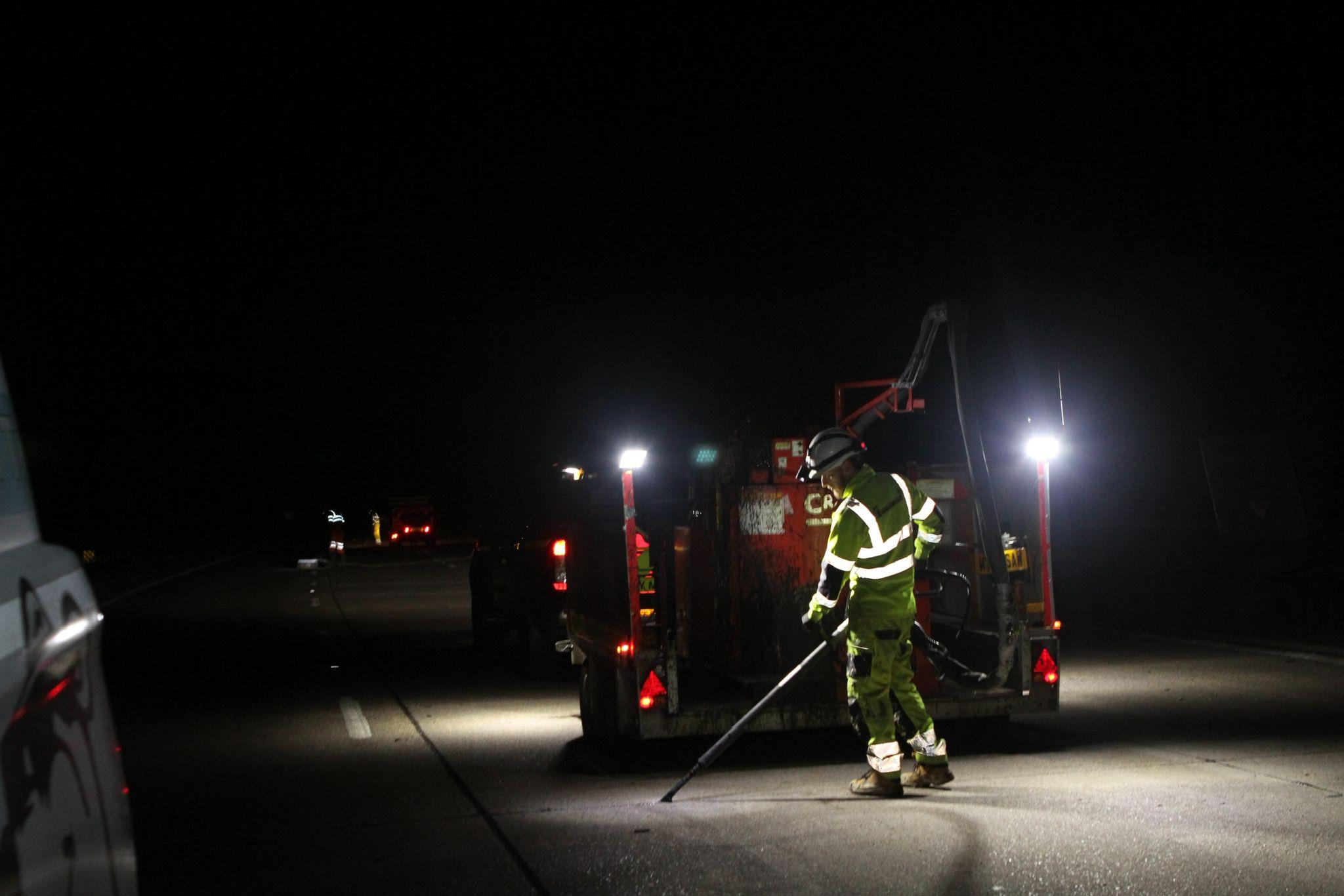 Concrete Cutting
How Long Does Concrete Cutting Take?
Read More »