
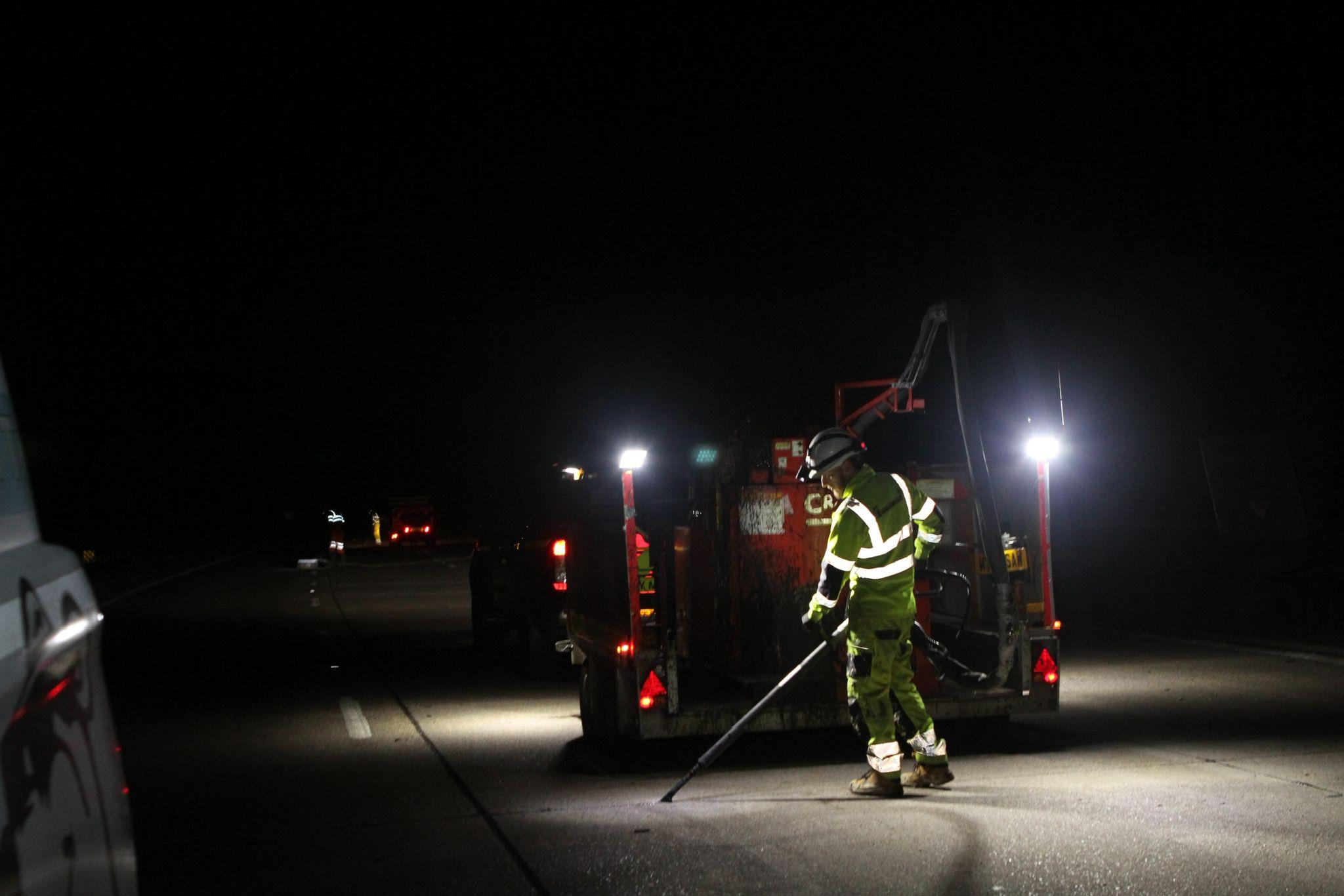
Concrete cutting can take anything from part of one shift to several weeks, and the saw is rarely what decides it. The time a job takes is set by the window the site can give, the depth and thickness of the concrete, the steel inside it, how the water and slurry are handled, and everything that has to happen after the cut. A long run of joints on a motorway or an airfield is planned in nights, because the length of each closure caps what one shift can finish.
The honest way to answer the question is with real jobs and the factors behind them, which is what this article does. Most of the examples are floor sawing and coring on highways and airfields, where the programme is fixed by a possession and the cutting has to fit inside it.
Three real jobs, and what set their pace
On the M20 between junctions 8 and 9, coastbound, the works covered around 20 kilometres of concrete carriageway. The possession ran from 10pm to 3.30am, and twenty night shifts produced 23,304 linear metres of joint, an average of about 1,165 metres a shift. Each metre was not only sawn. The old sealant was ploughed out, the slot sawn, dried, grit blasted, caulked and sealed, so the nightly figure is set by the whole sequence, inside a window that also has to fit traffic management going in and coming out.
At Stansted, working with Lagan Aviation and Infrastructure, our team cored out 150 airfield ground lighting seating pots as part of a ten week project, all within restricted overnight possession windows on a live airfield. At Luton, also with Lagan, a bolt-down coring rig took four night shifts to drill cable routes through reinforced concrete at a depth of 320mm. Both ran inside overnight possessions on live airfields, so the nightly output was planned around the window from the start.
The window is the first limit
On a live road or airfield the work happens between the last movement and the first, and the surface has to be handed back usable. Traffic management, setting up, cleaning down and handing back all come out of that window before any cutting starts. Airside working adds escorted access, tool counts and debris checks, each of which takes time from the same few hours.
Near homes the hours can be set by the council instead. Under section 60 of the Control of Pollution Act 1974 a local authority can limit the hours of construction work, and a section 61 prior consent agrees them in advance, which floor sawing noise and vibration under BS 5228 explains. Either way, the hours available are fixed before the rate of cutting comes into it.
Depth, steel and aggregate
A saw cuts to a little under half its blade diameter, so deeper cuts mean bigger blades or more passes. Our working maximum on a floor saw is 625mm in one pass, in concrete and asphalt, and sections thicker than that are cut from both faces, in stages, or by wire sawing. How deep you can cut concrete sets out where each method stops. Every extra pass or change of method adds time.
Reinforcement slows the cut and wears the diamond faster, and cutting through reinforced concrete covers what the steel means for the method. The concrete itself matters too. The US Federal Highway Administration's advisory on concrete pavement joints says saw blades should be matched to the hardness of the aggregate and the power of the saw, and a blade that suits one pavement can be slow on another.
The people running the tools
Rate is also limited by how long one person can safely run the equipment. HSE's brief guide to hand-arm vibration lists pedestrian controlled floor saws and hand-held saws for concrete among the equipment whose users will often be exposed above the daily action value, and says a hammer action tool can reach that value in about fifteen minutes. Trigger time limits and rotating operators keep exposure down, and they are built into the programme rather than discovered on the night.
Rig mounted methods change that. A core drill clamped to its rig, a track mounted wall saw or a remote controlled wire saw can run for longer because nobody is holding it, which is part of why stitch drilling and wire sawing are chosen for sensitive structures despite the extra setup they need.
Water, slurry and clearing up
Wet cutting needs a water supply at the rate the saw or bit needs, and HSE's guidance on cutting with a cut-off saw asks for enough water, a plan for the slurry and cleaning up as soon as possible. Collecting slurry, protecting gullies and leaving the surface clean all take time, and on an airfield the surface must be clear of loose material before it is handed back. Silica dust and the EH40 limit covers why the water matters and where the slurry may go.
Fresh concrete runs to its own clock
New concrete pavements set a deadline of their own. Contraction joints have to be sawn within what the FHWA calls the sawing window, which opens once the concrete is strong enough to cut cleanly and closes when shrinkage stress overtakes its strength. Warm, dry or windy weather shortens it, and the advisory says contractors should have enough saws, with backups, to cut all the joints before it closes. When it is closing fast, it describes sawing every third or fourth joint first to relieve the stress, then cutting the rest as soon as possible. On new work, the cutting time is set by the concrete, not by the contractor's preference.
What follows the cut
Very few cuts are the end of the job. A joint is sealed, a bay is lifted out and replaced, a trench is excavated and reinstated, a pit is cored and set. On the M20 the sawing and the sealing were one operation, which is why the nightly figure counts finished joint rather than sawn metres. How long joint sealant lasts and hot applied or cold applied joint sealant cover the sealing side.
How to get a reliable programme
A reliable duration comes from the same information every time.
- The length, depth and layout of the cuts, or the number and size of the holes.
- The thickness of the concrete, and whether it is reinforced or post-tensioned.
- The hours available, including traffic management, airside rules or council limits.
- Water and power on site, and where the slurry can go.
- What has to happen after the cut, and who is doing it.
With that, a cutting contractor can price in shifts and say how many, rather than quoting a rate per metre and leaving the programme to luck. Shepherd and Sons work across highways, airfields and ports from Little Westerhill Farm in Linton, near Maidstone, through our concrete cutting, core drilling and joint sealing services. Send us the drawings and the window you can give us, and we will tell you how many shifts the job needs. Ring 07768 662153 or contact us with the details.
More on Concrete Cutting
 Concrete Cutting
What is Core Drilling?
Read More » Concrete Cutting
 in London
Read More » Concrete Cutting
What is floor sawing?
Read More » Concrete Cutting
What is concrete cutting?
Read More » Concrete Cutting
What is diamond drilling?
Read More »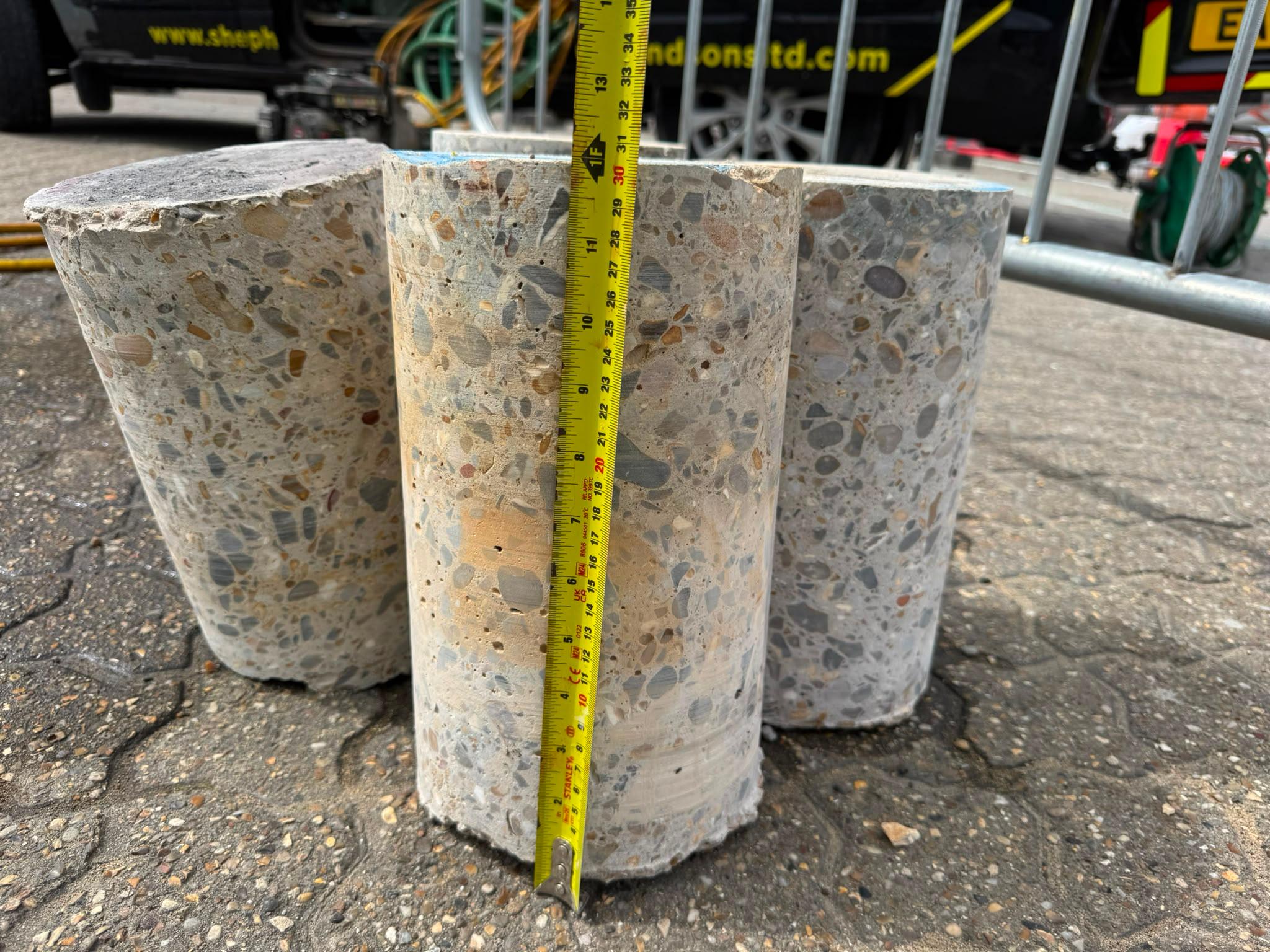 Concrete Cutting
Can You Cut Through Reinforced Concrete and Rebar?
Read More »