Shepherd and Sons Ltd
Why Does Airfield Concrete Fail at the Surface First?
A runway slab can be sound all the way through and still be a defect. The concrete below the surface is doing its job. Nothing is faulting at the joints, and no bay rocks under a load. Yet the top two or three millimetres are coming away under a boot heel. That is the ordinary way airfield concrete fails, and it catches people out because it looks cosmetic.
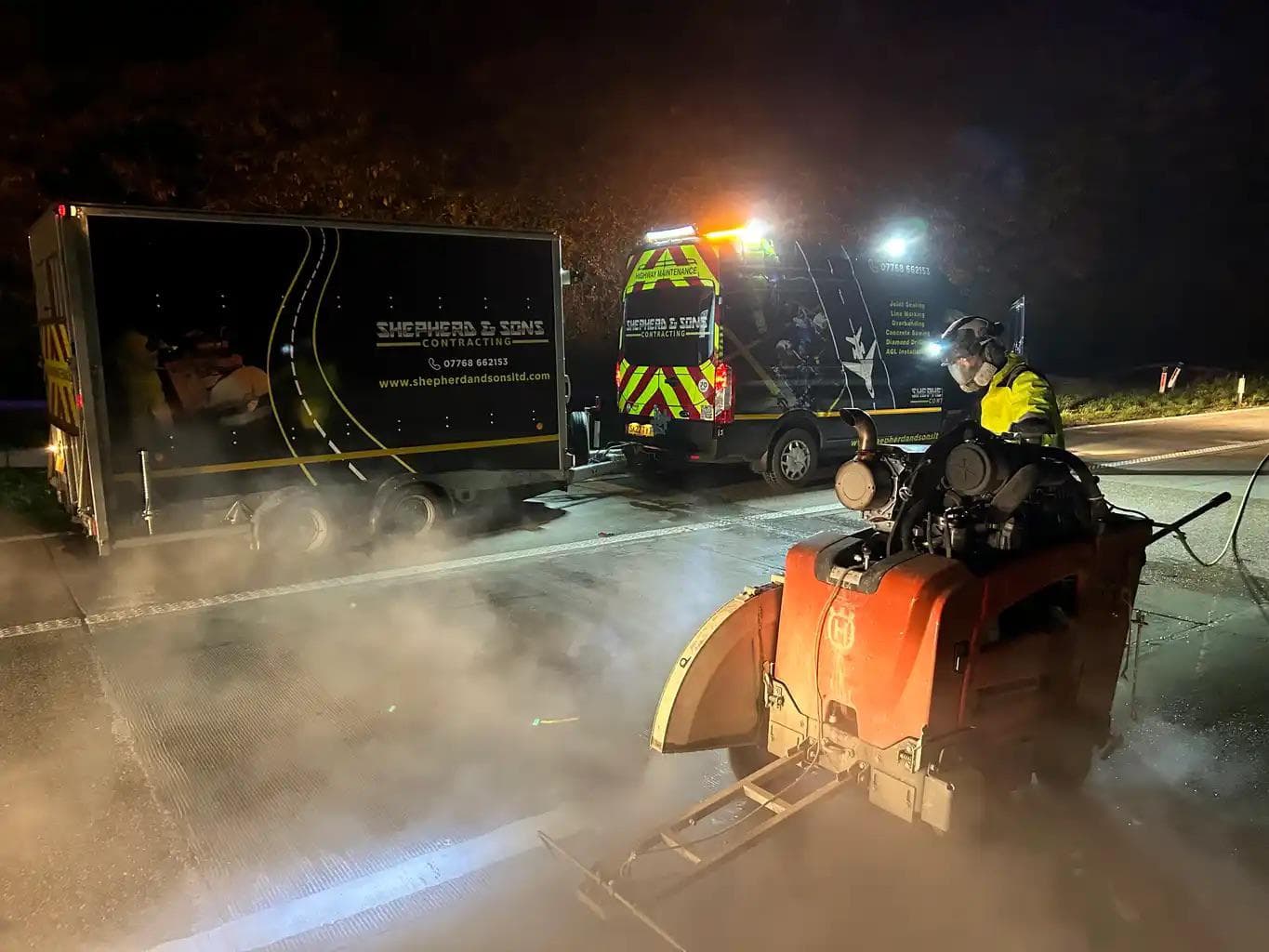
Shepherd and Sons have worked on airfield pavements for more than 40 years. We have been sole contractor to the British Airport Authority since 2008, across all seven former BAA airports. Surface deterioration is the defect we get asked to look at most often on a taxiway or a stand. This article is about the mechanism behind it. Why the face fails first while the slab is still sound. What de-icer changes about the exposure. What is going on inside the concrete while nothing visible on top has changed yet. What the repair itself involves is set out on our concrete airfield repair page.
Water is the agent, not the weather
Frost takes the blame for this, and frost is only the trigger. The agent is water, and it is already inside the concrete before the temperature does anything at all.
Concrete is not solid, whatever it looks like from standing height. The water in a mix does two separate jobs. Some of it combines chemically with the cement and becomes part of the hardened paste. The rest is there to make the mix workable enough to place and compact, and once the paste has stiffened that surplus has nowhere to go. It is left behind in a network of fine channels running through the material. Those are the capillary pores, and the more surplus water a mix carried, the more of them there are and the better connected they turn out to be.
Near the face, that network is open to the sky. Rain, standing water, wash-down, melting snow and run-off all sit in it. Concrete pulls water in by capillary action rather than waiting for gravity to push it, which is why a slab takes up water from a merely damp surface. The pores at the top of a pavement therefore spend a British winter close to full.
Then the temperature drops through zero. Water expands by roughly nine per cent as it turns to ice, and the ice has nowhere to go, so it pushes outward against the pore walls from the inside. Water that has not frozen yet gets driven ahead of the freezing front through whatever channels are still open. That movement raises pressure of its own in the finer pores it is forced into. Two things are working on the paste at once, and neither of them needs the weather to be severe.
One cycle does nothing anybody can see. Repeated through a winter those cycles open microscopic cracks between the pores, and the top few millimetres then lose their hold on the material underneath. The face comes away in flakes and small plates, taking sand and fine aggregate with it. That is freeze thaw scaling.
Why it stops in the top few millimetres
The mechanism explains the shape of the damage, which is the useful part of knowing it. Three conditions line up at the surface and nowhere else in the slab.
- The pores are wettest there. Free water has to be sitting in the pore for freezing to do any work at all, and saturation falls away quickly with depth. Well down in a slab the concrete is damp rather than full.
- The face is the coldest part. Cold arrives from above, so the surface crosses zero first, crosses it hardest and crosses it far more often than anything below it. A few centimetres down, the mass of the slab smooths the swings out.
- The paste is weakest there. The top of a pour is where bleed water collects and where over-working a surface brings fines up. The layer taking the most punishment is often the layer least able to take it.
Add those together and the damage is shallow, because only the pores near the face hold enough free water and see enough crossings. It is also widespread rather than local, because every square metre of a pavement gets the same weather. That pattern is worth recognising on a walkover. Deterioration that follows the weather looks nothing like deterioration that follows the traffic path or the joint layout.
Why a treated apron suffers worse than a road
De-icer is the difference, and it changes the exposure in two separate ways.
The first is what de-icer is for. It depresses the freezing point, so water that would have sat locked up and inert as ice stays liquid and mobile below zero. Liquid water travels into pores. Ice does not. A treated surface keeps feeding its own pore network right through a cold spell, at temperatures where an untreated one would have stopped.
Worse is what repeated treatment does to the cycle count. Every application pulls the surface back across the freezing point. It crosses again in the other direction once the de-icer has been diluted by melt, washed off by traffic or simply used up. Freeze thaw damage counts crossings rather than degrees. The number of times the face goes through zero matters more than how cold it got on any one night.
We reseal motorway concrete as well, so the comparison is not theoretical. On the M20 between junctions 8 and 9 the joints take a hammering from traffic and from water, and a carriageway is salted through the winter too. The real difference is the standard the surface is held to. A taxiway has to be clear rather than merely passable, so it is treated more often and more thoroughly for the same weather. In our experience that is the part specifiers underestimate, because they compare the two climates rather than the two treatment regimes.
Two further loads sit on an airfield surface that a highway never carries. Spilled fuel and hydraulic oil soak into the same pores the water uses, so the network is contaminated as well as full. Jet efflux puts a hot, fast airstream across a cold wet surface, in a pattern no tyre reproduces. Both are part of why airfield pavements are inspected and maintained to a tighter standard than the equivalent road.
Fine cracking is what feeds the cycle
Fine surface cracking shows as a network of hairline cracks across the face, a few millimetres deep and no deeper, with sound concrete behind them. On its own it looks like the mildest thing on the pavement. What it does next is the reason it is not.
Every one of those cracks is a route in. A crack is enormously wider than a capillary pore, so it fills fast and drains slowly. It delivers water and de-icer to pores a few millimetres further down that were effectively protected before. The wetted zone deepens. More pores come into play, and the next frost has more material to work on. Scaling tends to follow fine cracking rather than turn up alongside it.
That is the part worth holding on to. The mechanism is a loop rather than a slope. Each winter leaves the face slightly more open than it found it, which is what makes the following winter worse than the last one at exactly the same air temperature. Nothing about the weather has to get harsher for the damage to speed up.
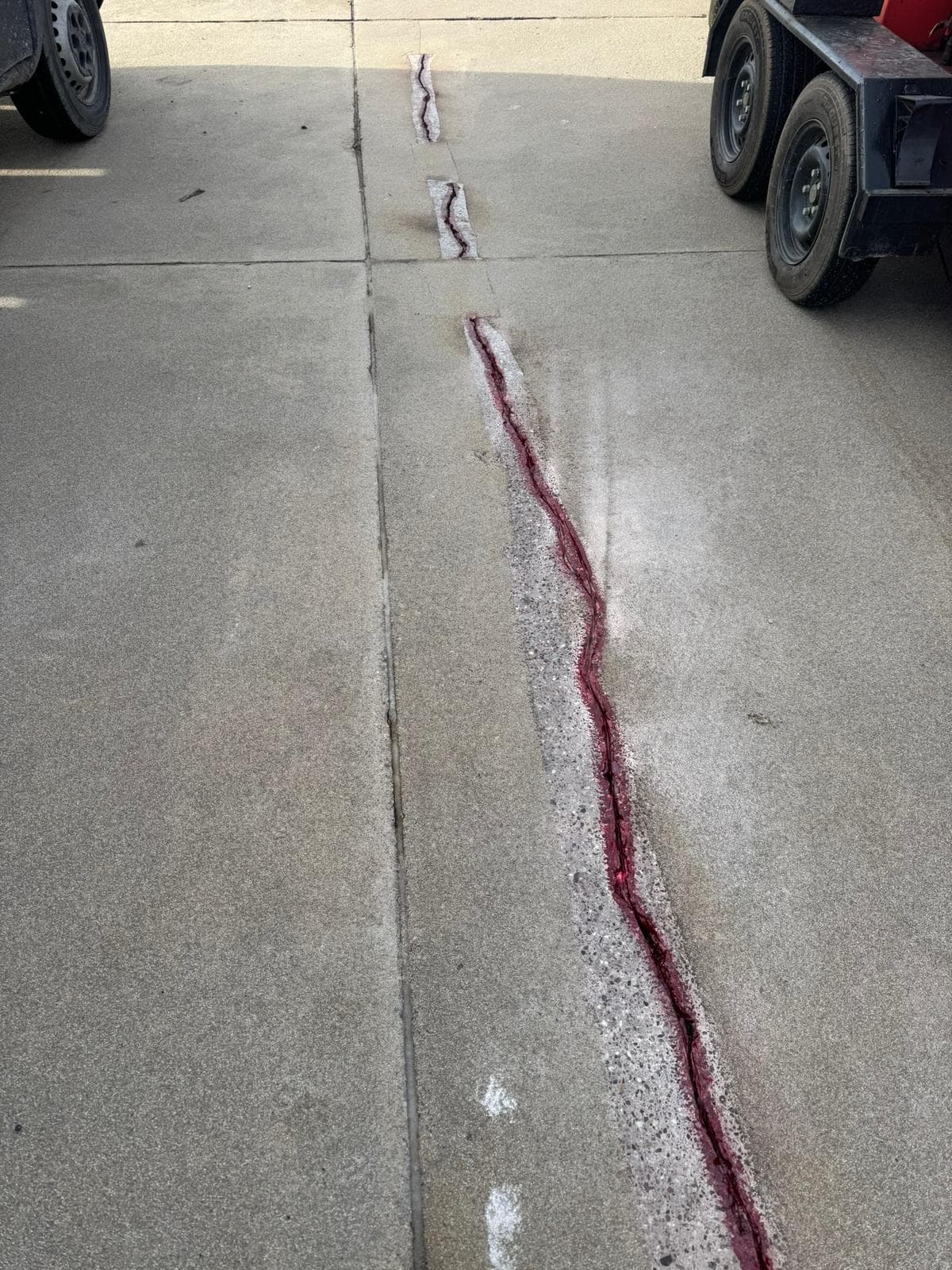
There is a point where a crack stops being a surface defect. Once it is wide enough to hold water and open enough to move with the slab, binding the face will not close it. It wants cutting out to a regular profile and sealing properly. That is crack chasing work, and the technique is a different operation from treating a face. We've found that this is the thing most often missed on a survey, because somebody has measured crack width and nobody has checked whether the crack moves.
What alkali silica reaction actually is
The third way a face fails is worth being precise about. The name gets used loosely on site, and it describes something genuinely different from the other two.
Alkali silica reaction is not weather damage. It is a chemical reaction inside the concrete, between the alkalis carried in the cement and certain reactive forms of silica present in some aggregates. Those two meet in the pore solution and produce a gel. The gel takes up water and swells as it does so, and it is sitting in a material with no room to give. The expansion cracks the concrete outward from within.
Three things have to be present together for it to carry on: reactive silica, enough alkali, and moisture. The first two were settled when the mix was designed and placed, and nothing done to a pavement afterwards changes them. Moisture is the only one a maintenance regime can touch. Keeping water out slows the reaction, because the gel needs water to keep swelling, but no standard of maintenance undoes chemistry that was built into the mix.
What makes it relevant to a surface post is where it appears first. It shows at the face long before it is anywhere near threatening the slab, usually as map cracking, sometimes with a gel deposit or staining along the crack lines. A face showing early ASR can often be bound and sealed as surface work. The same reaction working through the full depth of a bay announces itself much the same way on top, and no amount of looking from above separates the two. That case is an engineering assessment rather than a maintenance item, and it is the honest limit of what any surface treatment can claim.
Loose material is an operational defect, not an appearance problem
This is where an airfield parts company with every other pavement we work on, and it has nothing to do with how the surface looks.
Anything loose on an airfield pavement is potential foreign object damage. A fragment of aggregate a few millimetres across can be thrown hard enough to notch a fan blade, mark a leading edge or open a tyre. Jet blast lifts it, or a tyre flicks it up. None of that needs a large piece. It needs a hard piece and a lot of energy, and the aircraft supplies the energy for free.
So the defect is not that the concrete looks worn. The defect is that the pavement is producing debris, and because the mechanism restarts every time the temperature crosses zero, it will carry on producing it. That is why FOD walks, sweeping and surface inspections take up real money on an airfield, and why a scaling surface gets escalated airside rather than added to a list.
The same surface is worth dealing with early on a car park, a yard or a depot, for a different reason. There the problem is water. An open face lets it straight in, and water in a pavement is what turns a worn surface into a pothole. Airside it gets escalated because the surface itself is a hazard for as long as it is shedding material. The wider version of that discipline is covered in what is different about airside working, and it runs through everything on the aviation side of what we do.
Surface or structural, and how a core settles it
One question decides what any of this is worth. Is the concrete under the damage sound? If it is, the loss lives at the face and a penetrating resin treatment can arrest it. If it is not, nothing laid two or three millimetres into a surface will help, because the problem is load and support rather than the face. How to read the signals either way is a piece of work in its own right, and it starts with a core rather than with a material. What the two answers then ask of a pavement is set out on our concrete airfield repair page.
The mechanism gives you the rule of thumb. Chip back a surface defect and you reach sound concrete within a few millimetres, because the process that caused it only ever reached that far. A structural defect carries on down, because whatever caused it was never about the pores at the face.
A walkover gets you a long way and it does not get you all the way. Core drilling gives you a cylinder of the real pavement. For a question about mechanism that is exactly what you want, because the story is written down the depth of it. How many millimetres down the deterioration has genuinely reached. How deep carbonation has got, which is the other process quietly moving the protection away from the steel. Whether alkali silica reaction is confined to the top or working through the body of the bay. A core is also the only thing a laboratory has to work on if the aggregate itself has come into question, and the aggregate is where ASR begins.
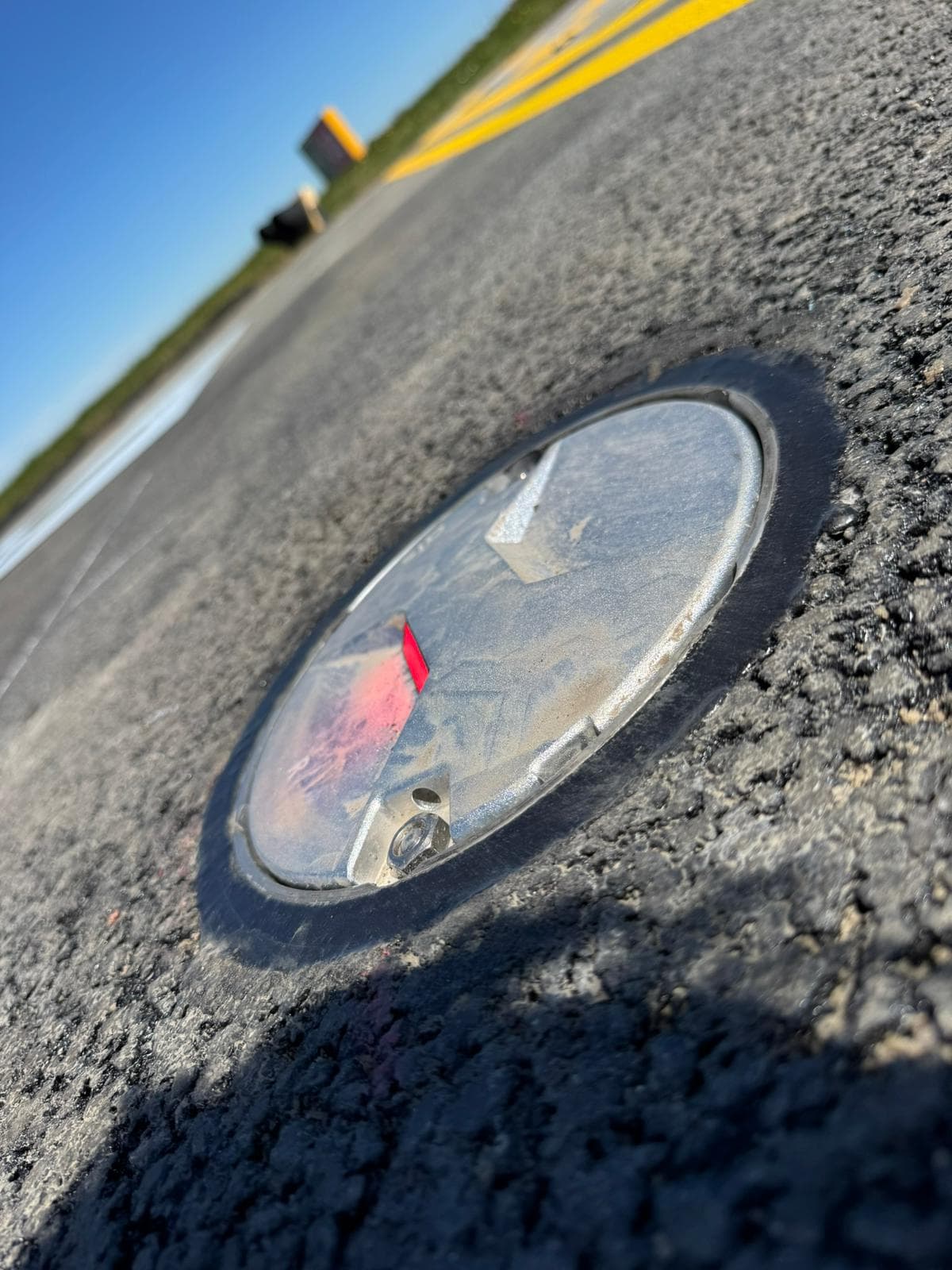
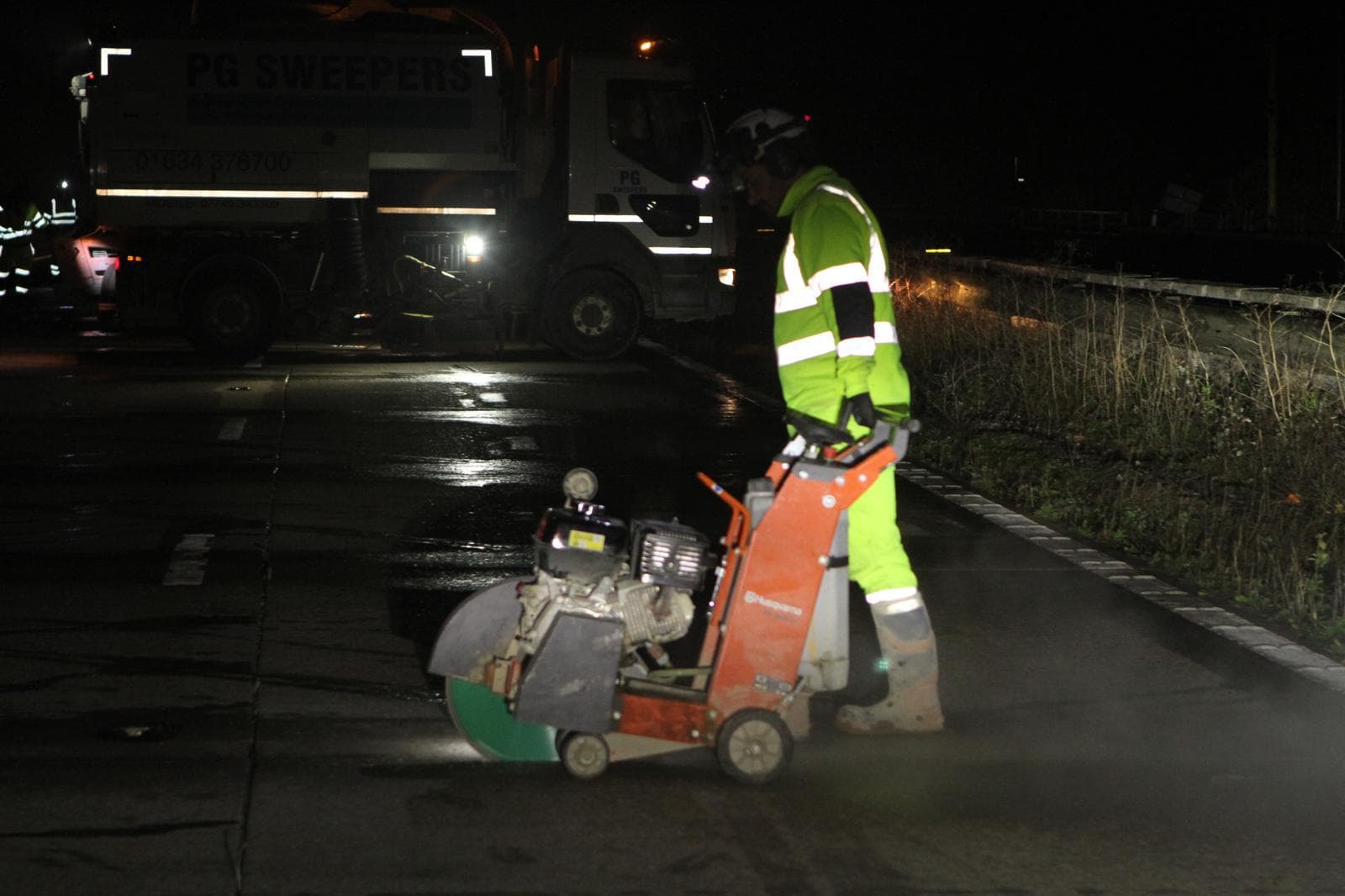
The rig, the window and the escort are the same whether the core is for a light fitting or for a condition survey. That is why survey cores added to a programme already airside cost a fraction of mobilising for them on their own. We are coring 150 airfield ground lighting seating pots at Stansted at the moment, over a ten week run of restricted overnight possessions.
Shutting the mechanism off at the pores
Everything above points the same way. The pore network near the face is the mechanism, so a treatment that does not deal with the pores is decorating.
The pores are also why preparation matters more than the resin does. The top few millimetres of a slab that feels perfectly dry are still carrying water, fuel and de-icer. Nothing bonds to a contaminated pore. Hot compressed air clears them out first. Resin goes onto a slab that is still warm from that treatment. The concrete draws it inward as it cools, so it finishes up inside the pore network rather than lying across the top of it. A broadcast of hard wearing aggregate holds it there. The mechanism and the preparation are the same subject read from opposite ends. Pores that hold water are what fails, so the repair begins by emptying them.
One published figure speaks directly to that, and it comes with a caveat. Treated concrete, tested in the laboratory, took up 0.19 per cent water where the untreated control took up 4.19 per cent. Those are the system manufacturer's results and not readings we have taken on a pavement of our own, which is worth saying plainly, because numbers like that get repeated as a contractor's own soon enough. What the drop describes is the mechanism being shut off at source. Pores that will not take up water have nothing in them to freeze, however many times the temperature crosses zero.
Where the loss has gone deeper than a penetrating treatment can reach, the answer is a repair material rather than a binder. The defect is cut out and taken back until what sits beneath it is sound and dry, then reinstated as a surface repair. That is usually in Maxi-Crete, which gains strength fast enough to return the bay to service in hours rather than days. Where the deterioration has got as far as the joints, they are reformed and resealed. That is joint sealing work, and it brings its own list of things to get right.
If you have a taxiway, apron or stand with a face that is starting to let go, the useful next step is a small one. Get somebody to look at it properly, and take a core if there is any doubt about the depth. Tell us which pavement it is, how much of it is affected and what possession you can offer. We will tell you what we think we are looking at before anybody writes a specification. Ring 07768 662153 or use the contact page.