
Shepherd and Sons Ltd
Resin Repair or Bay Replacement? How to Tell Which You Need
By Jordan Shepherd, Director. Published .
A failing concrete bay on a runway, taxiway or stand leaves two honest options. Treat the surface and leave the slab where it is, or cut the bay out and reinstate it. The deciding question is whether the concrete beneath the defect is still sound. If the damage stops at the face, a penetrating resin treatment binds it and the slab carries on taking load. If the slab has cracked through, lost its support or started moving, nothing laid on top will hold, and the bay has to come out. Pick wrongly and you either spend money the concrete did not need, or buy a repair the pavement was never going to hold.
We have been sole contractor to BAA since 2008. We saw bays out and lift them, and we repair and treat concrete surfaces, so we have no reason to push you towards either answer. What follows is how the decision gets made on site, and the signs that settle it before anybody prices anything.
The question every other question follows from
If the concrete is sound, the damage lives at the face. The top few millimetres have gone, fine cracks have opened and loose material is starting to lift, while the slab below carries on doing its structural job. A penetrating resin is drawn two to three millimetres into the concrete and locked in with a hard wearing aggregate, so the loose face is bound and the pores are shut against water and de-icer. The slab is never opened, which is why concrete airfield repair is bought as maintenance rather than reconstruction. Why the face goes first is answered in why airfield concrete fails at the surface first.
Where the concrete underneath has gone, a resin a few millimetres deep cannot carry load. It will not close a crack that runs through a slab, and it will not put back support that has washed out from beneath one. Treat a structural failure as a surface one and the pavement looks right on handback, then fails again in the same place.
Signs that the damage stops at the face
The FAA's guidelines for maintaining airport pavements sort concrete defects in much the same way, and this group is what a penetrating treatment is built for. These defects tend to cover far more area than they do depth.
- Scaling. The wearing surface has flaked away and left the coarse aggregate standing proud of the paste.
- Spalling confined to the top few millimetres, with sound concrete immediately behind it when you take a chisel to the edge.
- Crazing. A network of shallow hairline cracks through the upper surface only, rather than a single crack you can follow from one joint to the next.
- Loose aggregate coming away under a boot or a broom. On an apron that is the urgent one, because loose material in front of an engine is foreign object debris.
- Alkali silica reaction showing at the face, with map cracking and gel staining at the surface while the body of the slab is still intact.
Alkali silica reaction is the one to treat carefully. A reaction working through the body of a bay can print a pattern on top that looks much like one confined to the face, and the two cannot be told apart from above. That is an argument for a core rather than a photograph.
Signs that the slab itself has failed
This group is different in kind. There are usually fewer of them, they go deeper, and each says the slab has stopped behaving as one sound piece.
- A crack running full depth, or clean across a bay from one joint to the other. A corner break goes vertically through the whole slab, where a corner spall angles down to the joint.
- Faulting. One side of a joint sits higher than the other, and you can feel the step underfoot or catch it with a straightedge.
- A slab that rocks or deflects under a loaded wheel, because it has lost its support.
- Pumping. Staining and fine material on the surface beside a joint, which is sub-base coming up through it. The FAA reads pumping near joints as a sign of poor load transfer, a poor joint seal or groundwater.
- Deterioration that has reached the reinforcement, showing as rust staining, cracking along the line of the steel or exposed bar.
Any one of those takes the pavement out of surface repair territory. Faulting and pumping tell the same story. Water is getting under the slab and carrying fine material out of the sub-base, and the void underneath is the real failure.
A core is how you stop guessing
Between the two lists sits a real middle ground, and you often cannot tell from standing over it. A shallow spall and the crown of a full depth crack look much alike at two in the morning with a torch on them.
A core settles it. It gives the real slab thickness and how deep the deterioration has reached, shows whether a crack carries on below the face and what state the reinforcement is in, and brings up the layers beneath the slab. Taking and examining cores is covered by BS EN 12504-1. A handful on representative bays is the cheapest line in the whole exercise, set against the cost of getting it wrong either way. Treat a slab that has already failed and you pay twice, once for the treatment and again for the replacement. Replace a bay whose concrete was sound and you have bought a closure, a break-out and new concrete for nothing.
What each option asks of the pavement
A resin treatment leaves the slab alone. There is no perimeter cut, no break-out, no spoil and no haulage. What it asks for is preparation. Hot compressed air drives water, fuel and de-icer out of the top few millimetres and opens the pores, and the resin goes on while the slab is still warm so it is drawn in as the concrete cools. Addagrip, who make the 1000 System for this work, put the expected extension to pavement life at 10 to 20 years, and say just as plainly that base failures and significant slab movement may still need conventional reconstruction. Those are the manufacturer's figures, not ones measured on a pavement of ours.
Replacement is a sequence, and every step takes time. Full depth sawing round the perimeter frees the bay, and the piece is lifted clear rather than hammered out, because an airfield slab can have fuel mains through it and lighting circuits beneath it, and a breaker is blind to both. Whatever sits under the bay is inspected and made good, a new section goes in, and only then are the joints round it reformed and sealed.
Then the new concrete has to gain strength before anything drives on it, and that time out of service is the honest reason replacement costs more. How much you lose depends on the material. In our experience, a rapid strength repair concrete such as Maxi-Crete works better than a standard concrete patch on an operational airfield, because it returns the bay to service within hours rather than days. What no material does is make up for a base that has gone. Our structural repair work goes onto ground that is sound and dry, and nothing bridges a void.
The possession is usually what decides it
On a live airfield the technical answer and the practical one are not always the same, and the window separates them. Possessions are short and fixed. You get the pavement between the last movement and the first, you hand it back serviceable, and nobody extends it because the work ran long. A treatment finished and handed back trafficable inside the window is a different proposition from a bay that stays fenced off while concrete cures, and airside working makes that sharper than anywhere else.
Working to a fixed window is normal in this trade, not an airfield peculiarity. The M20 between junctions 8 and 9 took twenty night shifts because the work was sized to the possession rather than the possession to the work. Do that sum before the materials sum. Count the nights the bays you want replaced would really need, set them against the nights the same area would take as a treatment, and price the closures first. None of that argues for treating everything with resin. It argues for knowing exactly which bays need replacing, so the closures you do take are spent where they buy something.
Waiting narrows the choice
Surface damage does not stay surface damage. An open, scaled face takes water in, and water carries the damage down. Fine cracks widen and join up, water reaches the reinforcement so the steel corrodes and swells, and at the joints water getting past a tired seal starts moving fines out of the sub-base. It only ever runs one way.
So the cheaper option has a shelf life. A bay that suits a resin treatment now can cross the line while it waits for a decision, and once it has, the cheap answer is gone. The same goes for the joint seals and crack chasing around the bay, because those keep the water out in the first place.
Most pavements need some of each
A survey rarely comes back all one thing. A stand might have two bays that have really gone and thirty that are scaling, and the sensible programme replaces the two and treats the thirty. Order matters. Cut and replace first, then treat the surfaces, so no plant tracks across fresh resin and no saw slurry runs over a prepared face. Reform and seal the joints round the new section before the rest of the surfacing starts.
Having both trades in one gang keeps that sequence in one set of hands, with nobody coordinating two subcontractors across the same escorted possession. We work that way on airfields and on highway concrete, where the deterioration behaves much the same and only the traffic changes.
The order to work it in
If you are looking at a pavement now, walk it and mark the defects by type, keeping the ones that read as surface apart from the ones that read as structural. Test the doubtful ones. Tap for hollowness, lay a straightedge across the joints for a step, look for staining beside a joint after rain and watch a loaded vehicle cross the bay. Core the doubtful ones and the worst ones, and only then price the two jobs against the possessions you can realistically get.
Shepherd and Sons are a family firm at Little Westerhill Farm in Linton, near Maidstone. Tell us the pavement, what you are seeing on it and the window you can give us, and we will tell you which of the two it needs. If the honest next step is a core rather than a price, we will say that instead. Contact us with the details and we will look at it properly.
More on Aviation
 Aviation
What Is a Cable Chase?
Read More » Aviation
Concrete Cutting at UK Airports
Read More »- Aviation
Why Does Airfield Concrete Fail at the Surface First?
Read More » - Aviation
What Is Different About Airside Working?
Read More »  Aviation
What Is Airfield Ground Lighting?
Read More »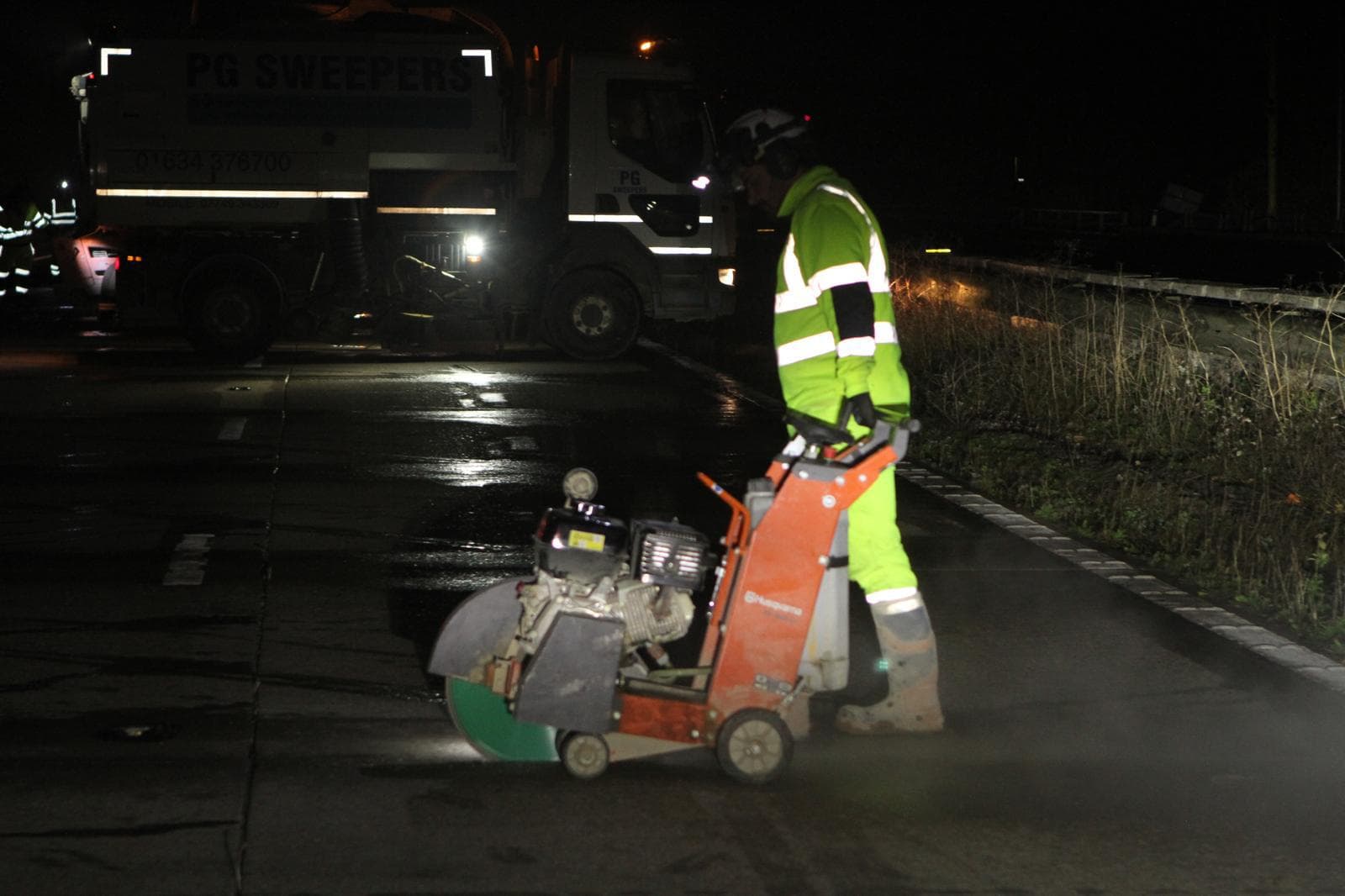
What is joint widening?
Read More »